Glastonbury
Le Morte d'ArthurGlastonbury stands at the intersection of legend, material remains, and narrative closure. It is identified as the burial place of Arthur and Guenever, invoked as evidence that Arthur existed, and finally receives Guenever’s body after Lancelot carries it there from Almesbury. The place thus serves not merely as a reported tomb but as a site where the story’s claims about its past meet the sorrowful ceremonies of its ending.
Identity and Legendary Associations
The account links Glastonbury with Joseph of Arimathea, said to have founded the monastery and to have been buried there. His body, however, was sought in vain during the reign of Edward III. This association gives the site a sacred history that precedes its Arthurian claims, while the uncertainty surrounding the search for Joseph’s remains anticipates the complicated status of the relics attributed to Arthur and Guenever.
Legend says Glastonbury possesses Arthur’s coffin. Another tradition, reported in the book’s introductory material, holds that Henry II found the bodies of Arthur and Guenever there and that Guenever had yellow hair. Their skulls were later taken as relics by Edward Longshanks and Eleanor. These claims connect the place to successive rulers and to the treatment of royal remains as objects of remembrance; they are presented as traditions about the site, rather than as an unqualified account of verified discoveries.
Evidence and the Question of Arthur’s Existence
In Caxton’s prologue, Glastonbury is offered as physical testimony against the view that Arthur was merely a fictional king. The argument cites Arthur’s sepulchre in the monastery alongside references to chronicles and histories, including the account of his body being buried, found, and translated to the monastery. Glastonbury therefore has a polemical role: its supposed tomb helps Caxton answer doubts about Arthur’s existence and justify printing the history of the king and his knights.
That appeal belongs to a wider catalogue of material and textual witnesses. Caxton also points to Arthurian remembrances in different parts of England, including the Round Table at Winchester and objects associated with Gawaine at Dover, as well as Arthur’s reputation abroad and accounts in Welsh and French. The sepulchre at Glastonbury is especially forceful within this case because it is a named burial place, but the prologue’s reasoning depends on many kinds of testimony rather than on the tomb alone.
Guenever’s Funeral and Lancelot’s Journey
At the close of the narrative, Lancelot goes from Glastonbury to Almesbury with seven companions after receiving a vision and learning that he should not disobey it. The journey takes more than thirty miles and two days because the men are weak. They arrive at the nunnery shortly after Guenever has died. She had asked that Lancelot come to fetch her body and bury her beside her lord, King Arthur, while also praying that she would never see him again with her worldly eyes.
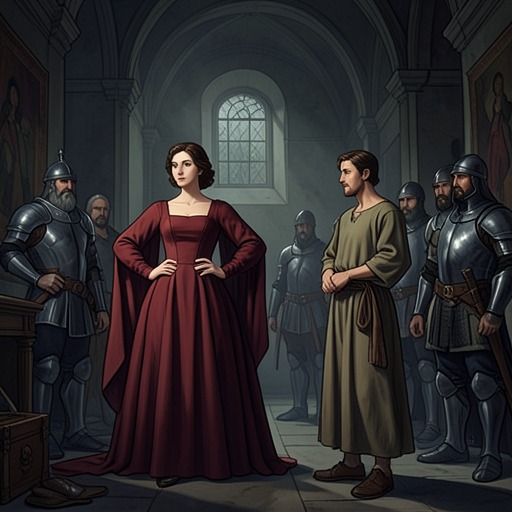
Lancelot and his companions bring her body on foot from Almesbury to Glastonbury. The funeral is marked by prayer and formal observance: the group accompanies the horse bier by torchlight, and Lancelot takes part in the services. At the chapel and hermitage, the former Archbishop of Canterbury celebrates the Requiem Mass. Guenever is wrapped, enclosed in lead, placed in a marble coffin, and buried there. The detail of these rites makes Glastonbury the destination not only of a body but of a final act of care undertaken by Lancelot and his companions.
Burial, Memory, and the Ending
The burial beside Arthur fulfills Guenever’s stated wish and gives the legendary royal pair a shared resting place. The introductory tradition that Henry II found both bodies at Glastonbury and the closing narrative of Guenever’s burial there converge around the same memorial geography, though they belong to distinct accounts within the book. In each, the site gathers the story’s memory of Arthur and Guenever into a place associated with the abbey and its tombs.
Lancelot’s grief at the burial is tied to his recognition of the couple’s former excellence and of his own failure toward them. He explains that his sorrow is not a celebration of sin: remembering their goodness, and his own unkindness, overwhelms him when he sees their bodies laid together. Glastonbury consequently closes the narrative on a conjunction of reverence, remorse, and loss. Its significance rests in that conjunction as much as in its legendary claim to preserve the remains of Arthur and Guenever.