Medieval anarchy
Le Morte d'ArthurMedieval anarchy is a cycle of political disintegration and private violence against which the account sets the rise of feudal bonds and chivalry. Its defining problem is not simply that force exists, but that weak public authority leaves people to defend themselves, while the protections devised to contain violence can themselves become instruments of domination.
Breakdown of Order
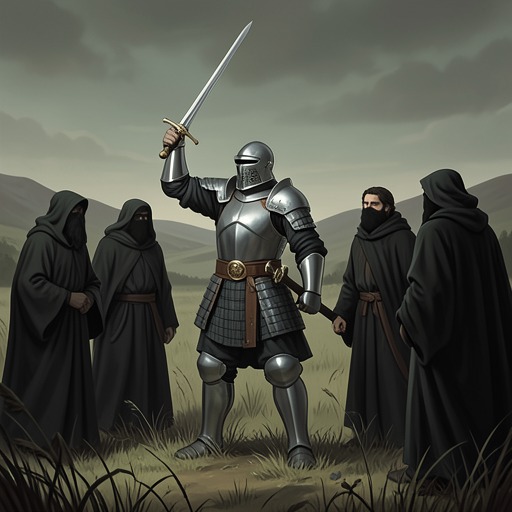
The account describes recurring collapses of order after the unifying influence of rulers such as Alfred, Charlemagne, and Otho disappeared. Their leadership could bring temporary calm, but their withdrawal was followed by renewed anarchy. War became at once an effect and a cause of disorder: powerful and unscrupulous people fought for rule, plunder, or the pleasure of fighting, while those without reliable help from law or government had to protect their families and possessions as best they could. The result was a continuing risk of social regression toward brutality.
The account also connects this insecurity to a wider sense of despair. As the first thousand years of the era drew to a close, people in Europe expected the world to end; some spent their wealth in revelry, others gave it to churches and convents, and multitudes gathered at altars. The expectation of destruction could bring hope as well as dread because their actual condition seemed so miserable. This response makes anarchy more than a record of armed conflict: it marks a world in which ordinary security and confidence in the future have become difficult to sustain.
Remedies That Could Reproduce Violence
Feudalism arose as a response to this pervasive insecurity. The account describes it as a partly patriarchal and partly military order in which those unable to stand as lords became vassals, and people from king downward were bound by reciprocal obligations of service and protection. These bonds were not presented as purely transactional: family, neighborhood, and clan could connect lord and vassal as well. In principle, the structure offered protection where impersonal government was ineffective.
Yet the remedy contained a new danger. A lord responsible for his own vassals could become an aggressor against neighboring lords and their dependents, renewing the very violence the system was meant to restrain. Feudal protection therefore did not automatically establish public peace; it could relocate conflict into competing networks of power. This tension—between legitimate authority that protects and authority turned toward private gain—runs through the account's treatment of medieval political order.
Other measures tried to place limits on private retaliation. The Peace of the King required a delay of forty days before a private war could begin in response to an alleged crime. The Truce of God suspended private hostilities from Thursday through Monday each week. At the Council of Clermont in November 1095, Urban II confirmed the Truce, condemned private war, placed women and priests under the Church's protection, and extended a three-year safeguard to husbandmen and merchants, who were vulnerable to military depredation. These provisions recognized that restraining violence required protected intervals and persons, even while the underlying habit of private vengeance persisted.
Chivalry and the Use of Power
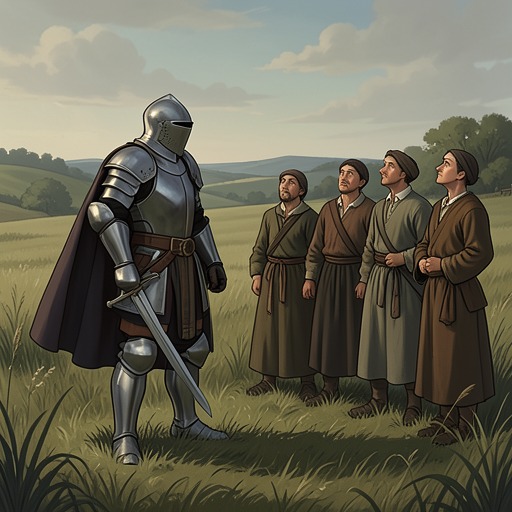
The account presents chivalry, or knighthood, as part of the same effort to control disorder. The knight embodies a double obligation: as a mounted warrior and a figure of lordship, he possesses visible military power; as a servant, he is supposed to obey as well as command. His strength is not meant for selfish ends but for service, particularly the defense of poor, weak, and oppressed people who cannot protect themselves. Chivalry thus gives force a proposed social and moral direction rather than treating force alone as the solution.
The distinction between an ideal and its execution matters. The text argues that power can be used to protect or to prey upon others, just as feudal lordship can supply reciprocal security or revive violence. Its Arthurian examples place royal judgment, political claims, and armed conflict beside one another. When King Uther Pendragon dies, he publicly names Arthur as his successor and charges him to claim the crown justly; after the sword ordeal establishes Arthur's kingship, Arthur forgives those who had delayed him and restores lands taken through wrongful acts. Authority is represented here as a means of repairing disorder, not merely winning submission.
The Arthurian Test of Authority
The narrative also shows how quickly claims of lawful authority meet armed opposition. At Bedegraine, a coalition of eleven kings gathers after the earlier affront to six of their number; they swear not to abandon one another until Arthur is destroyed. Their oath turns a dispute over status and power into a coordinated military threat, illustrating how allegiance can strengthen an opposing faction as readily as it can uphold a realm.
The demand for Roman tribute presents a different contest over sovereignty. Twelve elderly ambassadors arrive with olive branches and demand that Arthur acknowledge the Roman emperor and pay the tribute claimed for Britain. Arthur forbids his young knights to harm the envoys and provides for their lodging, even as he rejects their demand. He then declares that he owes no earthly prince tribute and claims the empire by the right of his predecessors. The episode contrasts disciplined treatment of messengers with the threat of war: restraint in one encounter does not settle the larger conflict over who has the right to rule.
The cycle reaches a stark limit when Mordred presumes to take the kingship of England and seeks to marry the queen, his uncle's wife. The usurpation and attempted marriage make the struggle over rule an intimate as well as a political rupture. Against the earlier scenes of succession, public recognition, and restored lands, the claim exposes how fragile order remains when authority is contested from within.
Significance
Medieval anarchy, as presented here, is not a condition overcome once and for all by the creation of institutions. Feudal reciprocity, royal justice, restraints on private war, and chivalric service all seek to turn force toward protection, but each depends on those with power honoring the obligations attached to it. The account's central contrast is therefore not between violence and a perfectly peaceful order, but between violence left to private will and power constrained by duties of service, judgment, and protection. The Arthurian narrative gives that contrast political form: a king may repair wrongs and protect even hostile envoys, while rebellion and usurpation threaten to return the realm to the disorder that those institutions were meant to contain.