Merlin's Peron Stone
Le Morte d'ArthurMerlin's Peron Stone is a stone near Camelot whose narrative significance lies in the encounters it gathers around itself: a promised meeting between Tristram and Palamides, a fierce battle between Tristram and Launcelot, and the recognition that brings the latter two knights into friendship. Set beside a grave associated with earlier lovers and a prophecy by Merlin, the stone links remembered violence with a new test of knightly identity and allegiance.
Setting and Earlier History
The stone stands by a meadow near the river of Camelot, at a place associated with Merlin. It is also described as a tombstone: Lanceor and Columbe were buried beneath one stone there after their deaths. Lanceor, the son of the king of Ireland, had been slain by Balin; Columbe, who loved Lanceor, died by his sword after his death. The monument therefore carries the memory of a pair whose story ended in death before Tristram and Launcelot arrive to fight at the same place.
Merlin had prophesied that two of the best knights of Arthur’s days, and the best lovers, would fight at the tomb. The prophecy gives the place a meaning beyond its physical role as a landmark. It makes a coming encounter seem anticipated, while the deaths already associated with the stone offer a grave precedent for the danger of love and combat meeting there.
A Meeting Promised
Tristram and Palamides arrange to meet at the meadow by the river, at the stone Merlin had set beside Camelot. Tristram has just rescued Palamides, even though he calls him his mortal enemy and admits that he hates him most of all. Palamides, wounded and saved from death, says it would be dishonourable to fight a fresh opponent immediately after being rescued; he agrees instead to meet Tristram on an appointed day. Their choice makes the stone the destination for an encounter shaped by rivalry but constrained by the debt created by rescue.
Palamides later explains to Dinadan that he could not keep the appointment because he was taken prisoner with other men. He says that his failure came from captivity, not fear or cowardice, and that Tristram would understand the explanation. The place remains central to his account even though the promised duel does not take place as arranged: Palamides measures his honour by the appointment and the reason he missed it.
Tristram and Launcelot Fight
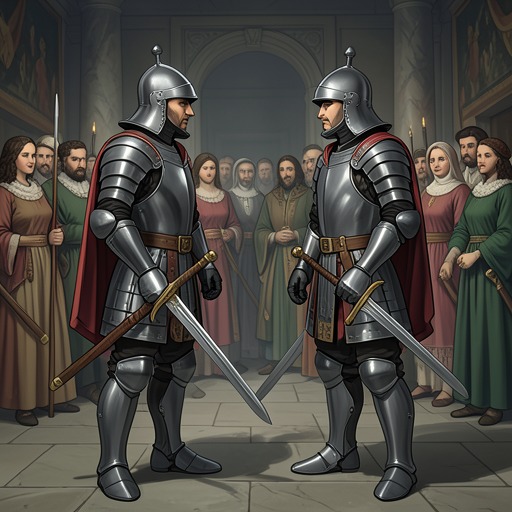
Instead, Tristram reaches the tomb while looking for Palamides and meets a knight in white, carrying a covered shield. The knight welcomes him and acknowledges that Tristram has kept his promise. They charge on horseback, both fall, and then continue on foot. Their combat lasts four hours in one account; Dinadan later tells Palamides that the battle lasted more than two hours. Both accounts stress its exceptional severity and the mutual cost of the fight, without establishing a winner.
Neither knight speaks during the combat. Their servants watch with concern, comparing the blows each has dealt and fearing that the two could destroy one another. At last Launcelot asks his opponent’s name. Tristram is reluctant to give it, but learns that the other knight is Launcelot du Lake. Tristram then reveals himself as Tristram de Liones and recognizes the man he loves best. Launcelot kneels and yields his sword; Tristram does the same. The recognition brings their fight to an end not through defeat, but through reciprocal surrender and the revelation of who each has been fighting.
From Combat to Fellowship
After yielding their swords, the two knights sit on the stone, remove their helmets, and kiss repeatedly. They then ride together to Camelot, where they meet Gawaine and Gaheris. The change is striking: the tomb that had recalled the deaths of Lanceor and Columbe and carried Merlin’s prediction of a great battle becomes the setting for an encounter that ends in mutual recognition rather than death.
Dinadan’s later account adds that Launcelot and Tristram were made friends and sworn brethren, and that no one could judge which was the better knight. Tristram becomes a Knight of the Round Table and occupies the seat associated with Marhaus. Palamides hears that Tristram met Launcelot at the same stone on the very day he had been meant to meet Tristram there; his missed appointment thus leads to a different, consequential encounter. In this way, the Peron Stone gathers together rivalry, a broken appointment, the testing of knightly prowess, and the recognition that redirects violence into fellowship.