Middle Ages
Le Morte d'ArthurThe Middle Ages in this account are defined by a struggle between disorder and the institutions meant to contain it. The book describes a Europe repeatedly shaken by war and weak government, then traces how feudal obligations, religious restraints, and chivalry sought to make power answerable to service. Its Arthurian episodes give that broad history a literary form: kings claim authority, knights swear duties, and justice is measured against the temptation to turn strength into private advantage.
Disorder and the Search for Order
The account begins with the upheaval that followed the collapse of Roman civilization under the incursions of Teutonic peoples. For centuries, the forces of destruction seem stronger than those capable of creating a more settled society. Figures such as Alfred, Charlemagne, and Otto can bring temporary order through personal authority and strength, but their influence does not permanently secure the social peace they establish. Once such rulers are gone, the account says, society repeatedly falls back into anarchy and war.
War is presented not as an isolated emergency but as an ordinary consequence and instrument of that disorder. With no effective protection from law or government, people must defend themselves, their families, and their possessions. The selfish and rapacious fight for power and plunder, while violence generates further violence. The resulting threat is moral as well as material: instead of sustaining human community, insecurity tends toward a brutish existence.
The book nevertheless insists that human beings can rise above these impulses. Passions and physical power, though shared with the brute world, can be subdued and directed toward humane and spiritual purposes. The historical movement of the Middle Ages is therefore framed as neither inevitable decline nor effortless progress, but as a prolonged contest in which human capacities are refined into forms of outward conduct.
Feudal Bonds and Their Limits
The Church is identified as the great civilising force of the period, but the book also assigns the State its own role in ordering society. Its first major response to widespread anarchy is the extension of the feudal system, described as both patriarchal and military. Those without enough wealth and power to be lords become vassals, and a hierarchy from king downward binds people through reciprocal service and protection.
These bonds are not presented as merely commercial or administrative. They grow from family, neighbourhood, and clan, and from the interests and sympathies attached to those ties. Yet the remedy carries the danger of repeating the original harm. A lord charged with protecting his own vassals can become an invader of a neighbour’s rights and possessions. Feudal allegiance can thus organize protection while also furnishing new means for private violence; the account describes anarchy as capable of arising again from the very structure designed to resist it.
Restraints on Private Violence
The period’s attempts to limit violence reveal both the scale of the problem and the moral pressure to answer it. The Peace of the King delays private warfare until forty days after the alleged offence that is to be avenged. The Truce of God suspends private hostilities from Thursday through Monday each week. Neither measure abolishes conflict, but each places a boundary around the impulse to retaliate.
At the Council of Clermont in November 1095, Urban II confirmed the Truce of God and censured the freedom to wage private war. The Church placed women and priests under its safeguard and extended three years’ protection to husbandmen and merchants, identified as vulnerable to military rapine. The account compares these protections to the biblical Cities of Refuge: in both cases, religious or civil safeguards create a space in which vengeance must yield, at least in part, to a more ordered judgment.
These measures prepare the way for the book’s account of chivalry. Chivalry is described as emerging from the same moral impulse as the Peace of the King and the Truce of God: the attempt to subject violence to restraint and responsibility. The Middle Ages are thus not represented as having solved the problem of force. They are shown devising rules and ideals that make unchecked force less acceptable and offer protection to those least able to defend themselves.
Chivalry as Power Recast as Service
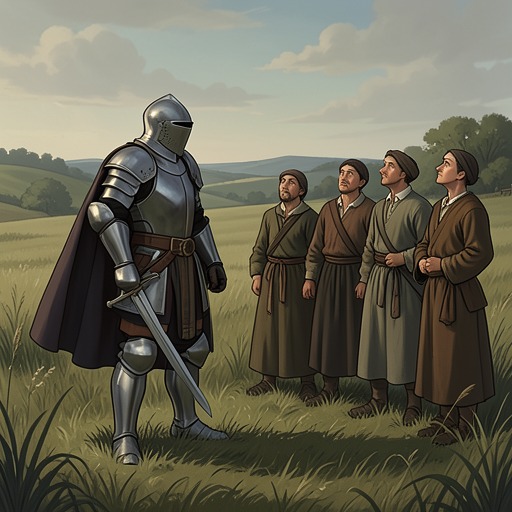
Chivalry and knighthood are treated as complementary names for a single ideal. The knight is a mounted warrior whose birth and wealth allow him to lead vassals into war, embodying lordship, mastery, dignity, and power. But that commanding figure is also defined as a servant. The knight is expected to obey as well as command, and to use strength not for selfish ends but in the service of others—especially the poor, weak, and oppressed.
The book resists assigning chivalry’s moral spirit to one single people or origin. It invokes possible precedents among Germans, Crusaders, Saracens, Romans, Greeks, Trojans, and Hebrews, then argues that the spirit belongs to humanity more generally. What has a distinctive history is its medieval European form, whose institutions and influence developed in ways different from those of the ancient world.
In the Arthurian material, this ideal is expressed as an oath-backed code rather than an abstract compliment. When Arthur establishes his knights after the early quests, he requires them to avoid outrage and murder, flee treason, show mercy to those who ask it, and aid ladies and gentlewomen under pain of losing their status. The knights also swear not to undertake wrongful battles for law or worldly goods. Renewed each year at Pentecost, the oath makes chivalry a recurring public obligation. Its standards offer a moral answer to an age of private violence, even as the wider narrative repeatedly shows how difficult those standards are to sustain.
The Crusades, Chivalry’s Flowering, and Its Legacy
The book places the golden age of chivalry approximately from the middle of the eleventh century to the end of the fourteenth. Following Gibbon, it describes the Crusades as both cause and effect of chivalry. In the Holy Land, the ideals associated with knighthood mobilize people of many ranks and nations against an enemy understood by Christendom as comparable to the robber or plunderer whom an individual knight might confront at home. The chivalric impulse abroad, in turn, helps sustain and intensify chivalry in Europe, for both men and women.
During this period, the chief institutions of chivalry either begin or reach their established form. Their rougher features gradually soften as society becomes more refined. The book associates their later, polished appearance with the age of Edward III and the Black Prince, as represented by Froissart, Chaucer, and romances composed or reshaped from older materials. It further presents the English court of that era as a pattern of knighthood recognized beyond England.
Afterward, chivalry’s outward forms gradually decline, despite apparent revivals. The account distinguishes this institutional decline from the persistence of the ethical spirit: no simple return to the old forms can restore it, because that spirit is seeking new settings. Its historical achievement lies partly in carrying Christian ethics into everyday worldly practice during a rough and partly barbarous age. That transfer was slow and mixed with evil, and the work remained incomplete; nonetheless, the book regards its importance as considerable.
Manners and the Work of Civilization
The account’s final emphasis falls on conduct in ordinary life. Its maxim, “Manners makyth man,” treats manners not as decoration but as a condition that helps virtue live and grow while making wrongdoing harder to maintain. Laws and manners alike create an atmosphere for social behavior, and habitual, unaffected politeness makes small acts of spontaneous kindness possible.
The Middle Ages therefore matter in this argument not because violence disappeared or chivalric conduct became pure, but because ideals of restraint and service were given institutions, rituals, and practices through which they could enter daily life. Their legacy is unfinished: the distance between ethical aspiration and historical action remains visible. But the effort to make power answer to service, and public conduct answer to humane standards, is the period’s central contribution as the book presents it.