Penance and spiritual redemption
Le Morte d'ArthurPenance and spiritual redemption become the governing terms of Sir Launcelot’s final years. Queen Guenever’s withdrawal to a nunnery forces him to reckon with the devastation their love has helped bring about; he chooses not to return to worldly life, but to seek religious discipline, serve God, and pray for her. His penitential course leads from confession and fasting to a vision directing him to Queen Guenever’s deathbed, and finally to his own death. The narrative does not erase his grief or declare his salvation in an impersonal voice: it places the hope of redemption alongside the lasting cost of his earlier choices.
Recognition and the Choice of Penance
At the nunnery at Almesbury, Queen Guenever explains to the assembled women why the sight of Sir Launcelot overwhelms her. She names their love as the cause of the war and the deaths of many of the realm’s noblest knights, and says that her present course is directed toward her soul’s health. Trusting in God’s grace, she hopes for a sight of Christ after death and a place at his right hand on doomsday, despite the sins of her life. Her words make repentance more than private regret: she treats withdrawal from Launcelot as a necessary change of life, and asks him to return to his own kingdom, protect it from further disorder, and take a wife.
Sir Launcelot refuses that return to the world. He says that he will not break the promise he has made to her, and that he will take the same religious course she has chosen. He recalls that during the quest for the Holy Grail he might have surpassed every knight except Sir Galahad had he given himself to the quest wholeheartedly; instead, Queen Guenever had remained his earthly joy. He now understands her turn toward spiritual perfection as a demand upon his own life. His response preserves his devotion to her while redirecting it into prayer and penance, rather than marriage or renewed companionship.
Separation, Confession, and Religious Service
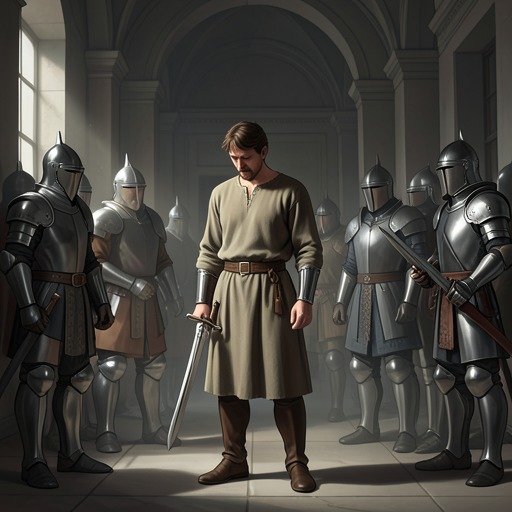
Queen Guenever refuses to kiss him and tells him to abstain from their former intimacy. Their parting is marked by lamentation, but Launcelot leaves Almesbury and rides through the forest, weeping. At a chapel and hermitage between two cliffs, he hears the bell calling worshippers to mass. There he encounters the bishop of Canterbury and Sir Bedivere. After hearing Sir Bedivere’s account, Launcelot expresses despair at trusting the world, kneels, and asks the bishop to hear his confession and grant absolution. He also asks to become the bishop’s religious brother; the bishop receives him and gives him the habit. Launcelot then serves God through prayer and fasting, making his turn from worldly knighthood visible in both religious observance and community life.
The change draws other knights into the same discipline. Sir Bors de Ganis finds Launcelot at the hermitage and asks to wear the habit himself. Later, seven more knights join them, taking religious clothing and remaining with Launcelot. The group endures six years of penance. Launcelot then takes priestly orders and sings mass for a year; his companions read, help sing mass, ring bells, and perform bodily service. The company’s former standing as knights gives way to shared work and religious routine, while Launcelot’s austerity becomes an example that others choose to follow. The narrative emphasizes the material cost of this life: he grows so lean through prayer and fasting that he is no longer readily recognized.
The Vision and Queen Guenever’s Burial
One night Launcelot receives a vision three times. It directs him, for the remission of his sins, to hurry to Almesbury, where he will find Queen Guenever dead, and to bring her body for burial beside King Arthur. The hermit urges him not to disobey the vision. Launcelot and his seven companions set out on foot from Glastonbury, a journey of a little over thirty miles that takes two days because they are weak and feeble. Their religious life has prepared them for this act of service, but it has not made them physically strong: the journey itself registers the bodily consequences of prolonged austerity.
Launcelot reaches the nunnery about half an hour after Queen Guenever’s death. The women report that before she died she had foretold his arrival and asked that she be buried beside King Arthur. They also say that, for the two days before her death, she prayed never to see Launcelot with her worldly eyes. He sees her face but does not weep greatly at first. He performs the funeral offices himself, including the Dirige, and sings mass the next morning. With eight companions, he accompanies her body on foot to Glastonbury, among a hundred continually burning torches, while they sing prayers and burn incense. The burial proceeds through layers of wrapping and a lead enclosure to a marble coffin.
When Queen Guenever is laid in the earth, Launcelot swoons. The hermit rebukes him for grief that might displease God, but Launcelot explains that his sorrow is not a desire to return to sinful pleasure. He remembers Queen Guenever’s beauty and nobility, the bodies of her and King Arthur lying together, and his own pride and failure, which he believes helped bring them both low. His grief therefore holds two meanings at once: enduring love for the dead queen and sorrow for the harm attributed to his own conduct. Penance has altered the form of his devotion, but remembrance remains painful rather than resolved.
Death and the Hope of Redemption
After the burial, Launcelot eats and drinks very little, sickens, and wastes away despite the efforts of the bishop and his companions. He spends much of his time praying and lying face down on the tomb of King Arthur and Queen Guenever. Within six weeks he takes to his bed and asks the hermit-bishop to administer the Christian rites. When his companions suggest that his illness is only a temporary heaviness, he insists that his body is going into the earth and that he has received a warning. He asks to be carried to Joyous Gard, explaining that he regrets having broken his vow to be buried there and wants his companions to fulfill it.
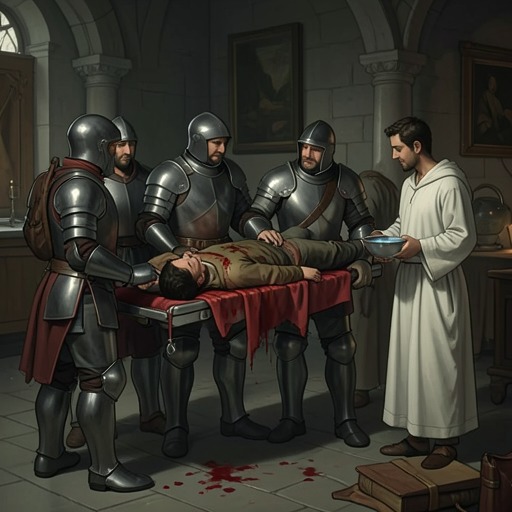
That night the bishop dreams that Launcelot has come to him with angels and has been lifted toward heaven as its gates open. Sir Bors doubts that the dream can establish what has happened, but when the companions go to Launcelot’s bed, they find him dead. His face appears peaceful, and those present experience the death as a moment of profound sorrow. The bishop celebrates the Requiem mass, and he and the nine knights place Launcelot in the same bier that had carried Queen Guenever before accompanying his body to Joyous Gard. The heavenly vision offers an image of spiritual welcome, not an explicit doctrinal verdict; alongside it, Launcelot’s final requests, religious observance, and lifelong sorrow give the ending its account of repentance. Redemption is held out as hope, while the story leaves the consequences of his past and the grief of those who survive him fully present.