Scabbard of Excalibur
Le Morte d'ArthurThe Scabbard of Excalibur appears in the evidence as an object stolen from Arthur by Morgan, an act that forms part of the account of her response to Accolon’s death. The passage establishes its importance through that theft, but does not describe its appearance, magical properties, or role in a later encounter. The accompanying material instead places the object within a wider world where Arthurian memory is attached to named relics and sites, while leaving the scabbard itself largely undescribed.
The Scabbard in Morgan’s Actions
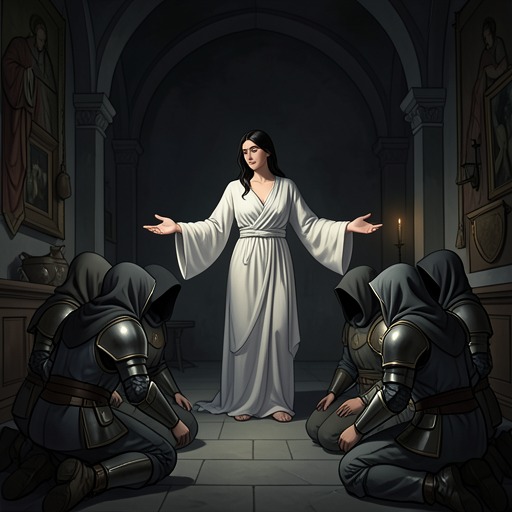
A chapter heading records that Morgan, grieving for Accolon, stole the scabbard from Arthur. This places the object in a sequence of political and personal reversals: the theft follows Accolon’s death and precedes an account of Morgan saving a knight who was about to drown. The evidence does not specify how Morgan obtained the scabbard, what she intended to do with it, or what consequences its loss had for Arthur.
Relics and Arthurian Memory
The surrounding discussion presents physical objects as evidence used to support belief in Arthur’s existence. In the account of Caxton’s preface, a nobleman cites Arthur’s burial place at Glastonbury, Gawaine’s skull at Dover, the Round Table at Winchester, and other relics, including Launcelot’s sword. The scabbard is not identified among those particular proofs; its documented theft is a separate instance of an object bound to the remembered actions of Arthur’s court.
The text also describes the shifting geography attached to Arthurian tradition. Tintagil’s castle ruins are said to remain visible in Cornwall, while Joyous Gard is variously identified with Berwick, Anwick, or Bamborough. These examples show how locations and material remains could gather competing identifications. The scabbard’s brief mention belongs to the same broad setting of legendary objects, though the evidence supplies no comparable account of a surviving artifact or historical claim about it.
Limits of the Evidence
The supplied passages do not state that the scabbard has protective or healing powers, nor do they explain how it relates mechanically to Excalibur. They establish only that Morgan stole it from Arthur after Accolon’s death. Any more detailed account of its form, enchantment, or eventual fate would go beyond the evidence available here.