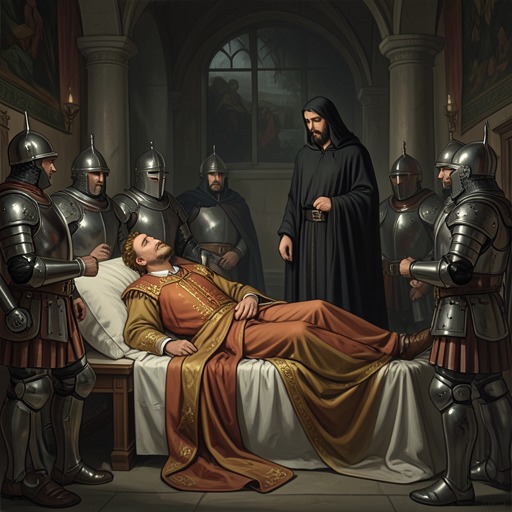
Sir Cador of Cornwall
Le Morte d'ArthurSir Cador of Cornwall is a counsellor and military commander in King Arthur’s service, prominent in the dispute over Roman tribute and the ensuing campaign. His interventions show him both advocating war as a path to honour and helping administer Arthur’s decisions; in the Roman conflict, he serves alongside Sir Launcelot as a commander responsible for prisoners and their escort.
Counsel and the Roman demand
After a period of rest and a royal feast, twelve elderly envoys from the emperor Lucius entered Arthur’s hall bearing olive branches. They demanded that Britain acknowledge Rome’s sovereignty and pay the tribute they said had been owed since the conquests of Julius Caesar. Arthur ordered that no harm be done to the messengers, despite the anger of some young knights, and provided for their lodging and hospitality while he consulted his council.
Sir Cador spoke first. He welcomed the prospect of a campaign, reasoning that the knights had rested and that war against Rome offered an opportunity to win honour. Arthur answered that the envoys’ demand was unacceptable and asked for counsel on how to respond. The exchange presents Sir Cador as eager for action, but also places his advice within a council where Arthur retains authority to determine the policy.
Arthur’s answer and Sir Cador’s commission
Arthur rejected the claim that he owed tribute to Rome and asserted a right to the empire through the history of Britain’s rulers. With the support of his allies, he resolved to take the dispute to Rome rather than submit. In the presence of his lords and knights, he instructed the envoys to report that he recognized no earthly prince as his lord and intended to claim the empire by force.
Arthur also ordered that the envoys receive generous gifts and that their expenses be paid. He assigned Sir Cador to escort them out of Britain, a practical commission that enforced the king’s protection of diplomatic messengers even while delivering a hostile answer. The envoys departed by way of Sandwich and continued through Flanders, Almaine, and Italy to Lucius.
The Roman campaign
At the parliament held at York before the expedition, Arthur arranged the government of Britain during his absence. Sir Bawdwin of Britain and Sir Constantine were appointed governors, while Arthur entrusted the queen and realm to their care. Sir Cador’s role in this preparation is not specified, but the account places him among the king’s allies as the campaign against Rome proceeds.
During the fighting, Sir Launcelot and Sir Cador are named as the leaders responsible for conveying Roman prisoners toward Paris. When Lucius sent a force of sixty thousand to ambush the escort, Sir Launcelot’s scouts discovered the Romans waiting in the woods. Launcelot led the available force of ten thousand into battle; the narrative reports that the Romans and their allies were routed and that several of their leaders were killed. Arthur arrived after the victory and praised the knights. Sir Cador reported that none had failed the others and singled out Launcelot’s prowess, while also identifying knights lost in the fighting. Arthur grieved for those deaths and reproved the company for holding out when outnumbered; Launcelot and the others answered that once shamed, honour could not be recovered.
Character and narrative role
Sir Cador’s appearances are concentrated around decisions of state and military action. He urges Arthur toward war when Rome demands tribute, then performs the diplomatic duty of escorting the envoys safely away. In the campaign, he shares responsibility with Launcelot for the prisoners and gives Arthur an account of the battle and its losses. Together these episodes define him less through an independent personal arc than through service: he advises, carries out the king’s orders, and helps interpret the conduct of the king’s knights.