Sir Gawaine
Le Morte d'ArthurSir Gawaine is one of Malory’s most forcefully individual knights: a fighter of conspicuous courage whose fierce loyalties and passions can lead him into unworthy acts, yet whose affection, service, and eventual repentance resist any simple portrait of him as a brute. His story repeatedly tests the distance between the knightly ideals he serves and the impulses that compromise them, from his vow to defend women to his later participation in vengeance against Sir Launcelot.
Identity and Family
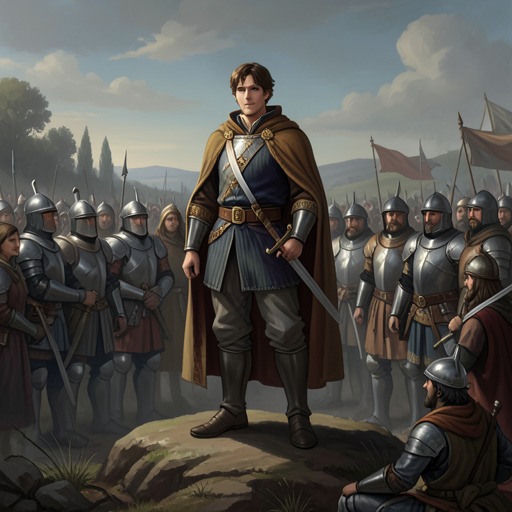
Sir Gawaine is the son of King Lot and Morgause, King Arthur’s sister, and the brother of Sir Gareth, Sir Agravaine, and Sir Gaheris. The family’s position places him close to the king as both nephew and knight, a double allegiance that shapes his conduct. When Sir Gareth reveals his identity after long adventuring under the name Beaumains, he identifies Sir Gawaine as his brother and recalls that King Arthur and Sir Gawaine had not known who he was. Their eventual recognition turns a prolonged, anonymous contest into a reunion between brothers.
The narrative’s account of his character emphasizes his regard for his mother’s honour, his passion for Ettard, and his affection for his brothers as powerful impulses. These attachments do not always make him better: the critic’s account specifically connects them with unknightly and unworthy deeds. His family loyalty is therefore both a source of emotional intensity and a cause of conflict, especially when the vengeance pursued by his brothers draws him into hostility toward Sir Lamorak and later toward Sir Launcelot.
Knightly Conduct and Its Contradictions
At the white hart adventure, Sir Gawaine kills a lady and refuses mercy to the knight associated with her; the lady’s body is carried before him as he returns to court. King Arthur and Queen Guenever are displeased, and a company of ladies judges him. Their sentence requires him, for the rest of his life, to support women’s causes, act courteously, and never refuse mercy to someone who asks for it. He swears to the obligation on the four Gospels, with the stated exception that he may oppose one lady when fighting on behalf of another. The episode establishes a public rule for conduct in the very area where his actions have failed.
That obligation becomes part of King Arthur’s wider code for the knights. The king charges them not to commit outrage or murder, to avoid treason and cruelty, to grant mercy when it is asked, and to succour ladies and gentlewomen on pain of losing their honour and lordship. Sir Gawaine’s personal sentence thus echoes a standard imposed on the fellowship as a whole: chivalric worth is measured not only in combat but in restraint and mercy.
His prowess is nevertheless unmistakable. In the encounter with Sir Marhaus, he fights with growing strength through the morning. By noon, his power has increased threefold; later, as evening approaches, it fades, while Sir Marhaus remains strong. Recognizing that their quarrel is slight and that Sir Gawaine is weakening, Sir Marhaus proposes that they stop rather than needlessly harm one another. Sir Gawaine agrees; they remove their helmets and exchange a kiss. The scene makes his unusual, time-bound strength visible, but its resolution depends on mutual recognition and restraint rather than victory.
Kinship, Friendship, and Enmity
Sir Gawaine’s ties to Sir Launcelot are deliberately complex. He has long loved him and, before their final break, opposes Sir Mordred’s hostility toward him. Yet after Sir Launcelot unintentionally kills Sir Gaheris and Sir Gareth, Sir Gawaine thirsts for revenge. Malory’s characterization holds the affection and the later antagonism together rather than allowing one to cancel the other. At the end, Sir Gawaine repents toward Sir Launcelot and asks him to visit his tomb and pray for his soul.
The family’s feud with Sir Lamorak reveals the darker side of his loyalty. Sir Gawaine and his brothers hate the man because he is the son of King Pellinore, whom they believe responsible for the death of their father, King Lot. Sir Gawaine also says that Sir Lamorak shamed their mother, and declares that he intends revenge. The account identifies the brothers’ shared hostility as a family cause of conflict; later, Sir Tristram calls the brothers destroyers and murderers of good knights and grieves for Sir Lamorak, whom he considers exceptionally capable. Sir Gareth distances himself from the brothers’ vengeance, making the family division plain.
His relationships are not confined to hostility. When Sir Gareth and Sir Gawaine meet unknowingly in combat, they fight for two hours before Linet calls out that the knight facing Sir Gareth is his brother. Sir Gawaine immediately casts aside his weapons, embraces Sir Gareth, and asks his mercy. Sir Gareth recognizes him, kneels in return, and asks mercy too. They weep, exchange the honour of the battle, and speak kindly; Linet tends the wounds both have received. Recognition transforms a prolonged fight into reconciliation, displaying a tenderness that stands in sharp contrast to Sir Gawaine’s vindictive conduct elsewhere.
He also accepts Sir Launcelot’s help when Sir Carados captures him. Bound to the saddle, Sir Gawaine tells Sir Launcelot that only he or Sir Tristram can rescue him. Sir Launcelot defeats and kills Sir Carados, then frees Sir Gawaine. The episode gives practical form to their older bond: even amid a narrative that will later turn them against each other, Sir Gawaine trusts Sir Launcelot as a rescuer.
The Grail Quest and Spiritual Judgment
During the Grail quest, Sir Gawaine’s worldly reputation and fighting ability do not secure spiritual success. After learning of Sir Galahad’s adventures, he regrets that he did not follow the same route and says he would not readily leave Sir Galahad if they met. A monk answers that Sir Galahad will not accept his fellowship because Sir Gawaine is wicked and sinful while Sir Galahad is blessed. The rebuke makes the difference between martial companionship and spiritual fitness explicit.
Sir Gawaine later seeks confession from a hermit and recounts being called a wicked knight. The hermit does not dismiss the judgment: he explains that Sir Gawaine should have undertaken a particular obligation when first made a knight. The surviving account then turns to Sir Gawaine’s vision in a chapel, which he explains to the hermit alongside Sir Ector de Maris’s account. The hermit interprets the green meadow in the vision as humility and patience, virtues associated with the Round Table. The episode frames the quest as an examination of the conduct that underlies knighthood, not simply another arena in which Sir Gawaine can prove his strength.
A chapter heading presents him as nearly weary of the Grail quest and refers to a marvellous dream. Elsewhere, he admits that he is unhappy not to have followed Sir Galahad’s route, while the hermit’s judgment exposes the moral limits of his claim to the fellowship. Together, these moments place his quest between aspiration and failure: he seeks the adventure, but the narrative repeatedly measures him against humility, patience, and a religious standard that prowess alone cannot meet.
Character and Narrative Role
A critical account of Malory’s characterization rejects the view that Sir Gawaine is simply meant to match Sir Launcelot as his counterpart. Instead, it finds art in the creation of a new Sir Gawaine with a strongly individual character. His regard for his mother, passion for Ettard, and affection for his brothers drive him toward deeds unworthy of a knight, while his devotion to King Arthur and his history of affection for Sir Launcelot show other dimensions of the same fierce nature. His repentance at the last does not erase the vengeance that precedes it; it makes that vengeance part of a morally divided life.
His ghost is also allowed a final role in the story. The prayers of ladies for whom he had fought in a just cause permit him to warn King Arthur. The warning extends his relationship with the king beyond death and recalls the obligation imposed after the white hart episode: service to women’s causes, though entangled with failures and violence, remains bound to his narrative identity. Sir Gawaine’s significance lies in these unresolved contrasts—fighter and penitent, loyal nephew and vengeful brother, friend of Sir Launcelot and eventually his enemy—rather than in a single, settled model of chivalry.