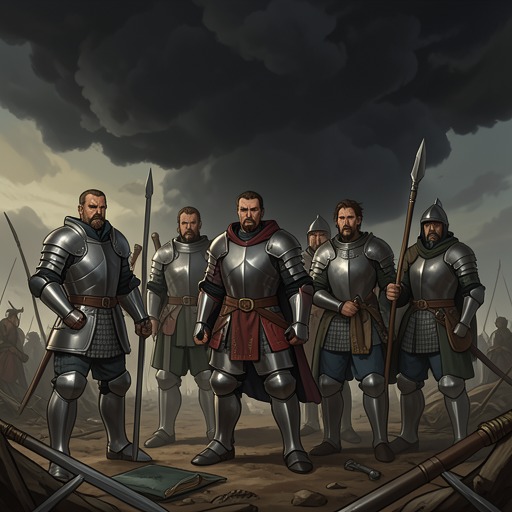
Sir Lamorak
Le Morte d'ArthurSir Lamorak is a formidable knight whose victories bring him renown at Arthur’s court, but whose career is shaped by recurring contests and the lethal consequences of dynastic hostility. He can make peace with a former opponent, yet that capacity for accord does not protect him from the court’s cycles of rivalry and vengeance.
Prowess and the Tournament
At a tournament proclaimed by King Arthur, Sir Lamorak entered the lists and overthrew Sir Gawaine and many other knights. The episode presents his ability not as a private reputation but as a public fact: in a royal contest, he defeats a prominent member of the court and a larger field of competitors. His success places him at the center of the fellowship’s competitive life, where prowess earns notice but can also intensify rivalries.
Another account describes Sir Lamorak jousting with thirty knights. In that encounter, Sir Tristram, acting at King Mark’s request, struck down Sir Lamorak’s horse. The incident makes the contest more than a simple measure of individual skill: a king’s request draws Sir Tristram into an action against a fellow knight, and the conflict continues beyond the lists. Sir Lamorak sent a horn to King Mark in defiance of Sir Tristram, after which Sir Tristram was driven into a chapel. The episode links Sir Lamorak’s public challenge to the escalating danger around Sir Tristram and the courtly relationships entangled in their rivalry.
Conflict and Reconciliation with Sir Tristram
Sir Lamorak and Sir Tristram met in combat, but their story did not end in a final defeat. After fighting, they agreed never to fight one another again. This accord distinguishes their relationship from the repeated contests around them: martial skill first brings them into opposition, while their own agreement sets a limit on that hostility.
The later encounter with the thirty knights complicates that settlement. Sir Tristram’s blow against Sir Lamorak’s horse, delivered at King Mark’s request, and Sir Lamorak’s defiant message to the king show how external demands could draw a knight back into conflict even after personal enemies had made peace. The account thus presents reconciliation as real but vulnerable to the pressures of royal service and wider rivalries.
The Orkney Family and the Tragic Outcome
Sir Lamorak’s visit to the wife of King Lot becomes part of a devastating family conflict. The account identifies her as the mother of Sir Gawaine, Sir Gaheris, Sir Agravaine, and Sir Gareth. After Sir Lamorak visited her, Sir Gaheris killed her, and the narrative emphasizes the terrible fact that she was his own mother. The episode does not describe Sir Lamorak’s precise role in the killing; it places his visit immediately within the sequence that ends in matricide.
This family catastrophe gives a darker dimension to the rivalries surrounding Sir Lamorak. He had already defeated Sir Gawaine in a tournament, while the later episode brings him into the story of Sir Gaheris and the Orkney family. His prowess is therefore framed alongside consequences that extend beyond the field of combat: courtly contest and kinship conflict converge in an outcome that destroys a family bond.