Sir Launcelot
Le Morte d'ArthurSir Launcelot stands pre-eminent among the knights of the Round Table, but his greatness is inseparable from the sin that darkens his life and the remorse that attends its close. The account of his death gives that contradiction its fullest form: a celebrated knight, lover, and friend measures his past against the deaths of King Arthur and Queen Guenever, while Sir Ector’s farewell gathers his virtues into a final tribute.
Identity and Knightly Standing
The narrative’s retrospective judgment sets Sir Launcelot apart even among the Round Table’s most accomplished members. He is called the head of Christian knights and unmatched by any earthly knight; his distinction lies not only in prowess but in courtesy, kindness, meekness, and gentleness among ladies. At the same time, he is stern toward a mortal foe. The praise is therefore not a portrait of softness: it presents a knight whose force in combat coexists with restraint and courtesy beyond it.
The account does not treat his pre-eminence as proof of moral perfection. He stands above his companions in knightliness “notwithstanding his one great sin.” That qualification governs the portrait: his excellence is real, but it cannot erase the failure he himself recognizes, or the consequences of that failure for the people he loved.
Love, Sin, and the Fall
Sir Launcelot’s love for Queen Guenever is bound to the tragedy of the royal couple. In his lament, he recalls her beauty and nobility beside King Arthur’s, and sees their bodies lying together after their deaths. The sight overwhelms him. His grief is not presented as delight in past wrongdoing; he insists that it has no end and that his sorrow is not a celebration of sin.
His confession names his own part in the catastrophe. He attributes the lowering of those who had been peerless to his default, pride, and unkindness toward their kindness. The passage makes remorse more than sorrow for loss: he understands the deaths as entangled with his own conduct, and that recognition is what he cannot bear. The celebrated lover is thus also the man who lives to acknowledge the damage his love and pride have helped bring about.
Exile and the Search for Reconciliation
The same account that stresses his guilt also emphasizes his patience toward Sir Gawaine. As Sir Launcelot leaves the realm and later endures the siege of Joyous Gard, Gawaine taunts and attacks him; Launcelot bears the hostility humbly and repeatedly seeks reconciliation. His response contrasts with the fierceness of the conflict around him: he does not answer Gawaine’s renewed aggression with a settled desire for revenge.
Gawaine’s hostility has its own history. He seeks vengeance for the unintended deaths of Gaheris and Gareth, yet he had previously loved Sir Launcelot and opposed Mordred’s hostility toward him. By the end, Gawaine repents toward Launcelot and asks him to visit his tomb and pray for his soul. Their relationship therefore moves through affection, grievance, and attempted reconciliation, rather than reducing either knight to a single fixed disposition.
Penitence and Death
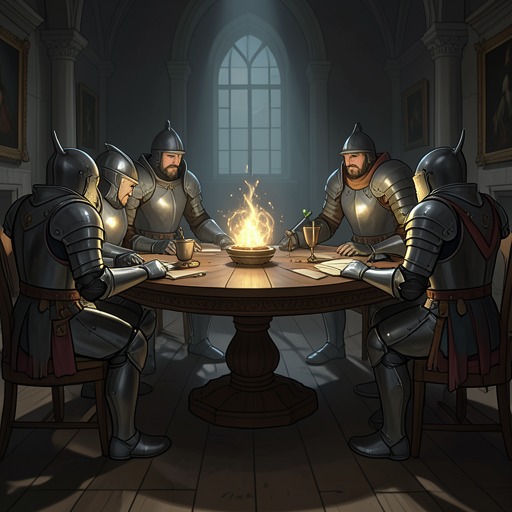
After hearing of the deaths of King Arthur and Queen Guenever, Sir Launcelot goes to Almesbury and takes leave of the queen. He then follows her example, withdrawing to a forest hermitage and chapel set between two cliffs, where he serves God with prayer and fasting. The knights who join him endure six years of penance. Sir Launcelot then takes priestly orders and sings mass for a year.
A vision directs him to take Queen Guenever’s body from Almesbury and bury her with King Arthur at Glastonbury. After the burial, he swoons. When the hermit rebukes his grief, Sir Launcelot explains that the sight of the king and queen together, and the memory of his own failure and pride, have overcome him. He wastes away praying at their tomb and dies. His body is taken to Joyous Gard for burial, bringing his final life back to the castle associated with his story.
Friendship and Narrative Significance
Sir Ector arrives at the burial after searching England, Scotland, and Wales for seven years to find his brother. He does not recognize the people gathered in the choir until Sir Bors tells him that Sir Launcelot lies dead. Sir Ector casts aside his shield, sword, and helmet, then falls in a swoon when he sees his brother’s face. His lament names Launcelot’s unmatched standing, courtesy, loyalty to his beloved, kindness, beauty, meekness, and gentleness, as well as his severity toward mortal enemies. The praise makes friendship, not merely public fame, the final measure of the dead knight.
The paired laments give Sir Launcelot’s ending its particular force. His own words expose the burden of responsibility he carries for the king and queen; Sir Ector’s words preserve the range of qualities that made him beloved and admired. The account thus holds virtue and sin together without allowing either to cancel the other. Sir Launcelot’s renown survives, but it is shadowed by a grief that he understands as inseparable from his own choices.