Sir Tor
Le Morte d'ArthurSir Tor’s story turns on the difference between the household that raises him and the royal parentage that Merlin reveals. First appearing at King Arthur’s wedding court as the son of a poor cowherd, he is made a knight at his own request; once his identity as King Pellinore’s son is disclosed, his demonstrated prowess and restraint earn him a place among the Knights of the Round Table. His later recognition rests not on lineage alone, but on deeds that the court has already had reason to value.
Identity and Background
Tor comes to court with Aries the cowherd, who explains that the young man has resisted the labor expected of his thirteen sons and instead longs to watch battles and become a knight. Tor is eighteen, rides a lean mare, and is described as notably handsome and well formed. His ambition is his own: Aries tells King Arthur that the request for knighthood comes from Tor, not from his father.
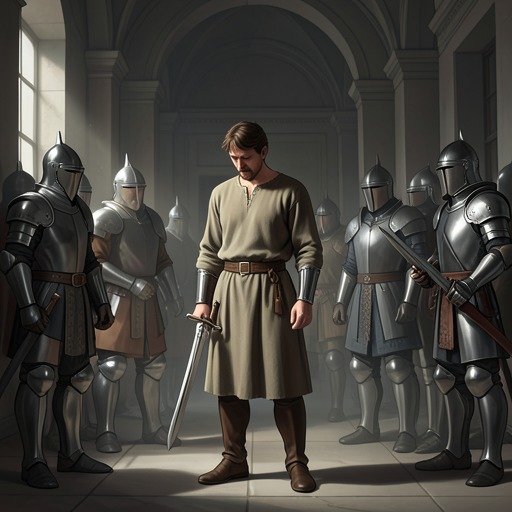
When Arthur asks for the sword with which to dub him, Tor dismounts, draws it, kneels, and asks to become a knight of the Round Table. Arthur grants the knighthood, while making membership in the fellowship conditional on Tor proving his prowess and worth. The ceremony therefore recognizes his aspiration without yet settling his place among the kingdom’s foremost knights.
Merlin supplies the decisive correction to Tor’s apparent family history. He says that Aries is not Tor’s father and identifies King Pellinore as his father; Tor’s mother confirms that Pellinore had encountered her before she was married. The revelation explains why Tor differs in appearance from Aries and his other sons, and Merlin frames the royal descent as an honor that can advance both Tor and his mother. Tor objects when Merlin’s disclosure risks dishonoring his mother, a response that gives the scene a measure of his concern for her dignity as well as his newly exposed status.
First Quest and Recognition
Tor’s first adventure follows the brachet taken from Arthur’s court. He sets out with little support: King Pellinore gives him an old courser, while Arthur supplies armor and a sword. Tor rides alone, pursues the matter, and returns to Camelot after completing his quest. The court hears his account and rejoices at his return, turning an initial act of self-assertion into a publicly witnessed record of service.
Merlin distinguishes this early exploit from the greater career he predicts for Tor. He describes Tor as destined to become a noble knight, courteous, truthful in his promises, and unlikely to commit outrage. Arthur responds by granting him an earldom from lands that had fallen to him. The reward joins martial promise to social advancement: Tor’s hidden royal birth is made known, but the court’s judgment is also grounded in what he has already done.
Tor’s reputation is expressed through a recurring contrast between speech and action. King Arthur later says that Tor says little but does much, and regards him as a notably strong and capable knight. In the same assessment, Arthur notes that Tor’s maternal birth is not as high as his paternal one, making the recognition a qualified judgment of both merit and lineage rather than a simple declaration of noble blood.
Place at the Round Table
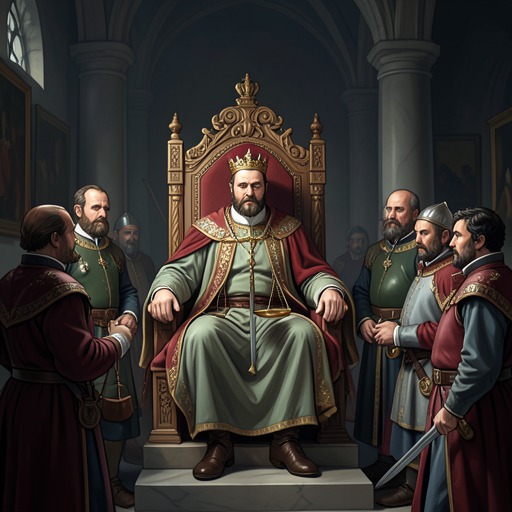
After a battle in which the fellowship loses eight Knights of the Round Table, King Arthur consults King Pellinore about selecting replacements. Pellinore recommends a balance of older and younger knights, then names Tor alongside Sir Bagdemagus as candidates. He is careful not to praise his own son simply because of their relationship, but still calls Tor, for his age, one of the best knights in the land, unwilling either to do wrong or to accept wrong.
Arthur chooses Tor for a vacant seat. His decision draws on personal knowledge: he has seen Tor tested and considers him exceptional in prowess and strength. Arthur also acknowledges that Tor’s maternal side does not match the high standing of his father’s, yet concludes that no knight in the court is his equal in the qualities under discussion. The scene makes Round Table membership a judgment of demonstrated worth conducted within the politics of rank and kinship.
The choice has an immediate cost for Sir Bagdemagus, who is angered at being passed over and rides away from court. His departure underscores that Tor’s advancement is not merely ceremonial: a place in the fellowship is a scarce distinction, and selecting one knight alters the standing of another. Tor’s advancement is presented through the king’s and Pellinore’s assessments, while the disappointment of the rejected candidate supplies a counterpoint to the honor he receives.
Conduct and Relationships
Tor’s connection to King Pellinore is both personal and public. Pellinore is revealed as his father and later advocates for his admission to the Round Table, while explicitly recognizing the difficulty of praising one’s own son. His recommendation therefore makes their kinship visible without pretending it is irrelevant; Arthur weighs the recommendation against his own experience of Tor’s conduct.
Tor is also identified within Pellinore’s larger family. Sir Lamorak calls him his half brother, and the account of Sir Percivale’s knighting identifies Tor as Pellinore’s eldest son, with Sir Aglovale, Sir Lamorak, Dornar, and Percivale among his brothers. These references place Tor within a family whose members recur in the court’s chivalric affairs, even when Tor himself is not the focus of the scene.
His reported character is bound to the obligations Arthur imposes on the Round Table. After several quests associated with the wedding court, Arthur charges his knights not to commit outrage or murder, to flee treason, to show mercy to those who ask for it, and to aid ladies and gentlewomen on pain of death. The knights swear to these requirements at Pentecost and renew their oath each year. Merlin’s earlier forecast that Tor will be courteous, faithful to his promises, and restrained from wrongdoing anticipates the code under which his fellowship is ordered; the text presents those qualities as both personal virtues and public duties.
Narrative Role
Tor’s introduction brings hidden descent into contact with an open test of ability. The court first sees a cowherd’s son asking for knighthood, then learns that he belongs to King Pellinore’s royal line; between those disclosures, the story gives him a first quest and lets the court assess his return. The sequence prevents ancestry from being the sole basis of his standing: the revealed identity explains his birth, while service and reputation make his promotion legible to Arthur’s court.
His later elevation repeats that logic on a larger institutional scale. Tor is considered for a Round Table seat in the aftermath of real losses, and Arthur chooses him because of his known prowess and character despite the complication of his maternal birth. In this way, Tor’s plot links recognition, family connection, and the fellowship’s rules: he rises through royal kinship, but the narrative repeatedly presents his deeds and restraint as the grounds on which his place among the knights is justified.