Sir Urre
Le Morte d'ArthurSir Urre is a knight whose persistent wounds bring him to King Arthur’s court in search of healing. His recovery becomes a public test of the court’s ideals and a striking episode in which the king’s touch fails, but Sir Launcelot’s succeeds, drawing the assembled knights into shared praise of God.
Arrival at Arthur’s Court
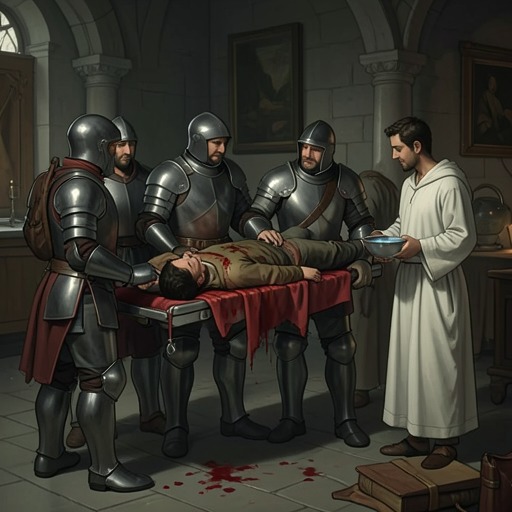
Sir Urre comes to court while King Arthur is present with the knights of the Round Table. The account identifies his purpose plainly: he seeks to be healed of his wounds. Arthur prepares to handle them himself, turning the attempted cure into a matter witnessed by the court rather than a private treatment.
The episode belongs to a wider world in which martial encounters leave knights in need of aid. Elsewhere, Sir Ontzlake explains that an adventurous knight had wounded him through both thighs; Arthur’s own injury is likewise connected to a sword taken from him by treason and enchantment. Against those stories of wounds caused by combat or deceit, Sir Urre’s arrival places healing, rather than prowess in battle, at the center of the courtly scene.
Arthur’s Attempt and Launcelot’s Healing
Arthur handles Sir Urre first, and then many other knights of the Round Table. The narration singles out the scale of this public demonstration: Sir Urre is not the only knight whose wounds Arthur examines. Yet the account’s decisive turn comes when Arthur commands Sir Launcelot to handle Sir Urre’s wounds. Sir Urre is immediately made whole.
The court responds by giving thanks to God. The sequence distinguishes the king’s authority from the healing itself: Arthur initiates the attempt and directs Sir Launcelot to act, but the successful cure follows Launcelot’s touch. The episode does not describe the wounds or explain their origin, keeping attention on the sudden restoration and the religious response it prompts.
Meaning Within the Court’s Stories
Sir Urre’s brief appearance gives the court a moment of recognition through healing rather than combat. His recovery confirms Sir Launcelot’s exceptional standing before the assembled fellowship, while the thanksgiving frames the cure as a gift for which human prowess alone is not sufficient explanation. The narrative leaves Sir Urre’s further life unstated; his significance lies in the witnessed cure and in the way it turns a knight’s appeal for help into a collective act of gratitude.