Trial by combat for treason or murder
Le Morte d'ArthurTrial by combat for treason or murder is a judicial custom in which a person accused of treason or murder must fight the accuser or find another knight to fight on the accused’s behalf. In the account of King Anguish’s summons to King Arthur’s court, the rule turns a charge into an obligation to answer bodily, while its reach and application are shaped by the court’s judges and the available champions.
The Rule and Its Procedure
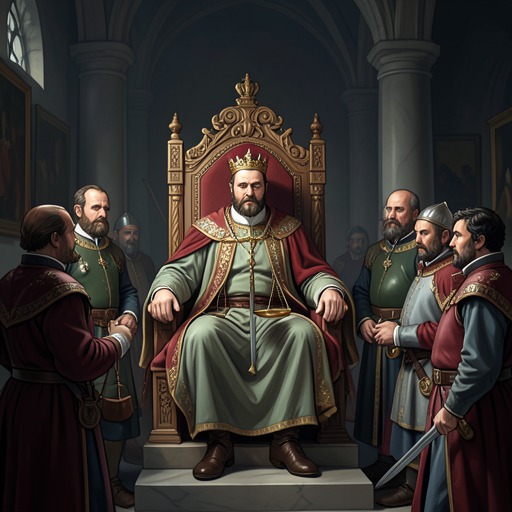
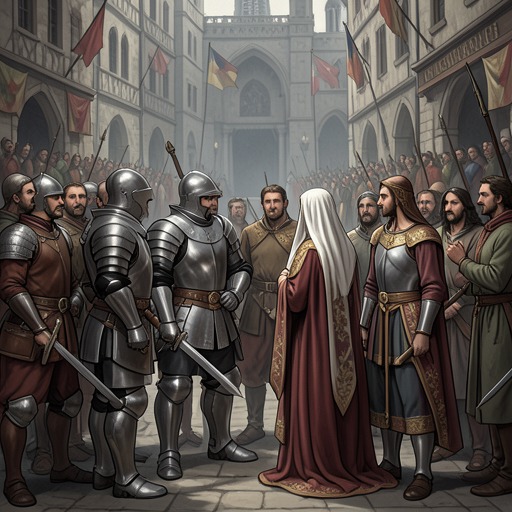
The procedure is stated when Sir Blamor de Ganis accuses King Anguish of treason for allegedly killing Blamor’s cousin in Ireland. Anguish has come to Camelot in response to a summons and did not know the reason for it before Blamor announces the charge. Under the custom described, a person appealed of treason or murder must fight the accuser body for body or find another knight to fight in that person’s place. The account adds that murderers in those days were classified as traitors, bringing both kinds of accusation within the same rule.
The obligation does not mean that a combat begins as soon as the accusation is made. Anguish is unprepared to answer, and the judges grant him until the third day to provide his answer. The episode thus distinguishes the charge, the defendant’s required response, and the ensuing trial by combat: the accused must meet the accusation through the prescribed form, but receives time to arrange that response.
Accusers, Defendants, and Champions
The custom places the accuser and accused in a direct contest, yet permits a substitute champion. That alternative makes knightly service part of the judicial process: an accused person who cannot or does not fight personally may seek a knight to answer the accusation. The rule is presented as an established practice rather than an exceptional remedy devised for Anguish’s case.
The narrative introduces this legal crisis alongside another appeal for knightly aid. A lady tells Sir Tristram that a knight has taken a child entrusted to her for delivery to Sir Launcelot, and Tristram agrees to pursue the child on Launcelot’s behalf. That parallel does not alter the combat rule, but it places the demand for a champion within a broader courtly world where knights are repeatedly called upon to act for others.
The Custom in Arthur’s Court
The hearing proceeds in Arthur’s absence: he is at Joyous Gard with Sir Launcelot and cannot attend on the appointed day. He assigns King Carados and the King of Scots to sit as judges at Camelot. Their presence shows that the custom is administered through delegated judgment as well as through the combat itself; the king’s absence does not prevent the court from receiving the accusation and requiring an answer.
Anguish is described as troubled by the accusation and aware that Sir Blamor is a noble knight descended from noble knights. The scene therefore sets the peril of the procedure against the accuser’s recognized standing. The rule supplies a formal response to grave charges, but the supplied account does not describe how evidence is weighed independently of the combat or report the outcome of this particular accusation.
Reach and Significance
The rule gives accusations of murder and treason a shared procedural consequence: both may lead to a fight between the parties or their champions. In Anguish’s case, the accusation concerns an alleged killing in Ireland, but it is heard at Arthur’s court in Camelot after a formal summons. The case connects a charge arising in one king’s realm to the wider judicial authority claimed by Arthur’s court.
The account presents trial by combat as a customary obligation, not as a modern evidentiary hearing. Its operation depends on the accused’s capacity to answer, the possibility of finding a champion, and the court’s power to set the proceeding in motion. By making physical combat the prescribed answer to an accusation, the custom joins justice to knightly status and exposes the accused to a contest whose result carries the force of judgment.