Agneta Müller
Los pacientes del doctor GarcíaAgneta Müller’s arc moves from ambitious Nazi youth leader to a young woman caught between family obligation, wartime catastrophe, and attachment to a fugitive. In Berlin’s final days, she goes looking for death in the service of Hitler and instead encounters Adrián Gallardo and Jan Schmitt. After the war, her choice to shelter and marry Jan, and her father’s assistance in giving him a new identity, help erase his past from the neighborhood. Her story makes the private home an instrument of both care and concealment.
Identity and political ambitions
Agneta is a committed member of the Nazi youth organization BDM. When the war forced her to abandon her studies, she devoted herself to the Party and became Untergauführerin of Schöneberg. By February 1942, she was the fourth-ranking figure in the BDM hierarchy and responsible for three thousand girls in her district. She had made her section a model of unity, activity, and efficiency, and it was the favorite section of the superior whose position she hoped one day to inherit.
Her political ambition conflicts with her mother’s idea of service. Beate Müller, an early Party member, expected her daughter to follow the path the Führer prescribed for women: leave youth politics at eighteen, marry young, and devote herself to bearing and raising a dozen children in the National Socialist faith. Agneta, proud of the insignia marking her leadership, had no desire to exchange her career for early marriage and motherhood. She kept that ambition from her mother because she knew Beate disapproved.
The contrast between Agneta’s aspirations and the options offered to young women in her movement is sharpened by the absence of an adult women’s organization in the Party. She hopes exceptional dedication and precocious achievement will open a route into BDM leadership, even as the prescribed alternative is domestic service to the Reich. Her politics are not simply an inherited family identity: they are also the field in which she has built a future for herself.
Family obligation and confinement
That future is abruptly curtailed when a tram accident crushes Beate’s legs. After a year of rehabilitation, Beate can move around the house with two crutches but leaves it only in a wheelchair. Agneta becomes her nurse, masseuse, errand runner, and general servant. She tries to combine care with Party work, but notices that her absences coincide with the sudden, unexplained worsening of her mother’s condition. Beate’s reputation among her fellow Nazis suffers when she is thought to be neglected, while her mother’s standing as an admired Party veteran makes defying her especially costly. Agneta yields, and Beate’s demands continue to grow.
The household’s history also unsettles the political categories Beate has embraced. Agneta’s father, Rudolf Müller, had once been a press chief, but in 1934 was demoted to the porter's post at Schöneberg’s town hall because his loyalty was doubted: he resisted joining the Nazi Party, and two of Beate’s uncles had belonged to left-wing parties. By April 1945, Rudolf still leaves for work at the same hour, despite the city being surrounded. He is later found at his post by the Soviet occupiers, who recognize him as a dissident. Agneta’s family thus contains both a committed Nazi and a man whose survival under the regime depended on his politically suspect background.
The domestic setting preserves traces of Agneta’s earlier self. On the morning she leaves to seek out the fighting, she takes a note she has written for the neighbor Roswitha from inside a book. She does not say goodbye to the pink and blue blossoms decorating her bedroom walls. The hurried departure is a small break from the routine of being summoned back to her mother, but it does not free her from the family ties that will shape what follows.
Berlin and the encounter with Gallardo and Schmitt
On April 25, 1945, Agneta wakes before her alarm in the still-dark, cold room she has never renovated. She lies under the blankets waiting for the familiar cough of her father, whose early-morning routine marks the ordinary life that continues despite the Soviet advance. Later, amid the encircled city and severe shortages, her mother rejects the news that Berlin has run out of milk; Agneta explains that the trucks cannot enter and that the Russians are already there. The gap between Beate’s denial and the besieged city’s reality frames Agneta’s decision to go out.
She dresses in the old BDM uniform, but the body inside it no longer matches the image she remembers from adolescence. The uniform’s tightness and the uncomfortable boots make her appearance feel alien to her, while her two thick braids evoke the girl she used to be. She puts on an old tan jacket, takes Roswitha’s note, and tells Beate she is going out briefly. When she reaches the position where Gallardo and Schmitt are waiting, she gives her name and rank and declares that she has come to die for her Führer.
Her defiant announcement meets Gallardo’s laughter. He has already been on the brink of death, and Agneta’s arrival confronts him with an emphatic image of life. She does not understand the words he and Schmitt exchange, but she enters a world in which their friendship and wartime loyalties are already under strain. Gallardo’s attachment to her grows rapidly; he interprets her presence as a reprieve from a death he had expected, while Schmitt becomes her companion in the shelter.
Agneta asks to go to the Reich Chancellery. She has passed it many times without interest, but now that Hitler is in his bunker she wants to see what he sees when he comes outside and the entrance used by those who are allowed to visit him. She says the visit would let her say goodbye. Gallardo and Schmitt accompany her. At the bunker entrance, Agneta stands to attention, raises her right arm, and shouts the Nazi salute. Schmitt embraces and kisses her forehead, crying; when she turns and sees the two men across the fence, he salutes her again. Gallardo recognizes the bond between them in that exchange.
The attachment becomes a decisive break among the three. After lunch, Schmitt tells Gallardo that Agneta wants to return home and that he will go with her. He acknowledges that they had come to defend the Reich to the end, but says that everything has changed. Gallardo answers by telling him that, despite Schmitt’s brutality, he has been the best friend he has ever had. He then knocks Schmitt down with a right punch. Agneta rushes to beat at Gallardo’s chest with her fists as she tries to revive Jan. Gallardo leaves them and wanders for hours; when he returns to the shelter, Jan and Agneta are gone.
Return home and Jan’s new identity
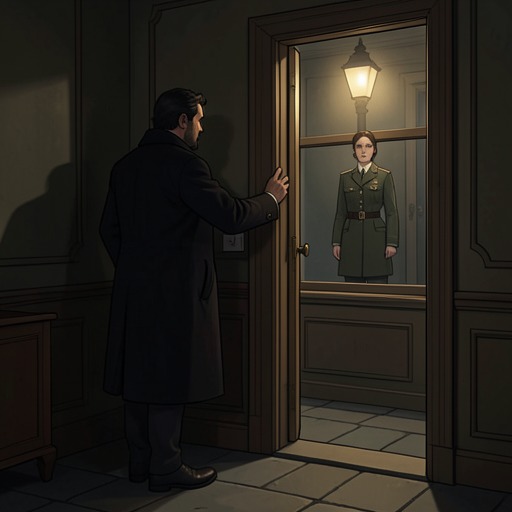
On April 30, Agneta brings Jan back to Schöneberg and hides him in a small storeroom reached through the courtyard before entering her parents’ flat. Her father embraces her, kissing her cheeks, hair, and forehead; Beate welcomes her with kisses and no reproaches. They eat boiled cabbage and a little bread. Rudolf gives Agneta his portion after seeing how quickly she has eaten her own, unaware that she had saved it for Jan in her pocket. The tenderness of this reunion is shadowed by scarcity and by the fugitive hidden in the building.
Rudolf’s routine continues into the collapse of the Third Reich. On the morning of April 30, he goes out to work without his usual cough; the occupiers find him at his post on May 3. By then the town hall building has been deserted for nearly a week. His quiet persistence leads the Soviets to recognize him as a dissident, and he becomes one of Schöneberg’s most powerful men. Beate and Agneta, by contrast, are trying to preserve the man they have concealed at home.
On May 8, the day after the German surrender, Agneta tells her father she loves him and needs his help with a serious problem. She says Jan is an ordinary soldier with no criminal responsibilities, and she is not lying as far as her knowledge goes: she has never heard of Klooga. Beate supports her daughter and the fugitive, seeing the assistance as a final chance to serve the Reich she had loved before history swallowed it. Rudolf agrees only after Agneta returns to him with a more consequential request. During one quarrel she takes a kitchen chair to reach a suitcase on the wardrobe; before she begins packing, he gives in.
Rudolf asks Jan for his father’s second surname. The next day, at his office, he completes and stamps a residence certificate identifying Jan Schmitt as Johannes Grunwald, born in Schöneberg and living there at Roswitha’s flat. Roswitha agrees to host him temporarily to forestall an inspection. This paperwork makes the assumed identity usable: Johannes can apply for a municipal police position reserved for citizens born in and resident in the district. His connection to Agneta’s father helps him obtain the post. Once he patrols the streets in uniform, the trace of Jan Schmitt disappears from the lives of those who have known him in Berlin.
Marriage, motherhood, and the concealed past
In the months after the war, Jan presents himself as industrious, responsible, and loving. Though he is not especially skilled at repairs, he tackles the household damage left by the war, mending wiring, lamps, and furniture, and painting the Müller home before the end of 1945. His work is makeshift, but it earns him a small neighborhood clientele. He searches unsuccessfully for more secure employment while keeping his status as an undocumented man hidden, using only his Argentine passport and ensuring that no one records its number.
Agneta and Johannes marry in June 1946. The cost of rent and Beate’s condition lead them to remain in the Müller home rather than establish a household of their own. Their first son, Rudolf, is born there in February 1947, nine days before the prisoner listed as Alfonso Navarro López is released. Domestic life therefore develops alongside the separate aftermath of Gallardo’s assumed identity, while Jan’s history as a war criminal remains unknown to the people he has encountered in the neighborhood.
Agneta’s trajectory is marked by reversal rather than a clean escape from her earlier commitments. She enters the final battle of Berlin professing a willingness to die for Hitler; she leaves it with Jan, returns to a family home, and helps secure his passage into ordinary civic life. The women’s domestic labor and family loyalties that once seemed to constrain her also become the means by which she protects him. Her father’s certificate, Roswitha’s hospitality, Beate’s support, and Agneta’s insistence combine to transform a fugitive’s identity. The resulting marriage and child form a private future, but that future rests on the concealment of Jan’s past.