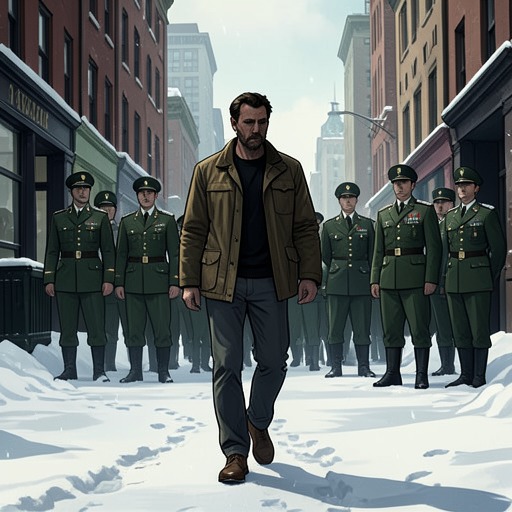
Alfonso Navarro’s identity papers
Los pacientes del doctor GarcíaAlfonso Navarro’s identity papers are the documentary hinge between Adrián Gallardo’s life as a Spanish combatant in Berlin and his survival under the name Alfonso Navarro López. Gallardo takes them from the man he has killed, destroys his own documents, and uses the papers to make his disappearance appear administratively real. What begins as a desperate act at a street barricade becomes a durable false identity, carried through Soviet interrogation and imprisonment into the postwar world.
The papers taken in Berlin
On the Wilhelmstrasse, Gallardo and the other defenders are waiting in a makeshift position built among paving stones. When the opportunity comes, he draws his pistol, checks that it is loaded, and shoots the man crouched at the only usable machine gun. He searches the dead man’s uniform, finds the documents, and puts them in his wallet. Then he burns his own papers in the fire inside a perforated barrel used as a stove. Only after Gallardo has, in effect, officially ceased to exist does he move the body aside and occupy the dead man’s position. A Russian tank passes without noticing him; he does not fire, but waits for another chance to fight.
The documents are not merely a way through a checkpoint. They make the substitution legible: Gallardo can leave his former name behind because he possesses papers belonging to another person. The sequence makes the administrative act inseparable from murder. The dead man’s identity is not assumed through a harmless change of name; it is seized from his uniform, while the evidence of Gallardo’s previous identity is committed to the fire.
A borrowed name after surrender
Gallardo’s reason for taking the papers reaches beyond the immediate danger at the position. By the time the defenders’ resistance ends, he has fallen in love with Agneta Müller and no longer wants to die. He believes that he must become someone else if he is to have any prospect of a life after the war. His service at Klooga also leaves him exposed: the men connected with the camp might identify or denounce him. He kills Navarro to secure a new identity, and the papers give practical form to that calculation.
When Soviet forces finally confront the position, Gallardo comes out with his arms raised, carrying Alfonso Navarro’s documents and concealing Navarro’s corpse. He does not surrender alone in the sense of surrendering under his own name: the papers accompany him into custody and allow his former identity to recede. The novel makes the difference stark. The man who had been Adrián Gallardo is physically present, but the name available to his captors is Navarro’s.
Identity under interrogation
The papers’ usefulness depends on Gallardo’s ability to sustain the identity they certify. After six weeks in an overcrowded cell, a Soviet officer questions him about his poor German. Gallardo answers that he is Spanish. Asked whether he had served as a volunteer, he says yes, though he would have preferred to deny it and expects that denial would not be believed. The exchange tests the borrowed identity against details of language and military service; the papers alone cannot answer every question, but they give him a name under which to answer.
Months later, another Russian officer speaks Spanish and hears a fabricated biography from the prisoner calling himself Alfonso Navarro López. Gallardo has spent the intervening period constructing that account through long days in darkness, sleeping seated and crowded among exhausted, starving men. The officer records little, then sends him to prison to await trial. He says that Gallardo may be transferred to a British or American tribunal because the Russians have no serious charge against him for his conduct on the Eastern Front and cannot manage the number of killers in custody. The documents have carried Gallardo past the first interrogations, but they do not erase the possibility of later scrutiny.
From battlefield papers to a postwar identity
The book sets Gallardo’s appropriation alongside other uses of forged documents, showing how papers can be manufactured, altered, and made to pass through ordinary administrative systems. In 1937, Manuel Arroyo Benítez had been registered in Madrid as Rafael Cuesta Sánchez under a carefully prepared identity whose details were wholly false. Later, after the war, the escape network around Clara Stauffer supplies fugitives with clothes, assistance, and documentation; a baptismal record with German names and a date of 1907 is among the papers passing through her house. In postwar Berlin, Jan Schmitt likewise becomes Johannes Grunwald through a residence certificate that enables him to obtain a municipal police job. Against that wider pattern, Navarro’s papers are distinctive because Gallardo obtains them not through an office or a network but directly from a man he has killed.
The identity endures beyond the battlefield. In 1947, Gallardo works in Madrid as José Pacheco Hernández, while people at Clara Stauffer’s house continue to call him Adrián. That later use of another name makes clear that Navarro’s papers belong to the beginning of a longer life of concealment, not to a single escape from the Soviet position. Across these identities, the decisive resource is the ability to appear in the records as someone other than oneself; each name offers a temporary place in the world, while leaving the underlying crime and danger unresolved.
The cost of a usable identity
Gallardo’s choice is driven by the desire to survive and by fear that his role at Klooga will be discovered, but the papers do not make that survival morally neutral. He kills Navarro, hides his body, and takes the means by which the dead man can be represented in his place. The documents therefore carry two linked histories: they protect Gallardo from immediate exposure, and they preserve the consequences of the violence that made his protection possible.
Their force lies in the contradiction between a name’s apparent solidity and the violence beneath its transfer. To Soviet officials, Alfonso Navarro López is a Spanish volunteer whose story can be questioned and filed; to the reader, that identity is a construction held together by a stolen document and a rehearsed biography. Gallardo’s survival depends on becoming administratively recognizable as another man. The papers do not simply conceal him: they make the impersonation operational, extending a battlefield killing into the years that follow.