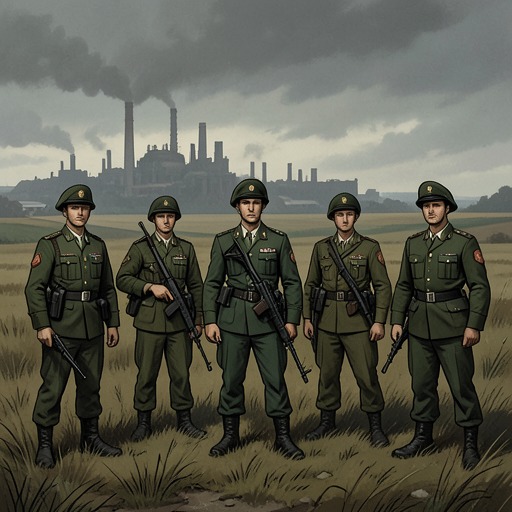
Anestesia moral tras la matanza de Klooga
Los pacientes del doctor GarcíaMoral numbness after the Klooga massacre is the condition through which Adrián Gallardo Ortega and Jan Schmitt de Wandaleer continue fighting after helping murder prisoners: Jan no longer needs to call the victims less than human, while Adrián still believes the same thing and finds that belief no longer matters to him. For Adrián, the massacre does not end with the killings. It extinguishes fear and remorse, severs him from any imagined homecoming, and leaves him expecting death as a debt to be paid. Yet that apparent indifference does not prevent another killing. At the end of the war, he murders Alfonso Navarro López to take his papers and approach Agneta Müller under a different identity. The concept thus names not the absence of consequence, but the way atrocity reshapes conscience, speech, and the struggle to survive.
The massacre and the altered language of violence
From September 20 to 22, 1944, Kleiber’s men, as they came to be called in the III Panzerkorps der SS, drank vodka through their meals and sleep while assisting the guards at Klooga with the murder of prisoners. The narrative gives the scale as approximately 550 prisoners killed per day; the men’s assigned share was 400 a day, or 1,200 in total. Intoxication accompanied the killings, but the change that follows is more than a temporary drunkenness. Jan stops feeling the need to insist after every volley that the victims are not human. Adrián continues to think they never were anything else, yet no longer cares to make the claim. Their positions differ, but both register a moral boundary giving way: the repeated assertion that had made the violence speakable becomes unnecessary.
When the unit withdraws from the Narva front on September 23, the atmosphere changes. The fierce, drunken exuberance associated with the trip to and from the killing ground dissolves at the border. The men do not speak naturally about what happened in the forest; instead, their conversations return in anxious cycles. They wonder whether Soviet forces will reach Klooga, whether bodies will be found, and whether anyone survived to identify the perpetrators. One reassurance—that Baltic Jews would not recognize German army insignia—offers relief for days at first, then only hours, before the questions begin again. The killings are not erased by silence: the repeated return of fear makes that silence evidence of what the men cannot safely put behind them.
Adrián’s silence and knowledge of guilt
Adrián does not join those conversations. He sometimes has to restrain himself from asking why his companions are afraid if they had been so certain the victims were not human. He can recognize the fear driving their questions and see it growing as final defeat approaches, but considers himself apart from their anxiety. He also feels apart from the man he once was: the other Adrián, the naive grandson of Don Carlos Garrote, who can scarcely be remembered.
His silence is not innocence or ignorance. Adrián believes the crimes will eventually be discovered: the Soviets may find the pyres of charred bones, or a prisoner may speak. He expects one of the men, perhaps Kleiber himself, to recite numbers and names. As the only Spaniard in the group, he believes he could not be mistaken for anyone else. The distinction he draws between himself and his frightened companions therefore does not remove his knowledge of responsibility. He is certain Germany will lose the war and that the killing will be exposed; the numbness lies in his inability to turn that certainty into fear or a wish to return to ordinary life.
The narrative gives this condition a stark image: Adrián understands that, though he has not physically died, he is already a living dead man. He has no country, village, or home to return to; in the Klooga forests, he has been born again alone and soaked in blood. The language of rebirth does not suggest renewal. It marks the destruction of his former self and the loss of any future in which the past can be left behind. He believes he deserves death, but fights mechanically across Latvia, Lithuania, Poland, and Germany, delaying it as long as possible. His resolve to die in Berlin is an attempt to bring his body into line with the deadness he already feels within.
The Berlin defense and the collapse of heroic rhetoric
At the final defensive ring around Berlin, a colonel urges the soldiers to defend the city street by street and house by house, promising that later generations will honor their sacrifice. The speech moves those around Adrián: tears appear in the colonel’s eyes, Lazlo weeps, and Jan sobs. Adrián, twenty-eight years old but feeling much older, notices instead the unpleasant taste of the brown liquid remaining in his cup. He watches as though he were a spectator to a scene in which he has nevertheless been assigned the leading role.
He recognizes the ceremony and gravity of the moment without believing its language. Glory, heroism, and honor seem to him a theatrical shell, cheap glitter attempting to disguise a filthy ending. Klooga has, in his understanding, taken away his capacity for fear and for any feeling more complex than hunger, thirst, heat, or cold. The order to die rather than surrender does not restore a cause to him; he expects that surrender would only postpone the payment he owes for the killings. He accepts the prospect of dying in a foreign land for a cause that is not his, and this conclusion impresses him more than the colonel’s appeal. The contrast makes his numbness legible: public rhetoric supplies meaning to the defense, while Adrián can perceive only its impending end and his own debt.
From moral numbness to another killing
On May 2, 1945, with a Soviet tank’s gun aimed at him, Adrián emerges from a Berlin shelter with his arms raised. He does not surrender alone in the sense of giving up his own identity: he carries Alfonso Navarro López’s documents and does not show the occupiers Navarro’s corpse. The distinction matters. Adrián had resolved to die in Berlin, but survival becomes possible when he sees another identity as a way to continue beyond the defeat.
His decision is tied to Agneta Müller. He knows Navarro was wrong to believe Agneta chose Jan because of race, skin, or surname; she chose him for the love Adrián lacked. But the final murder is not presented as revenge against Navarro for that mistake, nor as retaliation for the old wounds associated with him. At the instant Adrián fires, he is not thinking of the port of Bilbao, the fear that kept him from becoming Spanish champion in 1941, or Christmas Eve 1942. The narrative specifies that resentment, guilt, and fear do not move him. Instead, he acts from a love that fills his inner life and from the need to stop being himself if he is to have any chance with Agneta after the war.
The change does not amount to moral recovery. Adrián no longer wants to die without having kissed Agneta, but he also knows that his time at Klooga will sooner or later expose him. Kleiber, the other men, and the guards may be identified through the surviving witnesses or the discovery of the bodies; those left at Narva are numerous enough that someone may remember him and denounce him. To escape recognition, he needs another person’s documents. He kills Navarro for that purpose, and the new crime does not stir his conscience. The numbness that followed Klooga therefore persists as a capacity to act without moral hesitation, even when the immediate motive is intimate rather than ideological.
Narrative significance
The concept is built through contrasts between what the characters say and what they can still feel. Jan’s earlier insistence that the victims are not human falls away; Adrián retains that belief but loses the need to voice it. The surviving men’s recurring questions expose a fear that their language of dehumanization cannot finally contain. Adrián, meanwhile, understands the likelihood of exposure and punishment yet describes himself as outside the fear that governs the others. His silence is not release from guilt but a symptom of an altered relation to it.
The progression also separates numbness from simple emotional emptiness. Adrián can recognize love for Agneta and be driven by it, but that feeling does not restore concern for the person he kills to obtain a new identity. Klooga has left him both anticipating death as deserved and willing to commit another murder to postpone it. The movement from mass killing, to an expected reckoning, to the appropriation of Navarro’s documents gives the concept its tragic force: survival does not undo the atrocity or reconcile Adrián with his former self. Instead, he carries the violence forward under another name.