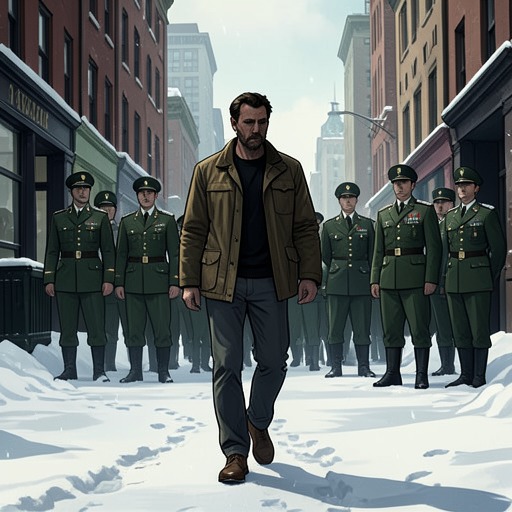
Antonio Ochoa Gorostiza
Los pacientes del doctor GarcíaAntonio Ochoa Gorostiza is a captain in the Nationalist army whose private battle with a hereditary muscular illness informs his hunger for purpose and his devotion to boxing. In Portugalete, he finds a mission in training Adrián Gallardo, converting the young soldier’s strength into a carefully prepared public contest. His method gives Gallardo a route to victory over Alfonso Navarro, but Ochoa’s interest in the fight is never merely athletic: he understands it as a symbolic confrontation between the army and the Falange, and he refuses to let his boxer lose.
Identity and Background
Ochoa is introduced in Portugalete on 18 July 1937, the first anniversary of the military uprising. His brigade has occupied the town for less than a month. The initial rush of destruction, arrests, summary trials, executions, religious ceremonies, and tributes to the dead has subsided; his company’s work has dwindled to closing offices and tearing down posters. The town had been a left-wing stronghold, but offered little resistance. Ochoa is bored with the inactivity and angry that the war continues elsewhere while his men are assigned a parade and a solemn Mass. His impatience with ceremony sounds like a complaint about idleness, but the narrative soon reveals a more intimate reason for his temper.
For a couple of years Ochoa has experienced an intermittent tingling that begins near his right shoulder blade. The sensation is not initially painful: it comes and goes, leaves part of his back numb, and has recently begun returning more often. On the morning of the anniversary it spreads down his right arm to his elbow. The progression frightens him because the Ochoa family has already endured the illness in several children. One brother died when Antonio was eight; another had been confined to a wheelchair since Antonio was twelve; and his sister Carmencita lost control of her right hand before taking an entire tube of painkillers and dying by suicide when he was nineteen. His parents and Antonio have treated him as the healthy child, the family’s remaining hope. His mother trusts in her prayers to Our Lady of Mount Carmel, his father in a fortune-teller’s reading of Antonio’s palm, and Antonio himself has believed the disease had passed him by. At twenty-eight, as he approaches marriage, the returning symptoms undermine that confidence.
The doctors know that the family’s condition is degenerative and affects the muscles: strength and elasticity disappear gradually until the limbs become unusable. They cannot identify a reliable cure. Ochoa’s father, Vicente, nevertheless reasons that weakened muscles should be strengthened. Although some specialists warn that exercise will be futile, his son begins going to the gym at ten and takes up boxing at fifteen. He never expects to become a professional, but continues training for more than a decade. The regimen began as his father’s response to a frightening diagnosis; for Antonio, it becomes a way of inhabiting a body whose future he cannot control.
War, Illness, and the Need for a Mission
Ochoa discovers that active warfare temporarily quiets his fear. On campaign, he can forget his parents and siblings. Hunger, cold, rain, mud, and the discomfort of sleeping badly in a trench make his bodily distress feel ordinary, no different from what the others endure. Orders set him moving before he can dwell on his condition, and the tension of military action fills the attention that peace leaves vacant. The return of tingling matters less while everything hurts and everyone is exhausted. In that sense, the front provides relief without providing a cure: its hardships obscure the symptoms and his thoughts about the family illness.
The quiet in Portugalete has the opposite effect. With no urgent work to occupy him, Ochoa notices the disease’s approach and grows irritable. His complaint that the army is not fighting in Madrid, La Mancha, or Aragón is therefore also an attempt to return to the conditions under which he can stop listening to his body. The story links his appetite for purposeful action to fear rather than presenting him simply as a soldier who thrives on war. When a new project appears, he expects the symptoms to leave him alone that night. His certainty that he has something to do is itself a form of temporary shelter.
Training Adrián Gallardo
That project begins when Lieutenant Barrios tells Ochoa about a soldier named Adrián Gallardo, reputed to be a very good boxer. The Fifth Brigade of Navarre has another boxer, Navarro, who has fought in official contests before enlisting, and the officers want to arrange bouts between the two men. Ochoa has not yet seen Gallardo fight, but he recognizes the value of the proposed match and takes responsibility for preparing his brigade’s fighter.
Gallardo is not the kind of soldier Ochoa usually likes. He is a clean-living, devout young man from a traditional Catholic family, does not drink or smoke, and repeatedly takes out the scapular his mother gave him to kiss it. Ochoa has found more fellowship among former Legionnaires, disreputable young men, and re-enlisted sergeants than among men like Gallardo. Yet the young boxer offers something those companions do not: a chance for Ochoa to build a team and pursue a definite goal. Gallardo’s innocence can strike him as either a sign of goodness or of foolishness, but it does not prevent him from becoming personally invested in the soldier.
Ochoa begins drawing up a training programme the same day he receives Gallardo. He requisitions a large, well-ventilated basement for a gym, releases two imprisoned Republican carpenters to construct a ring and training equipment, and goes with Gallardo to Bilbao to seize punching bags, gloves, and other supplies. He chooses sparring partners from the prisoners and available soldiers, imposing the same discipline on them as on his pupil. The preparation is organized around a demanding daily schedule: two hours of cross-country running in any weather, speed trials at the town football ground, gym work before lunch, and another two hours of exercise after a rest. The afternoon bouts become a favorite diversion for the troops stationed in Portugalete, while officers gather to watch the brigade’s new star train.
Ochoa is struck by Gallardo’s strength, though he knows that strength alone cannot make a skilled boxer. He considers the other soldier, Navarro, technically superior: faster and more elastic, with better footwork and a greater command of boxing. Gallardo, in Ochoa’s assessment, has powerful fists but is slow and poorly trained. A fair contest decided by the judges would almost certainly go to Navarro. This gap between raw force and technique is precisely what gives Ochoa’s coaching its purpose: he must use preparation, discipline, and planning to compensate for the advantages Gallardo lacks.
Gallardo, Navarro, and the Political Contest
Ochoa sees that the match is also a political performance. Navarro is not simply the Fifth Brigade’s boxer; he represents the Spanish Falange. A protégé of Sancho Dávila, he had earlier been protected by Fernando Villa Ruiz, a leading advocate of Falangist purity in Navarre. Villa was arrested after opposing Franco’s Unification Decree, which merged the legal parties in the Nationalist zone into a single National Movement. When Ochoa meets Navarro, the decree is still causing resentment among Falangists, Carlists, and monarchists, to the military leadership’s satisfaction. Ochoa recognizes that the fight will stand for the rivalry between the army and the Falange.
He thinks he might have enjoyed Navarro’s company on a night out, but that does not make him trust or admire him. Ochoa dislikes politicians and resents Falangists whom he sees as conspiring while the military wins the war. He is particularly contemptuous of Navarro’s failure to help Villa when his protector fell into disgrace. Most unsettling, though, is the fighting instinct Ochoa detects in Navarro’s eyes—the ferocity he had tried and failed to find in Gallardo. Navarro is not a good man, Ochoa judges, but he has a killer’s instinct. The match therefore places the gentler, devout Gallardo opposite a more naturally dangerous and technically accomplished opponent, with institutional prestige riding on the result.
That political weight also affects Ochoa’s conduct toward his own champion. Gallardo worries about hurting opponents who are on his side, asking whether he should hit them hard or hold back. He can accept striking a Republican, but hesitates when the opponent is one of their own, a good fellow whom he knows. Ochoa’s training builds discipline and performance, yet it does not erase Gallardo’s reluctance to treat every fellow soldier as merely an obstacle. The contrast sharpens the moral texture of the boxing project: Ochoa plans for victory, while Gallardo remains troubled by what that victory requires him to do.
The Bilbao Bout and Ochoa’s Methods
Before the decisive contest, Ochoa tells Gallardo that he must win and assures him that he has already arranged the conditions. The spectators will be on the quay, the two corners will face away from the crowd, and the higher barge will obscure the ring from the boats anchored in the estuary. The details turn the bout into a managed operation. Ochoa does not rely on Gallardo suddenly becoming the better boxer; he plans around what the audience can see and where the fighters will be positioned.
Gallardo holds his own through the first four rounds, better than his protector expected, although Navarro gives him a severe beating. Navarro’s speed, elasticity, and superior technique leave him with the advantage, and a judges’ decision would almost certainly award him the contest. After the fourth round, while Gallardo’s eyebrow and lower lip are being treated with Vaseline, Ochoa frames the boxer’s face in his hands, looks him in the eye, and gives him a single instruction: now. The clipped command is the culmination of months of training and the concealed arrangement of the venue.
At the bell Gallardo moves toward the side of the ring facing the estuary. Navarro follows, trying to trap him against the ropes, but Gallardo slips free, clinches, and turns quickly when the referee separates them. Navarro throws his right hand, unaware that Ochoa has manoeuvred him into the chosen position with the ropes behind him. Gallardo dodges and strikes him in the groin, shielding the action with his own body. Navarro falls at once. The result gives Ochoa the victory he promised and protects his brigade’s prestige, but it is not a straightforward triumph of superior technique: Ochoa has secured it through deliberate positioning and a concealed foul. His role joins the discipline of a trainer to the calculation of a commander, turning a boxing match into both a personal mission and a managed contest between rival political forces.