Berlin
Los pacientes del doctor GarcíaBerlin is the novel’s ruined capital, a place where defeat turns survival into an act of borrowed identity. Adrián Gallardo enters it in April 1945 intending to die, but emerges from the battle carrying papers taken from Alfonso Navarro López; in the hungry postwar city, he finds Agneta Müller again and builds a precarious life inside the household of her husband, Jan Schmitt. Berlin is at once a battlefield, a prison, and a shelter—never a setting that lets its survivors leave the past behind.
The city at the end of the war
Adrián reaches Berlin on 2 April 1945 after fighting through Latvia, Lithuania, Poland, and Germany. He has come not expecting rescue but seeking the last possible limit of his own destruction. What he finds is an immense field of rubble: hollow, collapsed buildings; streets buried under debris; and the debris itself turned into trenches. In this landscape, he sees a fitting place to say farewell to the world, because the Reich’s capital embodies the defeat he has been moving toward.
The city’s ruin does not belong to Adrián alone. On 25 April, Agneta Müller hears air-raid sirens near the Brandenburg Gate. Her first impulse is to keep walking and die under the bombs, but a soldier calls to her from a makeshift trench built of paving stones on Wilhelmstrasse. She stops, then runs to him. By taking shelter there, she finds herself participating in Berlin’s defense, and death loses its immediate urgency. The city’s collapsing defenses briefly redirect a life that had seemed already surrendered.
On 2 May, a lone Soviet tank advances along Unter den Linden toward the Brandenburg Gate. From a position at the corner of Wilhelmstrasse, the two remaining occupants watch it approach. The tableau brings the city’s battle to its endpoint: the defenders’ resistance has lasted an agonizing extra day, and only when the tank points its gun directly at their position does Adrián emerge with his hands raised. Berlin’s military defeat ends his immediate fight, but it does not settle what he has done or who he will become.
Survival under borrowed names
Adrián does not surrender alone. He carries the documents of Alfonso Navarro López and does not show the occupiers Navarro’s corpse. His escape into a false identity is not a clean break: he has participated in the Klooga massacre and understands that surviving witnesses may eventually identify the men responsible. Taking Navarro’s papers gives him a chance to disappear, but it also makes Berlin the starting point of a life built around concealed responsibility.
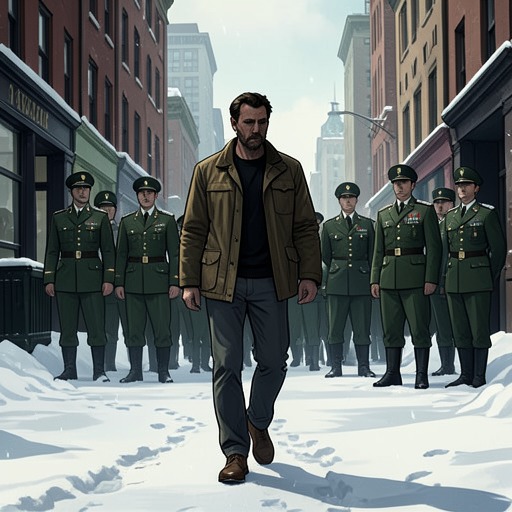
Nearly two years later, the man released from prison as Alfonso Navarro leaves his last cell, braces himself against the wall, and closes his eyes to breathe. After crowded cells and a yard so packed he could not make out its boundaries, open space makes him dizzy; people waiting for a bus barely notice when he vomits at their feet. His promised trial has not taken place. After Soviet custody, he was transferred to a western-zone prison, where an International Red Cross representative tells him that, as a citizen of a neutral country, he can be repatriated. The offer threatens the fragile protection his assumed identity provides, so Adrián persuades the priest Father Schulze to help make his refusal appear credible. He claims that returning to Spain would expose his role in repression there, including ordering the execution of people from his own family, and adds that a Berlin girlfriend gives him a reason to remain. The account keeps him in Germany and out of court, though it does not make him secure.
Once released, he reaches Schöneberg carrying little more than a bread roll and an uncertain future. He asks a woman at a doorway whether Agneta Müller lives there, not knowing that she is the well-known Roswitha. She tells him that Agneta is now Frau Grunwald, married, and that her husband should soon be home from work. The answer returns him to the life he left behind without restoring his place in it: Berlin offers him a route back to Agneta, not a return to the past unchanged.
Postwar refuge and its limits
Berlin’s surviving routines are shaped by hunger, cold, and scarcity. Adrián seeks food and small jobs through church connections; a sacristan gives him errands in exchange for food or a few cents, while the Salvation Army’s soup kitchen is a regular stop. During winter he is dirty, underdressed, and so cold that he considers returning to Spain even if prison or execution awaits him. He attends confession every few days, rests for hours in the cathedral, and is often allowed to sleep inside. At Christmas he leaves only at midday to queue for the soup kitchen. This devotional routine is also an improvised strategy for conserving strength and staying alive.
His circumstances change when Jan Schmitt, now working as a municipal policeman, recognizes him across the street on 23 December. Jan calls him by his old boxing nickname, Tigre. Adrián collapses before he can answer; when he regains consciousness, Jan is still there, amazed to have found him. The recognition cuts across the aliases that have kept Adrián alive. Yet the welcome does not undo the danger of his history: his return depends on the loyalty of a former comrade who knows him as a person, while the city around them remains a place where food, work, documents, and safety are all uncertain.
Agneta, Jan, and the life after defeat
Agneta’s own postwar life is inseparable from the household she rebuilds with Jan and her parents. On 30 April 1945, she hides Jan in a small storeroom reached through the courtyard, then returns to the family apartment and is received by her father and Beate without reproach. The three share boiled cabbage and a little bread; Rudi gives Agneta his portion after seeing how quickly she eats the one she had saved for Jan. Her family’s welcome is intimate and materially spare, a contrast to the grand political loyalties the war has destroyed.
Rudi accepts Jan’s presence on the condition that Agneta says he is an ordinary soldier without criminal responsibilities. She tells the truth as she knows it: she has never heard of Klooga. Beate supports the fugitive as a final way of serving the Reich she had loved before history swallowed it, while Rudi never develops the same sympathy for him. Jan, meanwhile, makes himself useful by repairing lamps and furniture, joining wires, and painting the house. His work is often clumsy, but it earns him some neighborhood customers and helps him inhabit a precarious postwar domestic life.
By the end of 1945, Jan is still searching unsuccessfully for steady employment and conceals from Agneta and her parents that he presents himself as undocumented so nobody will record the number of his Argentine passport. He has stopped using his Belgian passport, which he had thrown into the same fire where Adrián burned his identity. The household thus shelters more than one kind of fugitive: Berlin’s new domestic order is assembled around concealed papers and unspoken histories.
In the years that follow, the Grunwalds move to Luitpoldstrasse after Beate’s death in 1947. Her health had worsened after a severe bout of pneumonia, and her weakened heart finally stops while she sleeps. Rudi lets Agneta choose between keeping the Winterfeldtstrasse apartment or using its sale to buy another. He later moves near the Kurfürstendamm to live with his girlfriend under the respectable appearance of a paying guest. Agneta sees him less, but recognizes that he continues to love her as before. Berlin’s reconstruction is not a simple restoration: homes change hands, families lose members, and intimacy persists through altered arrangements.
Memory, return, and the afterlife of the ruins
In 1949, Berlin’s personal histories surface through small domestic scenes rather than public ceremonies. Agneta, now a wife and mother, sometimes remembers the young woman who sang the Horst Wessel Song among the rubble of Unter den Linden, with her blouse torn and her heart inflamed by devotion to the Führer. The memory embarrasses her; she has become someone different, and she sometimes regrets having married a man who witnessed her former self. The city’s ruins remain present in the person she no longer wants to be.
Adrián’s visits bring that past into the Grunwald home again. On his birthday, he gives Agneta a bracelet made from the linked pieces of a broken gold-colored mesh necklace he bought from an old woman selling trinkets at a subway entrance. She wears it through the summer, including at the Wannsee cottage Jan shares with a police colleague. The gift awakens her curiosity about whether she chose the wrong man, even as she tries to shut that question away. Later, after Jan fails to bring home a Christmas tree, Adrián comforts her and then arrives with a large fir. As he helps set it up, he hums the song associated with Schöneberg. The song, the bracelet, and the tree make the old city’s wartime loyalties and attachments recur in the rebuilt household, where affection can offer warmth without resolving what it has cost.
Berlin is therefore more than the place where the war ends for Adrián. Its devastated streets furnish the setting for his attempted death, his escape into Navarro’s identity, and his eventual return to the people from whom he fled. The postwar city offers shelter through kitchens, churches, work, and family ties, but those forms of refuge remain provisional. Even as homes are repaired and a child grows up, the ruins persist as remembered choices, concealed names, and relationships whose consequences have not disappeared.