Café de los Angelitos
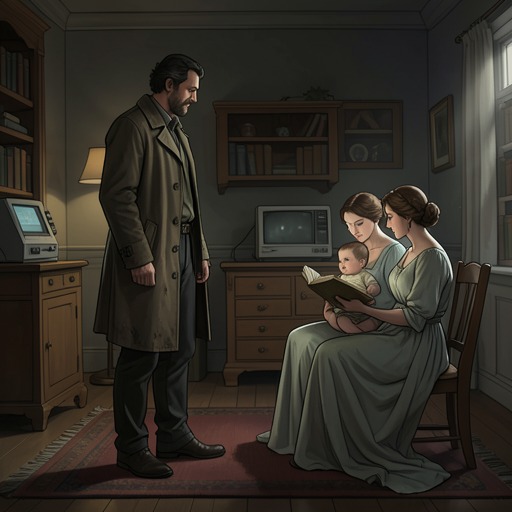
Los pacientes del doctor GarcíaCafé de los Angelitos is a Buenos Aires tango café that becomes a provisional home for Manuel Arroyo Benítez and the setting where his patient courtship of Simona Gaitán turns into love. First encountered through his landlady’s memories of dancing there, it draws him from isolation into a community of music, regulars, and repeated encounters; at its tables and bar, protection and affection change the course of his unsettled life.
Identity and reputation
The café is introduced to Manuel through Doña Encarnación, his landlady, whose stories accompany the substantial meals she cooks for him. She recalls going there on Saturday nights with her husband, Santiago, when she was twenty-two. The tables nearest the stage were moved aside so customers could dance tango, and competitions were held. She and Santiago won first prize twice; one time, the musician Aníbal Troilo served as a judge. The trophies she still keeps in a display case preserve the memory of the young woman she once was, a skilled dancer who contrasts sharply with the aches and complaints of her present life.
That recollection gives the café a history that is personal as well as public: it is the place where Encarnación’s youthful dancing, marriage, and remembered bodily confidence remain visible in the trophies. For Manuel, still largely confined to his room and the work of preparing classes, her account offers the image of a living social world outside his narrow routine. The café is not merely a venue mentioned in conversation; it is a destination already charged with someone else’s remembered happiness.
Setting and musical life
When Manuel finally visits on a cold, rainy Saturday evening in June, the café is crowded and animated, its Saturday-night bustle sharply unlike the empty room he later sees in daylight. Its little tables and large interior retain something of the rough dance hall it had been decades earlier. A police commissioner had given it a name that ironically referred to the criminal regulars who once frequented it. In the present, light, movement, dancing couples, and tango give the room the feeling of a vessel carried along by music.
The ensemble is old, but its performance is vigorous. A white-haired pianist in a worn tailcoat plays beside an elderly bandoneon player in a red shirt and a leather vest bristling with metal insignia; a woman in a sequined dress plays the cello. Their aged appearance initially suggests decline, yet the musicians have been together so long that they need not look at one another to enter in time. Their music exceeds the sum of their years. The café’s defining contrast is already present: bodies and surroundings bear the marks of age, while the tango they make remains forceful and alive.
Regulars and Simona’s place
The café is woven into the neighborhood’s relationships. Simona grew up there because she loved tango and her parents’ restaurant stood a block away; her parents were friends with the café’s owner. She is the owner’s goddaughter and the niece of Professor Peroni, the pianist. Peroni performs with his wife, Doña Berta, the cellist, and Simona used to come to the café with them almost every night. The music, then, is not an incidental attraction: it belongs to the place’s network of kinship, familiarity, and long practice.
Manuel first notices Simona after taking a drink at the bar and drawing nearer to hear the musicians. She stands apart from the other women in her short dark hair and unadorned face, then dances while he watches from his place. The waiter Artemio warns him that she bites. Rather than treating her hostility as a simple personality trait, Manuel comes to understand it as fear and as a deep wound. He does not try to force a dance or press her to respond. He stays at the bar, watching night after night, while Artemio and other regulars become informal supporters of his cause.
The bar as a place to belong
After months of visits, Simona approaches Manuel and asks whether he ever tires of sitting there. His answer is that he does not tire of her. She refuses his offer to buy her a drink, but later raises her glass toward him from her usual table, and he returns the toast. The exchange is small, yet he experiences it as a victory. From then on, they see one another nearly every day. Even on evenings when he has other commitments, including meetings at Kutschmann’s house, Manuel makes sure to appear at the café before or after them, sometimes both.
His place at the bar becomes a fixed point in a life otherwise marked by movement and false identities. He watches Simona dance with other men without abandoning his position. Later, when Clara Stauffer invites him to accompany her to Peru and Bolivia, he refuses in part because of Simona and because leaving Buenos Aires would mean leaving the café. The forty-five square centimeters of his barstool feel more like home than his room at Doña Encarnación’s. When Clara’s car departs, Manuel quickly searches for a ride back, enduring the long hospitality of an evening that proceeds from a meal to more food and drink before he finally gets away.
Protection, love, and transformation
On the night Manuel returns late, the café is again packed, the orchestra is playing, and couples are moving across the floor. He has come to see Simona, not to drink or dance. At her usual table, he finds a drunken young man leaning over her and trying to force her to stand. She clings to the table with one hand and resists. Manuel crosses the room, grabs the assailant from behind by the collar, and pulls him to the floor. With the music stopped and the dancers gathered around, he pins the man beneath his foot and insists that Simona wants nothing to do with him. When the man finally agrees to leave her alone, the music resumes and a path opens through the crowd for his escape. The surface of the evening returns, but the encounter has changed what the café means to them.
Simona looks at Manuel and asks why he has to make things so difficult for her. He takes her hand and kisses it, then starts to leave; she stops him, offers him the empty chair beside her, and asks whether he knows where Fortín Tiburcio is. Her bitter smile and question open a different conversation from the one their courtship has allowed. Eventually she asks why he wants a woman like her and warns that she cannot give him what other women might. She never finishes. Manuel leans in to kiss her, and she answers the kiss as the café erupts in applause, with Artemio striking two serving trays together like cymbals.
Their relationship enlarges the meaning of the place. Manuel’s imagined home had been reduced to a barstool; with Simona, it grows to encompass her body and the mutual tenderness she had gone without. The café has provided the repeated proximity through which he learns to see her fear beneath her harshness, and the shared public room now witnesses their private turning point. It is where his perseverance becomes more than observation: at last, Simona accepts his closeness, and the regulars’ applause makes their change visible to the community that helped bring it about.
Narrative significance
Café de los Angelitos stands between refuge and renewal. Its music links Encarnación’s remembered youth to Simona’s lifelong attachment to tango, while its worn performers embody the persistence of artistic life beyond youth. For Manuel, the barstool offers a modest, tangible substitute for the home, vocation, family, and even name he feels he has lost through years of borrowed identities and lodging. Yet the café does not resolve that history by itself. It gives his longing a place to gather and a community in which to be witnessed; his bond with Simona makes that temporary refuge feel capable of becoming a future.
That significance is sharpened by the contrast between the café’s old rough reputation and the living intimacy of its present. The room that once gathered criminals now gathers dancers, musicians, waiters, and people who recognize when someone needs help. Its remembered competitions, familiar tables, repeated toast, and sudden interruption of the music give the café a continuity that Manuel’s itinerant life lacks. When the orchestra resumes after the assailant leaves, the room sounds as before, but its social order has been tested and renewed: Simona is no longer alone at her table, and Manuel has found a place where his persistence can become belonging.