Canadian Institute of Blood Transfusion
Los pacientes del doctor GarcíaThe Canadian Institute of Blood Transfusion is the service that Norman Bethune and his collaborators established in Madrid during the Spanish Civil War. By collecting blood from volunteer donors, preserving it in refrigeration, and carrying it to the front in portable equipment, the Institute made transfusion possible without bringing donor and recipient together. Its work links a new medical practice to the people sustaining Republican Madrid: the volunteers who answered its appeal and the soldiers whose lives could be saved by blood stored and transported for use when needed.
Establishment and Premises
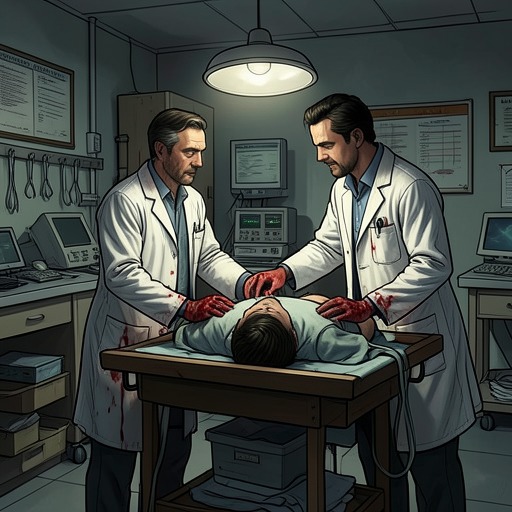
Bethune arrived in Madrid on 14 December 1936 as a Canadian volunteer offering his services to the Madrid Defense Council and the Government of the Spanish Republic. The authorities provided a fifteen-room apartment at 36 Príncipe de Vergara Street, formerly occupied by a German diplomat who had left after the military uprising. The International Red Aid office was located on the floor above. Bethune and his collaborators quickly transformed the residence into a medical laboratory, removing its furniture, pictures, and carpets to make space for equipment and supplies. The rooms held an Electrolux refrigerator, a large autoclave, sterilizers, glassware, blood bottles, instruments, serum, and gas masks. The Institute’s most distinctive resource, however, was a set of fifteen portable transfusion packs. Each pack included additional bottles, saline and glucose solutions, and a sterilized kit containing a towel, forceps, a knife, a syringe, and suturing thread. This arrangement joined a fixed collection and preparation site to the capacity to take supplies to patients beyond the apartment.
Donor Campaign and Blood Storage
The Institute began its public appeal the day after Bethune’s arrival. Newspaper advertisements and radio announcements over three days asked Madrileños to donate blood for soldiers at the front. At the time, transfusions generally required a direct connection between donor and recipient. The Institute’s project aimed to preserve blood so that it could be transported and administered later, but the organizers did not know how many people would respond or how long citrated blood could safely be kept. The response quickly exceeded expectations. When donations were due to begin on 19 December, volunteers were already queuing around the corner before the Institute opened. The donors included civilians and military personnel of different ages and occupations, with women more numerous than men. After confirming that donors had fasted, staff collected half a litre of blood, added sodium citrate, and labeled each filled bottle with the blood group, collection date, and donor’s identity. Donors received a food voucher and a drink of brandy; as the siege made food scarcer, the Institute would give a tin of beef for each donation. Within a little more than three days, the collected bottles had filled the largest refrigerator available, even as people continued to queue each morning outside the apartment. Bethune reported uncertainty about how long the citrated blood would remain in good condition, while hoping it would last several weeks. The crowded refrigerator thus registered both the campaign’s success and the practical problem the Institute had to solve: organizing a substantial supply of blood that could remain usable until the need arose.
Portable Transfusion at the Front
On 23 December, the Institute’s equipment was put to use at the Hospital de Sangre de la Casa de Campo, near the front. Bethune’s team filled the portable equipment’s bottles with blood from all groups, loaded the packs into a truck, and travelled to the hospital. There Bethune selected a soldier suffering from severe blood loss, after a Spanish doctor had considered him beyond help. The team determined the patient’s blood group and began the transfusion, giving a second bottle when the first was not sufficient. That intervention became the novel’s defining demonstration of what the Institute had been organized to accomplish: refrigerated blood could be carried to a wounded soldier instead of requiring a donor to be present and directly connected to him. Bethune’s work that morning revived twelve soldiers at the Casa de Campo hospital. The first survivor’s name is not known. His comrades marked his return to life by giving him a cigarette, while those present celebrated the contribution of Canada, Bethune, the Republic, working-class struggle, and international solidarity. The scene gives the Institute’s technical achievement a collective setting: its work depended on donors, medical staff, portable supplies, and the people who received the blood.
Influence Beyond the Institute
The Institute’s method also shaped the work of doctors elsewhere in Madrid. After news of the Casa de Campo transfusion reached the Hospital de San Carlos, Doctor Quintanilla devoted himself to obtaining a smaller transfusion unit for his own department. He could not persuade the hospital’s conservative administration, but continued to press for the equipment, anticipating that renewed fighting would make the need urgent. His response shows that the Institute’s significance in the novel lies not only in the patients treated by Bethune’s team, but also in the example its service offered to other medical workers. The Institute stands at the intersection of innovation and responsibility. Its blood service turned voluntary donations into a resource that could be stored, identified, and moved toward the wounded. In a besieged city, the queue outside its premises and the portable packs sent to the front form two parts of the same system: civic participation supplying a medical effort designed to reach people where direct transfusion was impractical.