Carabanchel Prison
Los pacientes del doctor GarcíaCarabanchel Prison is the setting for a carefully disguised reunion between Rafael Cuesta and his imprisoned son, José Antonio Urbieta Priego. The visit depends on forged legal credentials and a narrow, supervised channel of communication; within its twenty-five-minute limits, the prison becomes the place where a concealed parentage can be discussed and a relationship begins to take shape.
Entry Under an Assumed Identity
Rafael gains access on 26 October 1968 by presenting a convincing imitation of a Madrid Bar Association card borrowed from Ángel Valverde Roldán, along with a court paper identifying its holder as the defense lawyer for José Antonio Urbieta Priego. The card is so well made that, according to Ricardo, Valverde himself never believed it was false. A forged professional identity, rather than Rafael’s own history, satisfies the prison’s admission requirements.
The deception places Rafael inside an institution whose records and procedures ordinarily make people legible to the state. Here, however, the paperwork is turned to a private purpose: the false lawyer’s card opens a door that Rafael could not have entered under his own name. His clandestine medical work has already made him suspect that the Communist Party is the only organization in Spain that functions effectively; the practical help that makes this visit possible confirms that impression for him.
The Visiting Room
Before they enter, Ricardo explains the arrangements. Lawyer visits take place not in the general visiting area but in a small room divided by a partition with a little window. A prison official remains on the prisoner’s side, usually leaving the door open after the visitors sit down. Speaking quietly should allow father and son to hear each other without attracting notice. To give their conversation cover, Rafael is to hand over a folder and say aloud that it contains documents for review.
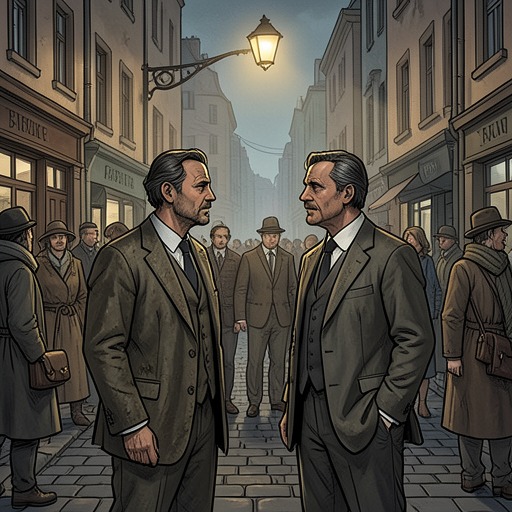
The room is number three. A guard checks Rafael’s papers, notes the time on a form, and grants him twenty-five minutes. The space is small, its walls bare and peeling and its floor dirty. The smell of boiled vegetables recalls Rafael’s wartime memories of the lower floors of Hospital de San Carlos. Before he can bring himself to look through the barred opening, he registers these details; when he finally does, he sees his son on the other side, older in appearance than the reflection he has carried in memory.
The first exchange is mostly gesture and hesitation. Rafael lowers his eyes to the chair and sits; when he looks up again, José Antonio has stretched out his right arm and placed an open hand against the grille. Rafael takes it for a greeting but has not yet decided whether to return it when his son speaks. The barrier enforces the prison’s separation even as the hand against it offers a tentative connection.
Repeated Visits and a Family Secret
The visit is not a single encounter. Three weeks after his arrest, in mid-June 1968, José Antonio is sentenced by the Tribunal of Public Order to eight months and one day for calling and participating in university assemblies. From 26 October 1968 until his release on 12 February 1969, with the customary extra days served, Rafael visits him at Carabanchel about six times. Each appointment is nominally twenty-five minutes, though the supervising officer’s discretion sometimes cuts it short and sometimes lets it run beyond half an hour.
The visits give father and son time to speak despite their confinement and the strained arrangement. José Antonio recounts how he began to suspect that his family resemblance did not fit: he looked unlike his Priego cousins and unlike the fair-haired Urbieta in the portrait above the piano. Seeing Rafael’s photograph helped him make the connection. A remembered remark from a girl he wanted to take dancing—that with straight hair he would look like El caballero de la mano en el pecho—had once seemed familiar without revealing why. The prison conversations allow him to join that memory to the likeness he recognizes in the photograph and to understand that his apparent family history is not the whole story.
A Site of Confinement and Recognition
Carabanchel’s role in the novel is defined by the contrast between state control and intimate disclosure. Officials inspect credentials, record arrival times, supervise the meeting, and limit its duration; Rafael and José Antonio nevertheless use the narrow opening in the partition to begin a conversation that reshapes their understanding of one another. The prison does not remove the risks surrounding their meeting, but its procedures make the encounter’s conditions concrete: a borrowed professional identity, a folder used as cover, a guard at the door, and a clock marking the minutes.
The same place is also associated with other forms of hidden custody and threatened identity. In an earlier episode, a wounded Rafael Cuesta is brought to an infirmary as a presumed corpse; after a credential identifies him as connected to the Madrid Defense Council, a police commissioner instructs the commander to bury him as an unknown man if he is dead, or save him without registering him under his name if he survives. Elsewhere, Sole’s visits to her brother at Porlier Prison place Carabanchel within a wider landscape of detention and political vulnerability. Against that background, Rafael’s later entry as a lawyer and his son’s emergence from behind the grille give the prison a particularly charged function: it is both an instrument of confinement and the setting where a suppressed family truth becomes speakable.