Central Intelligence Agency
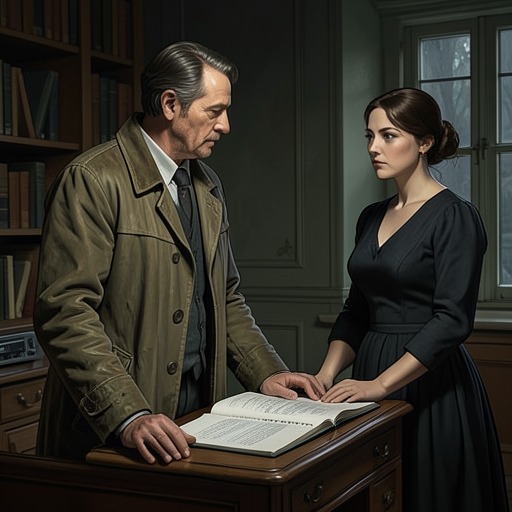
Los pacientes del doctor GarcíaThe Central Intelligence Agency (CIA) in the novel is both an intelligence service and an instrument of Cold War pragmatism: it investigates Nazi escape routes, recruits former Nazis for anti-Soviet purposes, and gives Manuel Arroyo Benítez a cover identity and operational support in Madrid. Its involvement opens a route into Clara Stauffer’s network, but the agency’s strategic accommodation with Franco’s regime repeatedly complicates the hope that evidence of Nazi crimes will produce consequences for Spain.
Intelligence Work and Cold War Priorities
The CIA’s presence first emerges through Robert McKay, an American contact whom Arroyo meets while working under the identity of Peter Louzán Valero. McKay presents himself as an independent commercial agent temporarily connected to the United States consulate, ostensibly exploring opportunities to export Spanish raw materials not subject to the blockade. He offers a detailed account of his commercial work, but Arroyo recognizes that the explanation is a cover: McKay is an intelligence agent, just as Arroyo is concealing his own identity and purpose. Their exchange establishes the agency’s preference for deniable, commercially framed activity rather than overt intelligence work.
The novel places that covert contact against the strategic value of Spanish wolfram. Peter Louzán’s cover story gives him a plausible reason to report on deposits that had supported Hitler’s wartime effort and have acquired new significance with the prospect of conflict with the Soviet Union. His fabricated family history also gives him an opening to criticize Franco. McKay hears that the Louzán and Valero families supposedly paid dearly for their loyalty to the Republic, yet answers that Franco is useful because he is Stalin’s enemy. The agency’s operative does not dispute the suffering described to him; he makes clear that it does not outweigh the new anti-communist calculation. In that exchange, political intelligence and political allegiance pull in different directions: the information concerns Spain, but the governing priority is the contest with the Soviet Union.
That priority shapes the CIA’s wider policy in the book. The Allies are recruiting former Nazis to build an anti-Soviet position, even as Nazi escape networks are moving fugitives toward South America. The agency is aware that Argentina is a likely destination for those avoiding international prosecution. Its interest in the escape routes therefore does not amount to a consistent campaign against former Nazis: intelligence about fugitives exists alongside a policy that can employ their skills against the Soviet Union. This contradiction provides the political setting for the novel’s attempts to gather evidence against the Franco regime.
The Stauffer Network and the Case for Exposure
The investigation into Clara Stauffer’s operation depends on information carried through personal and institutional links. Sole Ruiz, who had worked in Stauffer’s Madrid household, notices that the house at Galileo 14 changes in the summer of 1945. Stauffer has rooms converted into an office, a new telephone line installed, and secretaries hired. New male visitors arrive, thin and exhausted; they receive food, clothing, and assistance, but do not stay overnight. Sole suspects they are fugitives, and her suspicions deepen when a Spanish soldier repeatedly brings sealed envelopes bearing Madrid parish letterheads. One envelope left unsealed contains a German baptismal certificate dated 1907. That observation gives the investigation a concrete lead: the network may be using church records to furnish fugitives with Spanish identities.
The trail extends beyond Madrid through Meg Williams and the New York lobby represented by Sal Burnstein. Meg recognizes Jean-Jules Lecomte’s name and identifies him as a fanatical Nazi who belonged both to the Rexist Party and the SS, and who served as burgomaster of Chimay during the occupation. Burnstein has been investigating escape routes without finding firm evidence of a stable organization. Meg’s information persuades him that Stauffer’s network is an organized operation, while Arroyo and his Republican contacts see a possible political use for proof that Franco’s Spain shelters war criminals responsible for the genocide of Jews.
The suspected route to Argentina is built from several kinds of evidence, but remains unproven at this stage. The CIA, Burnstein, and Meg regard South America as the destination sought by fugitives escaping international tribunals. Argentina is especially significant because the Perón regime is the only one that disregards the blockade and sends Spain ships carrying grain and frozen meat. Stauffer is believed to provide fugitives with Spanish documentation through parish baptismal records and contacts in the state administration, then help them onward. The novel distinguishes this strong suspicion from a demonstrated case: names, certificates, visitors, and transport links point toward a route, but its full operation still needs confirmation.
For Arroyo and his allies, proof could have consequences beyond the arrest of individual criminals. They reason that public evidence of Francoist protection might force the Allies to break relations with Madrid and make intervention harder to avoid. But the testimony of a domestic worker alone cannot establish the identities of Lecomte or Horst Fuldner, confirm that Argentine visitors act for Juan Perón, or prove that Stauffer does more than provide Germans with clothing and meals. The CIA investigation and the Republican political objective thus overlap without becoming identical: both need reliable intelligence, while the latter hopes to use it against the regime itself.
Arroyo’s Infiltration and Agency Cover
The operation in Madrid is authorized through a divided chain of knowledge. Pablo de Azcárate tells Arroyo that Burnstein has been in communication with him and can arrange limited cover through the American Embassy. Meg is due to take up a post as vice-consul of commerce on October 1, and her intelligence contacts can provide Arroyo with an American passport. The CIA has approved the mission, officially to collect information about Nazis living in Spain and the organization sheltering them. Its senior officials, however, do not know that Arroyo is also working for the Republican side or that his deeper assignment is to penetrate Stauffer’s network.
That separation of purposes makes Arroyo useful and vulnerable. He is to pose as a Spanish Nazi war criminal, probably a former member of the Blue Division who continued fighting as an SS volunteer and became implicated in a crime serious enough to require escape. He must find a safe way to approach Stauffer rather than simply appear at Galileo 14, where an exposed approach could get him killed. The objective is not merely to gather names in Spain: if events permit, the trail should carry him as far as Buenos Aires. The CIA supplies a passport and official cover, but the most dangerous part of establishing contact remains Arroyo’s responsibility.
His day-to-day work at Galileo 14 turns access into an intelligence-gathering routine. After obtaining employment, he makes himself useful to the secretaries: he brings them the newspaper, shares coffee, and volunteers to run errands. When their workload increases as his vacation begins on June 15, he becomes, in practice, another office secretary. The ordinary errands are connected to the same documentary system that sustains the escape operation. He saves his small weekly allowance, buys a pocket notebook and pencils on Eloy Gonzalo Street, and is sent to collect a baptismal certificate for José Pacheco Hernández from the sacristy of the parish near the Iglesia roundabout. He is not told that the certificate will be used to create his own papers. The cover identities—Arroyo, Adrián Gallardo, and José Pacheco—make the act of collecting documents part of the very machinery he is trying to investigate.
The CIA’s formal and informal presence in Madrid also shapes the limits of the mission. Meg’s position offers a measure of protection, while the agency can present Arroyo’s work as intelligence collection about the Nazi population in Spain. Yet that cover does not erase the divergence between his assignment and the American service’s broader political agenda. The agency’s senior officials are unaware of his parallel work for Azcárate and his Republican associates; the mission operates through concealment not only from Stauffer’s network, but also from the institution that has approved it.
Evidence, Recruitment, and the Cost of Cooperation
The novel later gives the CIA a more direct connection to Arroyo’s accumulated evidence. After he presents his work, it is praised, and the agency attempts to recruit him. Arroyo refuses. The response confirms that the institution values his intelligence, but does not establish that it will act on the political case he hoped the information might support. His account of the recruitment is paired with his recollection of what he kept: a copy of his report in a blue folder, which he touches carefully as he explains why he did not send it to Azcárate or destroy it.
The folder survives because Arroyo’s relationship with the evidence changes over time. At first he fears that retaining a copy may bring danger. Later, after marrying Simona, he installs a safe in a wall and stores it there for years. When Juan Perón falls in 1955 and Argentine Nazis lose some of their protection, Arroyo is relieved that he did not destroy the document. He considers sending it to Simon Wiesenthal or another Nazi hunter, but believes publication could expose his family: the Nazis in Buenos Aires know him, and might find him. He also doubts that arrests in Argentina would alter anything in Spain, where Franco could laugh off the revelations. The CIA’s praise and recruitment attempt therefore sit beside a larger failure of consequence: intelligence can be valued as a personal asset even when the political outcome Arroyo wanted remains unattained.
The report’s surviving pages connect crimes and identities across national borders, but they also include a wound Arroyo cannot separate from his investigation. Among the names, dates, and accounts of deportations and killings is Adrián Gallardo, the man Arroyo killed to save his own life and that of his friend. In the dossier he is only one victim among many; in Arroyo’s memory he remains the person whose death continues to torment him. The intelligence file is both evidence against a network and a record that places its investigator inside the moral history it documents.
The CIA’s role is consequently marked by a persistent double edge. Its contacts help expose the Stauffer operation and sustain Arroyo’s infiltration, but the agency’s strategic approach to Spain is shaped by the same anti-communist realpolitik that permits Franco to remain useful. When Arroyo later recalls that the CIA tried to recruit him, his refusal registers not simply as personal independence but as distance from an institution whose interest in his information has not overcome his judgment that the evidence would not bring justice. Through the agency, the novel links clandestine intelligence, documentary proof, and the limits imposed by Cold War alliances.