Comité de No Intervención en España
Los pacientes del doctor GarcíaThe Comité de No Intervención en España is the London-based committee charged with enforcing non-intervention during the Spanish Civil War. The novel presents it not as a neutral safeguard but as a mechanism whose inaction left the Republic to document violations without stopping them, making its name a bitter measure of the distance between diplomatic promises and political action.
Establishment and Mandate
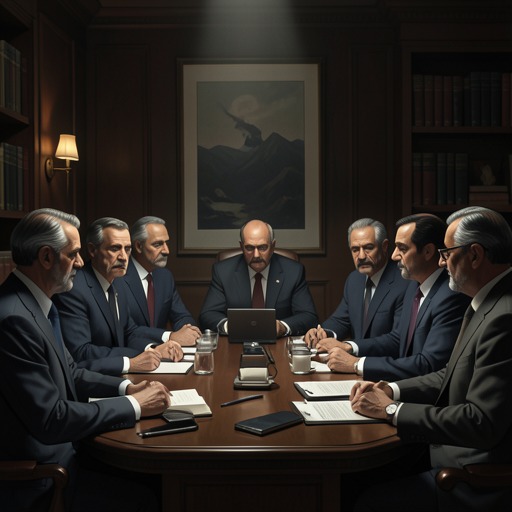
In September 1936, the committee had been operating in London for about a month. Pablo de Azcárate served there as the Republic’s representative, in practice dealing less with ordinary embassy business than with the committee and its response to the war. The agreement was meant to constrain foreign involvement, but Berlin and Rome repeatedly assisted the rebel side.
Manuel Arroyo Benítez’s task was to report those breaches. His evidence concerned Johannes Bernhardt and HISMA, Ciano and Italian volunteers, and deliveries of aircraft, troops, and ammunition. These were not merely suspicions: Arroyo repeatedly brought forward evidence of aid that contradicted the agreement.
Failure to Enforce Non-Intervention
The committee did not respond to the violations during the remainder of the war. Lord Windsor-Clive, its director, did not consider Arroyo’s evidence reliable, sufficient, or definitive. The repeated demand for proof therefore became part of the failure itself: the Republic could identify the assistance and submit its case, but the body charged with addressing it declined to treat the evidence as grounds for action.
The novel renders this work through the image of being handed a small bucket and ordered to empty the sea, while an idle audience watches for amusement. The image captures both the scale of the task and its political futility. At meetings and social occasions, labor, socialist, and social-democratic figures could be moved by Arroyo’s account and promise solidarity; their emotion did not translate into practical help. Diplomatic civility required him to conceal his anger even as he continued making the case.
Arroyo’s Work and Its Afterlife
The committee’s inaction shaped Arroyo’s experience beyond the London posting. After the Republic’s defeat, Pablo de Azcárate asked him to keep working for the exiled government through unofficial channels. Arroyo had already grown distrustful of declarations of sympathy that led nowhere, but Azcárate insisted that maintaining pressure and learning what was not said at public receptions remained necessary. Arroyo continued the work despite asking once to be relieved.
At the 1945 San Francisco conference that founded the United Nations, Francoist Spain was excluded and republican politicians were invited as observers. This was a diplomatic success in a limited sense, but it did not restore the Republic or remove Arroyo’s distrust. The experience of London had taught him to distinguish formal gestures from effective solidarity: exclusion from an international forum could matter, yet it was not the intervention that the Republic had needed during the war.
A Continuing Pattern of Political Protection
The committee’s record also belongs to the novel’s wider account of international failure to secure accountability. In later postwar episodes, allied demands for the surrender of Nazi fugitives encounter a different but related obstruction: Franco’s government invokes Spanish nationality and other forms of protection to refuse handovers. The story thereby sets the committee’s failure to confront wartime aid alongside the later protection of people wanted for war crimes. In both cases, international declarations and documentation meet political interests capable of making enforcement stall.
The committee’s significance lies in this contrast between its stated purpose and its practical effect. The Republic’s representatives could name violations, present evidence, and win expressions of sympathy, while foreign assistance to the rebels continued. The institution’s failure is not an absence of information but the refusal to let information compel action—a diplomatic pattern that helps explain Arroyo’s enduring suspicion of promises made in the language of solidarity.