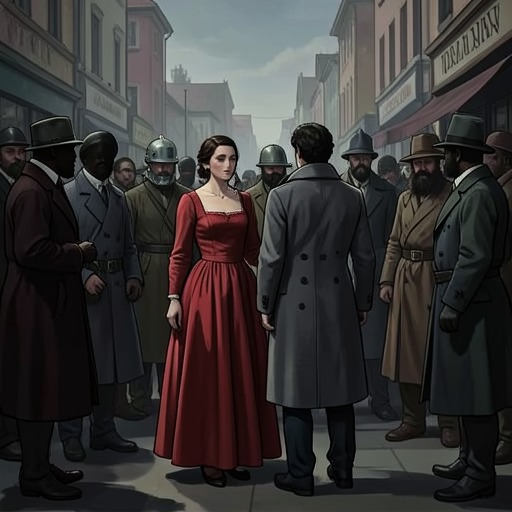
False Identities and Impersonation
Los pacientes del doctor GarcíaFalse Identities and Impersonation is the novel’s recurring means of navigating danger, and a political instrument through which lives can be protected, appropriated, or erased. An assumed name is never merely a disguise: it depends on documents, institutions, and other people’s cooperation. The same machinery that allows a fugitive to disappear can also conceal a crime, while a private record may preserve the truth that public authority has tried to suppress.
Identity as a Means of Survival
During the war, a wounded man is brought to an infirmary as a presumed corpse. A commander finds in his wallet a credential from the Public Order Council of the Madrid Defense Council and receives an extraordinary phone call: if the man is dead, bury him as an unidentified person without registering him; if he is alive, save him at any cost, but do not admit him to a hospital under his own name, lest someone try to kill him again. The caller, Basilio Rodríguez, offers no explanation beyond saying that the man is vital to the Republic. Concealment here is not simply an evasion of law; it is a clandestine form of protection, made necessary by the danger of being officially identified.
The novel also shows what happens when the state’s machinery turns from protection to plunder. After returning to his home, Guillermo García Medina finds that it has been ransacked: the wall of his grandfather’s study has been smashed to remove the safe, and the gold belonging to Don Fermín is gone. Family documents, including copies of wills and the house deed, lie trampled on the floor. Yet the envelope Manuel Arroyo Benítez had given him remains sealed in a locked desk drawer. The contrast is pointed: the occupants have taken the gold and violated the visible household, but a private, carefully concealed channel of information survives. A hidden document can outlast the violence that destroys the appearance of a stable home.
Documents, Networks, and Reinvention
After the war, Clara Stauffer’s house at Galileo 14 becomes a processing point for fugitives. In the summer of 1945, she renovates rooms for an office, installs a new telephone line, hires two secretaries, and fills new cupboards with men’s clothes and shoes in every size. Thin, exhausted visitors arrive at all hours. Sole Ruiz recognizes them as escapees from European prisons or released prisoners from Nanclares: they are fed, given clean clothes, and apparently helped with lodging or work, but do not sleep in the house. Many speak no Spanish. A stream of sealed envelopes, carried by a Spanish conscript, supplies baptismal certificates bearing German names and a birth date of 1907. The forged identity thus rests not on a single invented name but on a chain of assistance: clerical records, office staff, clothing, contacts, and onward arrangements.
Sole’s discovery becomes a lead for Meg Williams. She identifies Jean-Jules Lecomte as a Nazi and a member of both the Rex Party and the SS, formerly burgomaster of Chimay. The political identity that had carried him into office does not prevent him from using another identity to escape accountability. Manuel’s investigation seeks to establish not only who the fugitives are, but how the network turns its hospitality into a route outward. The evidence points toward Argentina: Clara’s contacts and baptismal records may help furnish Spanish documentation, while the fugitives’ presumed destination is a country that continues sending food to Spain despite the blockade. The route is a hypothesis that needs proof, not a conclusion the investigators can simply announce.
That distinction matters to the proposed investigation. Meg persuades Congressman Sal Burnstein that the Stauffer network appears stable, but testimony from a household servant is not enough to expose its operation or compel international pressure. The investigators need to verify that Lecomte and other suspects are who they believe them to be, identify the people assisting them, and establish what Clara’s organization does beyond feeding and clothing fugitives. Manuel is asked to become the infiltrator who can turn suspicion into evidence. His work therefore depends on inhabiting a false identity without losing sight of the factual distinctions it is meant to uncover.
The Cost of Assuming Another Name
Adrián Gallardo Ortega has killed Alfonso Navarro López and taken his identity. When a woman offers to arrange repatriation for the prisoner known as Navarro, Adrián recoils from the prospect of returning to Spain under that name. To accept, he would first have to reclaim his own identity, but he can see no way to do so without ruin. He has not yet confronted the price of having killed a man to survive. The possibility of repatriation turns a successful deception into a threat: the identity that protects him in captivity could expose him if he returns to the country where his former life and the consequences of his crime still exist.
The escape network then gives Jan Schmitt de Wandaleer a new civilian existence. When Agneta Müller is determined to leave, her father, Rudi, capitulates and asks Jan’s second surname. He completes and seals a residence certificate declaring Jan to be Johannes Grunwald, born and resident in Schöneberg, at the apartment of Roswitha, who agrees to shelter him for several weeks. The false certificate opens a path unavailable to an outsider: Johannes can apply for a municipal police position reserved for native residents of the district. With help from his fiancée’s father and his relations with the occupying authorities, he gets the job. Once he begins patrolling in uniform, Jan’s earlier trail disappears. He and Agneta marry in June 1946 and remain with the Müller family; their first child is born in February 1947. The forged papers do more than hide a fugitive: they give him a job, a household, and a future, while ensuring that the people he knew in Berlin never learn that Johannes Grunwald is a war criminal.
Manuel’s impersonation of Adrián is more elaborate because it must withstand scrutiny in the same network he is investigating. He reshapes his German into the characteristic mistakes of a Spaniard who learned the language without formal study. He also engineers a visible deterioration: a strict diet of small quantities of rice and black bread costs him nearly twenty kilograms, and long daily walks in the sun deepen the appearance of a camp inmate. The performance is physical as well as verbal, intended to make his assumed biography legible before anyone asks him to explain it. It becomes so convincing that he has to give up María Aránzazu’s comfortable hospitality rather than invite questions he cannot answer.
A third name, José Pacheco Hernández, supplies Manuel with a job and a fresh set of papers. On 1 July 1947, he starts work as a night porter in a building on Gran Vía, having signed his employment contract in the very office where Clara directs his life. His colleagues call him José; at Galileo 14 he remains Adrián, and the police officer who takes his fingerprints greets him with a knowing smile before handing over his new identity document. The overlap is not an accidental flaw in the disguise but a measure of how many people can participate in keeping a person’s identities separate.
The baptismal certificate that makes the new documentation possible reaches Manuel under false pretences. Stauffer’s secretaries give him money for the Metro and send him to the sacristy at the parish near the Glorieta de Iglesia to collect a certificate for José Pacheco Hernández, without telling him it will be used to construct his own identity. The counterfeit name is therefore produced through the routine authority of a parish record and the work of an office that appears to be carrying out errands. Documents do not merely confirm who someone is; in this network, they make a new person administratively usable.
The Hidden Record and the Unfinished Disguise
The night-portering job also gives Manuel the time and cover to write down what he learns. He has cultivated Stauffer’s secretaries by bringing them newspapers, sharing coffee, and running errands; during their vacation period he becomes, in practice, another secretary. From his modest pocket-money allowance, he buys a small notebook, pencils, and a sharpener at a stationer’s on Calle Eloy Gonzalo. He carries the notebook where it can be hidden inside his jacket. Yet for a time he writes nothing in it, even after moving into his own small, comfortable apartment on Calle del Pez.
The notebook’s eventual contents turn impersonation into testimony. During eight nights at work, Manuel records what Adrián has learned from his first conversation with Clara onward. Among the details is Clara’s boast that she can deliver war criminals safely to Argentina. She names Lecomte, who arrived in Buenos Aires in mid-May with a Spanish passport under the name Jan Degraf, De Graf, De Graaf, or Degraaf. Manuel did not dare ask how the surname was spelled; he recalls that the passport’s second surname began with Ver, enough, he hopes, to locate the passenger on a transatlantic ship’s list. His record preserves both the lead and its uncertainty. Unlike the polished identity documents produced by the network, the notebook does not pretend to know more than its writer can establish.
The story’s investigation widens from fugitive identities to the stolen material and missing archives that may have travelled with them. Manuel suspects that shipments Guillermo has agreed to supervise contain art looted from museums and Jewish owners in occupied territories, along with jewellery, antiquities, and possibly gold, silver, or foreign currency from the vanished Nazi treasury. He remembers that on 18 July 1947 Clara had planned to introduce Guillermo to a friend whose name sounded like Ban or Bam. If it ended in an m, Manuel reasons, it could refer to Josef Hans Lazar, known to intimates as Bam. The Allied Control Council has found little of Lazar’s presence in Hitler’s embassy in Madrid beyond a trail connected to the vanished treasures. The Allies suspect that Lazar secretly moved the embassy and ambassadorial residence’s valuables, as well as documents from an unseen archive, to a hiding place they have searched for years. The hypothesis links assumed names to the concealment of objects and records: a fugitive can disappear in the same shadow as the evidence he has carried away.
Erasure as State Practice
The novel’s later political history gives the motif its gravest meaning. Under the Argentine military dictatorship, the destruction of identity is no longer principally a fugitive’s stratagem or a clandestine network’s service: it becomes part of the state’s machinery of terror. Before the 1976 coup, President María Estela Martínez de Perón issues the decree that establishes Operativo Independencia. Though presented as a campaign against guerrillas in Tucumán, it divides the country into five military zones and gives their commanders sweeping power to repress those labelled subversive. The operation’s target expands beyond armed opponents to civilians, including teachers, students, intellectuals, artists, scientists, and religious people.
From the coup of 24 March 1976 onward, the dictatorship’s clandestine system links illegal detention, secret centres, torture, execution, and the disappearance of bodies. Specialized task groups also take babies from detained mothers and arrange their adoption by families aligned with the regime, erasing the children’s origins through offices responsible for falsifying or removing their identities. The scale of the crime is reflected in estimates of roughly thirty thousand victims between 1976 and 1982, many of whose bodies were never recovered. In the death flights, prisoners are drugged, bound, transported alive in military aircraft, and thrown into the sea. Here, disappearance attacks both the person and the possibility of proving what was done to them.
A comparable process of official concealment appears in the handling of an unidentified corpse in Madrid. The body, bearing a fatal bullet wound to the neck, is assigned to a mass grave at the Almudena Cemetery under the conveniently vague description of cardiorespiratory arrest. The gravediggers notice the gunshot, but their attention also turns to the dead man’s new overcoat: one proposes taking it because the victim no longer needs it. The brief exchange exposes the social routine that makes falsification possible. A body is stripped of identifying truth by the paperwork, then reduced to an opportunity for petty gain by those charged with burying it.
Across these episodes, assumed names and erased names are not equivalent acts. A false identity can protect someone from a renewed attempt on his life, let a fugitive build an ordinary future, or enable an investigator to penetrate the organization he is documenting. It can also allow criminals to evade judgment. State-backed disappearance goes further: it suppresses not only the public identity of the victim but the evidence of the crime itself. The recurring question is therefore not simply whether a name is genuine, but who has the power to assign it, what that name makes possible, and whether any surviving witness or record can restore what the official story has erased.