Fermín family’s secret-compartment bookcase
Los pacientes del doctor GarcíaThe Fermín family’s secret-compartment bookcase is both a childhood hiding place and a concealed route to safety. Built into Don Fermín’s study, its hollow lower compartment once held Guillermo and Amparo apart from the adults and the ordinary world; years later, Guillermo invokes that familiar enclosure as part of a plan to protect Amparo when danger threatens. The bookcase’s significance lies in this return: a space first associated with childhood intimacy becomes useful again as practical shelter.
Construction and First Use
The bookcase occupied an entire wall of Don Fermín’s study. Its stepped shelves rose toward the ceiling, but the books in the house did not fill them. The custom-made piece therefore had a hollow lower body, nearly a meter high and a meter wide, with a central door that opened into the cavity. Its ordinary appearance as a large piece of study furniture concealed a space that the children could enter.
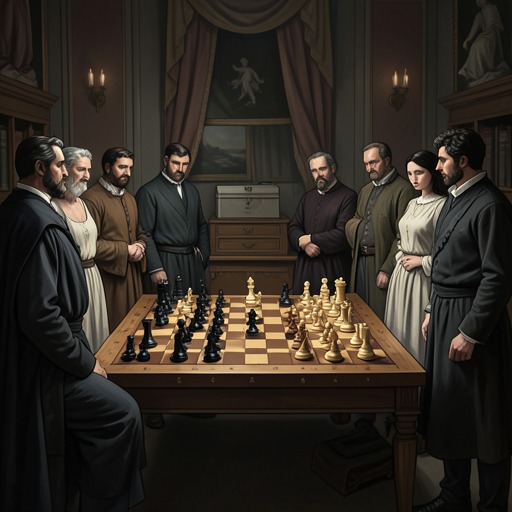
While their grandfathers played chess, Guillermo and Amparo crawled across the floor, eased open the central door so its hinges would not squeak, and shut it with equal care behind them. They sat in the dark and waited as the adults searched the house. The quiet, deliberate entrance was part of the game: the children were not simply out of sight but temporarily withdrawn from the world beyond the wooden door.
A Childhood Space of Intimacy
Hiding was one of the games Amparo regularly invented. The children also shut themselves in cupboards, the pantry, and behind baskets in the ironing room, but the bookcase in Don Fermín’s study became their favorite hiding place. In the confined darkness, they held hands and whispered while their elders called for them. The study remained close by, with the chess game and household activity just outside; the door nonetheless made the small compartment feel like a separate world.
Guillermo remembers the space through its materials and shared closeness: the smell of wax, the chamomile infusion Amparo used to wash her hair, and their fingers tightening together. He understands the hideout as the place where he discovered intimacy. Its force in his memory comes not from size or comfort—the hollow furniture was only a cramped cavity—but from the boundary it created between the children and everyone looking for them.
Return to Don Fermín’s House
On the night of 19 November 1936, Guillermo returns to Don Fermín’s house with Experta. He remembers that the bookcase had once stood against a wall and that there had been no lock on its door; now the wall looks freshly painted, and the furniture stands behind the desk, blocking access to the principal bedroom. The changed arrangement marks the distance between his childhood recollection and the present emergency, even as the concealed compartment remains usable.
Experta opens the central door as quietly as Guillermo remembers doing himself. She kneels, crawls into the old hiding place, knocks on another door—the one to the bedroom behind the bookcase—and passes through when it opens from within. She then calls Guillermo through the cavity, warning him to be careful. He is struck by how large his adult body has become and how difficult it is to move through the space in which he once felt comfortable. The childhood hiding place has survived, but he no longer fits it as a child did.
A Refuge in the Present
Later, as Amparo cries and Guillermo works out how to keep her safe, he tells her to put the gold in the safe and gives her instructions for what to do if danger comes. Her house has two doors, he explains: she can leave by the service entrance and enter her grandfather’s house through a corresponding door. The hiding place behind the bookcase is still there, so she can shut herself inside it and wait for him to come for her.
Amparo points out that Guillermo does not have the keys to her grandfather’s house. He answers that Experta does, and promises to go and get them. The exchange makes the bookcase part of a concrete escape plan, not merely a remembered symbol: access depends on the service route, the keys, and Amparo’s ability to wait concealed until Guillermo reaches her. What had once isolated the children from adults now offers a way to protect Amparo from a danger outside the childhood game.
Meaning and Recurrence
The bookcase joins two moments in Guillermo’s life through the same physical action: opening a central door, crawling into a hidden interior, and waiting beyond the reach of ordinary sight. In childhood, the enclosure makes the world temporarily disappear and allows a private closeness with Amparo; in the later plan, concealment has an urgent protective purpose. The details that once made the hideout a source of wonder—the quiet entry, the cramped space, the separation from the rooms outside—now acquire practical stakes.
Its return also exposes the limits of memory. Guillermo can recall the bookcase’s former position and the absence of a lock, yet the house has been rearranged and his adult body can barely pass through the cavity. The hiding place is at once recognizably the same and altered by time and danger. Its enduring usefulness does not restore childhood; it turns the remembered refuge into a tool for survival.