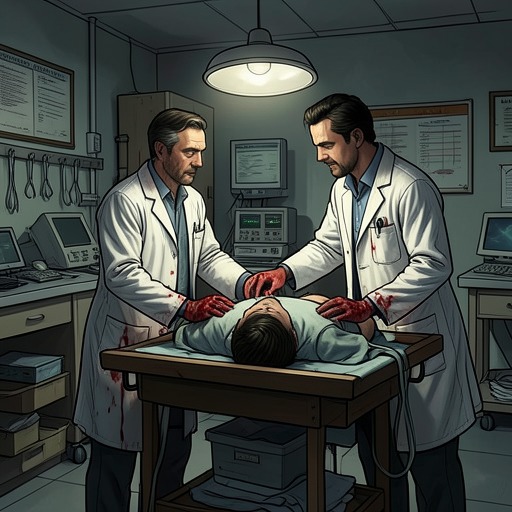
First successful refrigerated-blood transfusion in Madrid
Los pacientes del doctor GarcíaOn 23 December 1936, at the Hospital de Sangre de la Casa de Campo, Norman Bethune performed the first successful refrigerated-blood transfusion in Madrid, reviving a soldier whom the hospital doctor had given up for dead. The breakthrough made transfusion portable: stored blood could reach the wounded at the front without requiring a donor to be physically connected to the recipient. In the novel, the clinical demonstration becomes a scene of shared survival, with the unnamed soldier’s return to life answered by the joy of those around him and, finally, by his own cry of “¡Viva yo!”
Preparation and the front-line trial
The transfusion was the culmination of an organized blood-donation effort. Volunteers gave half a litre of blood for the Republic; each donation was put into a bottle with a small amount of sodium citrate and labeled with the blood group, date of extraction, and donor’s identity. The Institute’s collection quickly outgrew the largest available refrigerator. Donors still queued each morning on the even-numbered side of Príncipe de Vergara Street, while Bethune acknowledged uncertainty about how long citrated blood would remain usable in cold storage. The supply was not an abstract reserve: it was blood collected, identified, chilled, and prepared for use where the fighting made immediate treatment difficult.
Early on 23 December, Bethune’s team filled portable equipment with bottles representing all blood groups, loaded their packs into a truck, and drove to the Hospital de Sangre de la Casa de Campo, close to the front. There Bethune examined soldiers lying on the floor, many of them considered beyond help. He chose a young man suffering from hypovolemic shock after a massive loss of blood. The Spanish doctor responsible for the patient regarded him as a lost cause, as he had regarded others who had arrived in similar condition.
The transfusion and its immediate result
The patient’s breathing was weak; his skin was pale, damp, and cold, stretched over sunken cheeks, and his lips had no color. Bethune could not speak Spanish, so his interpreter asked the hospital director for permission to let the Canadian doctor try to revive the soldier. The director’s skepticism did not prevent him from authorizing the attempt: he expected the patient to die regardless and stayed to watch.
Bethune pricked the soldier’s finger and collected a sample on a glass rod. After two minutes, once he had identified the blood group, he inserted a needle and began transfusing the first bottle. The soldier moved and opened his eyes, but Bethune judged that one bottle was not enough after so much blood loss and gave him a second. Before the transfusion was fully over, the patient looked at Bethune and smiled. What the hospital staff had treated as an inevitable death had turned into a recovery unfolding before them.
A portable technique and its reach
Bethune’s success established, in the novel’s account, the first occasion on which refrigerated stored blood brought a hopelessly wounded patient back to life. The practical change was as decisive as the immediate rescue. Transfusion no longer depended on bringing a donor to the bedside and connecting donor and recipient with two needles and a length of tubing. Blood could be collected in advance, preserved, transported, and administered where it was needed—a method described as making transfusions easier, more convenient, practical, and effective.
The scene also emphasizes that the first rescue was not an isolated demonstration. That same morning at the Casa de Campo hospital, Bethune’s intervention revived twelve soldiers. The method would save thousands of soldiers in the People’s Army of the Republic during the Spanish Civil War; beyond the war, its beneficiaries would number in the millions. The passage links those later consequences to a specific gift to besieged Madrid: a Canadian, communist, internationalist doctor brought a new form of medical support to the people resisting there.
The unnamed survivor and the scene’s meaning
The first survivor’s name is never established. His anonymity keeps the moment from belonging to a single celebrated patient, while the details of his return give it a sharply individual human scale. His comrades put a lit cigarette in his mouth before anything else. He draws on it eagerly as unexpected joy and hope spread through the bleak field hospital. The response grows into cheers for Canada, Bethune, the Republic, working-class struggle, and international solidarity.
Then the revived soldier makes his own contribution, shouting “¡Viva yo!” Bethune does not understand the words, but recognizes the moment as a source of happiness. The line’s humor does not diminish the danger he has just escaped; it makes survival audible as the survivor’s own claim. The transfusion changes the scene’s governing fact from impending death to returned life, and the patient is not merely the object of a medical achievement: he asserts himself within its public celebration.
Echoes beyond the hospital
The transfusion’s significance persists in the novel through objects and family memory. Years later, a folder recovered from a hidden compartment contains the narrator’s medical degree, a union card, and a photograph of him posing with Bethune for the cover of El Heraldo. The photograph places the doctor and the Canadian side by side in the history of the transfusion effort, while the degree recalls the narrator’s medical work within a wartime landscape shaped by rescue and loss.
The episode also echoes indirectly through the narrator’s concealed relationship with his son. The boy grows up under the name José Antonio Urbieta, believing that the young Falangist in a prominent portrait is his father, a hero who died in Russia. As a child, he is treated during a serious illness by the doctor who visits him and teaches him chess; only much later does he connect that doctor to the hidden family documents and recognize him as his father. These later events are not part of the hospital operation, but they return the medical figure to the novel’s central pattern: acts of care can preserve life and establish bonds even when identity, history, and kinship remain obscured. The first transfusion thus stands both as a concrete medical turning point and as an early instance of the book’s wider concern with what rescue leaves behind.