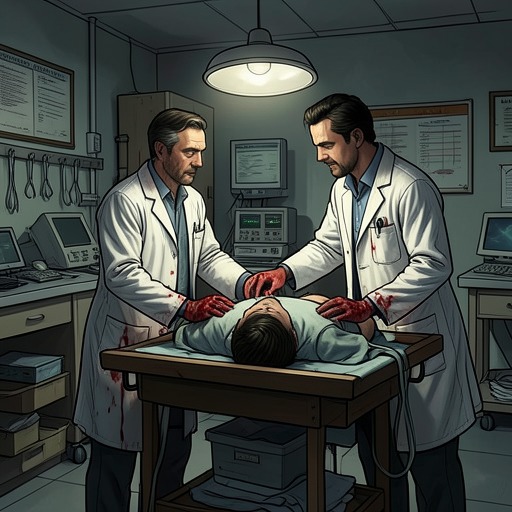
Fortunato Quintanilla
Los pacientes del doctor GarcíaFortunato Quintanilla is the surgeon and hospital chief whose authority, practical brilliance, and insistence on medical duty help shape Guillermo García Medina. During the war, he persuades Guillermo to remain at San Carlos Hospital rather than enlist, organizes its surgical service as supplies dwindle, and seeks a transfusion unit even when the hospital’s conservative leadership refuses permission. His influence reaches beyond clinical technique: Guillermo recognizes in Quintanilla a model of composure and responsibility, while also seeing how the refuge of hospital work can ease the moral burden of choices made elsewhere.
Identity and Background
Quintanilla is an excellent surgeon and the best teacher Guillermo has had at medical school. Guillermo chose his specialty in order to train on Quintanilla’s team, drawn not only to the quality of his knowledge but also to his ability to win students over through the force of his teaching. By the time the war begins, Quintanilla has acquired such authority over him that he can redirect Guillermo’s plans without needing to press the point for long.
That authority rests on more than rank or technical expertise. Quintanilla understands what a physician can contribute in wartime and can make that argument in concrete terms: the Republic would gain a hero by sending Guillermo to the front, but lose a doctor able to save lives. He treats Guillermo’s medical work as an urgent responsibility, not a lesser form of service than fighting.
Keeping Guillermo at the Hospital
When Guillermo considers enlisting, Quintanilla tells him that the hospital is where he is needed. He argues that people who cannot save lives may enlist, but Guillermo should not risk his own when he is more valuable in an operating theatre than at the front. He sends him to the treatment ward, where volunteer nurses need instruction and practical supervision. The advice is both personal and institutional: the hospital requires trained hands, and Guillermo’s skills are still developing under Quintanilla’s guidance.
Quintanilla’s confidence in that decision proves justified as the war proceeds. His authority allows him to assign work and direct the hospital’s energies, while his judgment keeps Guillermo’s medical ability in service of patients rather than exposing him unnecessarily to combat. The relationship is not simply that of a commanding chief and subordinate: Quintanilla’s example becomes a source of professional discipline that Guillermo later recognizes in his own conduct.
The Surgical Service and Its Organization
Quintanilla’s defining wartime talent is organization. He can keep track without consulting papers of admissions and discharges, available surgeons, operating rooms in use or free, and the hours each member of his team has worked without rest. In November 1936, while the most serious supply shortages have not yet arrived, he still notices if a subordinate has spent more than forty-eight hours in the hospital. He finds the exhausted worker and sends that person home to sleep, ending the instruction with the same phrase that marks his authority: it is an order.
As medicines, instruments, and even food for patients become scarce, this command of the service helps keep the surgical floor at San Carlos functioning under conditions described as nearly miraculous. His attention to staffing and rest is part of that achievement: the hospital’s capacity depends not only on equipment but on knowing who is available, who has been working too long, and how to distribute labor. When Guillermo reminds him of the repeated orders to go home, Quintanilla answers with a smile that giving orders is what a chief is for.
Transfusion Work and Institutional Resistance
News of the successful transfusion at Casa de Campo gives Quintanilla a new objective. He devotes his energy to establishing a small transfusion unit for his floor, modeled on the unit the Canadians have set up on Príncipe de Vergara Street. He believes the technique could save many lives if the enemy intensifies its attacks, and regrets that it was not available in November. His urgency comes from the gap between a treatment that could benefit wounded people and the time already lost without it.
The prestige he has earned at San Carlos is not enough to persuade the conservative hospital leadership, which rejects the proposal. Quintanilla does not accept that refusal as final. He asks Guillermo to take responsibility for the work because Norman Bethune does not speak Spanish and Quintanilla himself speaks German, which he considers of little use for the task. Guillermo warns that they lack permission and could face consequences if the effort becomes known. The exchange shows Quintanilla’s readiness to pursue a practical medical measure despite institutional opposition, while the evidence leaves the outcome of this particular attempt unstated.
Medical Ethics and Guillermo’s Inheritance
Quintanilla’s influence becomes clearest when Guillermo treats patients whose political identities and circumstances are uncertain. Guillermo recalls that he had never asked about the political affiliations of people admitted to the hospital. In the operating theatre, he saw a fragile human body like any other seriously wounded body and tried to repair it as well as he could. In a later crisis involving a politically targeted patient, he keeps working despite doubts about the man’s role and the factional violence around him, reminding himself that he is a doctor and that his obligation is to save lives.
Guillermo explicitly connects his ability to stay calm, think quickly, and organize resources in a crisis to Quintanilla’s example. He also sees that Quintanilla’s method of organizing work—continually reviewing schedules and assignments in pursuit of greater efficiency—helps him avoid the questions that trouble Guillermo. The hospital can function as a moral refuge in a violent rear area, a place where staff treat guilty and innocent people alike without asking for political credentials. That refuge protects the work of healing, but it can also make the consequences of other decisions easier to set aside. Quintanilla’s legacy therefore has two edges: he teaches a demanding ethic of competent care, and his example prompts Guillermo to notice how professional duty can shelter people from conflicts beyond the ward.
The relationship continues into Guillermo’s later life. When Guillermo says that a boy is ill, he tells Amparo that he will call Quintanilla, who is still working at a clinic and may know a specialist. Guillermo identifies the boy’s condition as rheumatic fever and explains that he recognizes the illness because he once encountered a similar case and had to study again in order to treat it. The brief recollection of Quintanilla as a reachable medical authority shows that the teacher’s role has not ended with the war: Guillermo still turns to the professional world and knowledge associated with him.