Franco regime
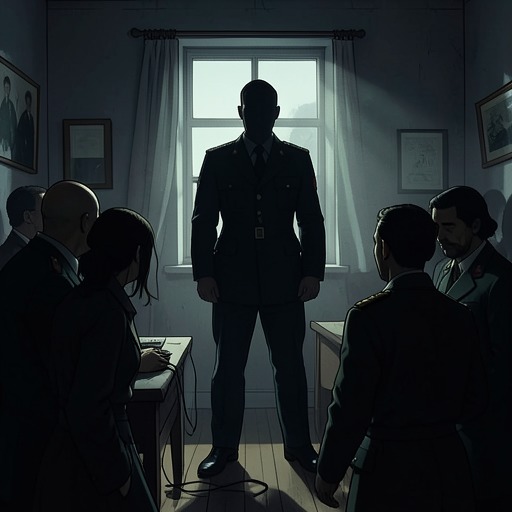
Los pacientes del doctor GarcíaThe Franco regime in the novel is more than a victorious authoritarian government: it is a system that controls people through records and documents while sheltering fugitives whose crimes it has reason to conceal. Its reach appears in the ordinary machinery of identity papers and policing as well as in the clandestine handling of prisoners, bodies, and evidence. Across Spain and Argentina, the narrative sets these practices against the fragile strategies of people who must alter or hide their identities to survive.
Authority, records, and false identities
The regime’s rule makes identity an administrative fact that can determine who is allowed to move, work, or remain alive. During the Republic, Manuel Arroyo Benítez had been issued papers identifying him as Rafael Cuesta Sánchez, a government employee with a fabricated biography. After the Francoist victory, Guillermo receives a new version of that identity from Manuel: the false Rafael is now described as a twenty-five-year-old unmarried man from Madrid, with no left-wing party or union affiliation. The document is assembled to pass as genuine, complete with a copied official signature and a seal imitated from Burgos. It turns a person’s political past into a liability that paperwork can erase—or expose.
The administrative system is shown at its most revealing when Guillermo presents the document at a Madrid police station to exchange it for papers issued by the Nationalist authorities. His identity earns him a fast route to the appropriate counter, while the defeated Madrileños who had endured the siege wait in the crowded lines. The small privilege of being directed to window seven makes the document’s force concrete: the regime classifies people before they speak, and their standing within its system affects how they are treated.
The Francoist order also produces spaces in which official and illicit identities meet. Jan Schmitt, a wanted war criminal, is registered as Johannes Grunwald, a native resident of Schöneberg, and uses the papers to obtain a municipal police post available only to district residents. The job and uniform help bury his former identity; the people who knew him in Berlin never learn that he is a criminal. This sequence presents bureaucratic recognition not as neutral verification but as a resource that can be captured by those able to secure the right documents and relationships.
Shelter for Nazi fugitives
The regime’s protection of Nazi fugitives is mediated through networks that give shelter, clothing, papers, and routes onward. In 1945, Clara Stauffer’s house at Galileo 14 is reorganized: rooms become an office, a new telephone line is installed, and cupboards are filled with men’s clothes and shoes in many sizes. Thin, exhausted visitors arrive, receive food and fresh clothing, and leave without staying overnight. Their repeated visits to the office, and the parish envelopes containing German baptismal records, reveal a sustained system for helping fugitives establish usable identities and continue their escape.
The narrative connects that assistance to the regime’s broader willingness to protect war criminals. Adrián Gallardo, preparing to return to Spain, understands that Francoist protection is a benefit he can claim only after abandoning the identity that has kept him alive. He expects Stauffer’s network to help those crossing the Pyrenees en route to South America or seeking a permanent home in Spain. Rather than emigrating, he wants to return home, but doing so requires him to erase Alfonso Navarro López from his papers once more. The regime’s sanctuary is thus both political protection and a practical system of identity substitution.
The escape network is not depicted as a single official office. It depends on private organizers, sympathetic intermediaries, forged or acquired records, work placements, and contacts across borders. Its operation makes the regime’s responsibility visible without suggesting that every act is carried out by a state employee: shelter and paperwork are provided through personal networks, while the surrounding political order makes such assistance possible and protects its beneficiaries from the consequences of their past.
Policing, concealment, and impunity
The regime’s relation to violence is also expressed through what authorities do after a killing. When a wounded man identified as Rafael Cuesta Sánchez is found near El Pardo, a police commissioner instructs the commander to bury him as unknown if he is dead, without registering the body. If he is alive, the commander is told to save him but keep him out of any hospital under his own name, because someone may try to kill him again. The orders offer no meaningful explanation; the man is described simply as vital to the Republic’s interests. The scene shows how control over registration and medical access can determine whether a person remains identifiable and protected.
A later death demonstrates the same machinery in a different political setting. After a man is found shot in the neck, Inspector Conesa and his superior agree to bypass the autopsy. The death is recorded as a routine heart stoppage, and the body is buried before the inspector returns to work the next day. At La Almudena, the corpse is assigned to a common grave for undocumented people whose official cause of death is repeatedly listed as cardiorespiratory arrest. The gravediggers notice the bullet wound, but the paperwork has already rendered the killing administratively ordinary. The episode makes impunity a process: investigation is curtailed, the record is falsified or emptied of detail, and burial removes the body from public scrutiny.
This institutional handling of death is accompanied by the regime’s ability to dispossess. When Guillermo returns to his house after the Nationalist victory, he finds that the safe has been broken out of his grandfather’s study and the gold taken. Family documents lie scattered and trampled. The home has been searched and ransacked, while the old papers that might preserve family history are left in disarray. The scene links political seizure to material plunder and shows how the victors’ authority reaches into private property as well as public records.
From Francoist Spain to the Argentine dictatorship
The book places this history of Spanish authoritarianism beside the later Argentine dictatorship, tracing both a transfer of refuge and a repetition of repressive methods. Nazi fugitives experience an even more complete sense of impunity in Perón’s Argentina than in Franco’s Spain, and Argentine officials welcome the false Adrián Gallardo into the European refugee reception service. The comparison does not make the regimes identical; it emphasizes how a refuge established for fugitives can become part of a wider international landscape in which political protection defeats accountability.
The historical account of Argentina also connects Francoist Spain’s postwar order to the methods adopted by later military dictatorships. Before the 1976 coup, María Estela Martínez de Perón’s decree supporting Operation Independence divides the country into military zones and grants their commanders sweeping power against those designated subversive. The operation’s violence extends beyond guerrillas to civilians, including teachers, students, intellectuals, artists, scientists, and religious figures. Under the subsequent military regime, clandestine task groups carry out abductions, secret detention, torture, executions, disposal of bodies, and the theft and reassignment of children born to detained women. The novel presents these practices as part of a political history in which techniques already used effectively in postwar Spain are taken up again in Latin America.
The Franco regime’s significance therefore lies in the conjunction of authoritarian classification and selective protection. Papers can make a fugitive employable under a new name, direct a defeated citizen into a segregated queue, or conceal a body from its own history. Networks can turn Spain into a passageway or destination for wanted men, while official routines make violence difficult to prove. Against that machinery, survival often depends on manipulating the very systems that make people legible to power.