Francoist Policy of Sheltering Nazi Fugitives
Los pacientes del doctor GarcíaThe Francoist Policy of Sheltering Nazi Fugitives made postwar Spain a place where former Nazi officials and collaborators could evade Allied demands, acquire new identities, and, in some cases, settle with official protection. The policy was more than a matter of quiet refuge: it joined diplomatic delay to the administrative manufacture of belonging, turning nationality and paperwork into barriers against extradition. In the novel, the fate of the Allied list of 104 exposes how a regime’s declared cooperation could coexist with a system designed to frustrate accountability.
Postwar refuge and selective cooperation
After the surrender of the Third Reich, the Allies repeatedly asked Spain to help locate and hand over people connected with Nazi activities in Spain, as well as prominent collaborators from occupied countries accused of crimes against humanity. Their requests produced little result. The case of Pierre Laval supplied a conspicuous exception: on 30 July 1945, under pressure from the French authorities and concern about offending the victorious Allies, Franco handed him over. Laval was tried in France, convicted of treason, and executed in mid-October. The novel presents this as the beginning and end of Spain’s cooperation with Allied justice, not as a change of policy.
The contrast is sharpened by Léon Degrelle’s fate. Belgium continued to demand his extradition for fifteen years, but Franco refused. In 1954, the regime definitively shielded him by making him, for official purposes, the Spanish citizen José León Ramírez Reina. Although Degrelle continued to speak publicly and sign articles under his real name, the new legal identity protected him from the consequences of the Belgian demands. He established a construction company and profited from the Francoist state’s preference for awarding him public contracts. Protection therefore meant not only shelter from prosecution but also the possibility of economic establishment under regime favor.
Citizenship and the manufacture of identity
The policy’s practical instrument was a conversion of false identity into apparently valid official status. The regime could grant Spanish nationality retroactively and prepare authentic documents for a fabricated identity. In Degrelle’s case, this process made his official Spanish citizenship a defense against extradition despite his public use of his actual name. The novel describes the same procedure as a means of protecting many other Nazis who sought Spain either as a final destination or as a stage on the way to another country.
That use of documentation has a telling parallel in the wartime experiences of Manuel Arroyo Benítez. When sent to Madrid by Juan Negrín, he registered at a hotel on 28 June 1937 as Rafael Cuesta Sánchez, using impeccably issued Republican papers that described a wholly invented person. Later, Arroyo passed the identity to Guillermo García Medina in a sealed envelope. He explained that its original version had described Cuesta as older, married, a UGT member, and resident in Valencia, whereas Guillermo’s version was adapted to a twenty-five-year-old unmarried man with no left-wing party or union membership. A baptismal record could not expose the fraud because the church register had burned in a bombing; the document had been prepared with copied seals and an imitated official signature.
Under Francoist rule, the same administrative principle served a different political purpose. Guillermo presented Rafael Cuesta’s papers at a Madrid police station to exchange documents, and the guard directed him to the counter for papers from the Nationalist zone. The papers that once helped a Republican survive thus demonstrate how a state’s systems of identification could be navigated, appropriated, and repurposed. The novel places such individual acts of concealment beside the regime’s organized grant of authentic documents to Nazi fugitives: paperwork could frustrate power for a vulnerable person, or make state protection durable for a wanted collaborator.
The list of 104 and diplomatic obstruction
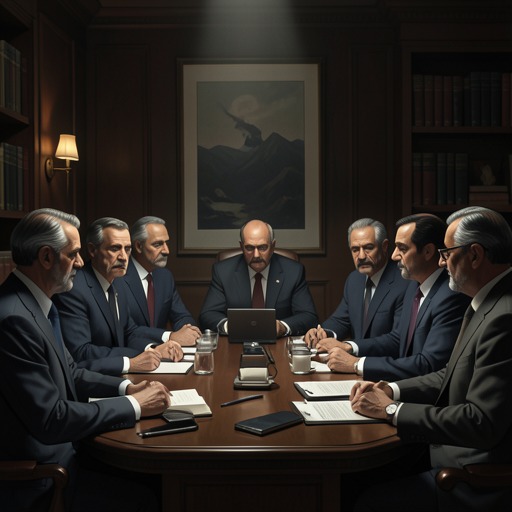
In October 1947, the Allied Control Council in Spain delivered the government a list of 104 names in an eleven-page document typed in English. Foreign Minister Alberto Martín-Artajo was its recipient. The list represented the culmination of Allied demands, but it arrived after more than two years in which Spain had offered little cooperation. The political setting had also changed: the emerging Cold War and the fear of a new conflict with Joseph Stalin had, within two years of Hitler’s defeat, improved Franco’s international position. The novel connects the regime’s obstruction to this shift, presenting anti-Soviet priorities as the context in which its diplomatic evasions could continue.
The 104 were not treated as interchangeable unknowns. The list identified German citizens who had actively helped advance Hitler’s cause and who had outstanding cases before German courts. The regime nevertheless regarded them as necessary to maintaining good relations with the victorious powers. Martín-Artajo let the matter drag on until the Council’s patience was exhausted. When he finally met its representatives, he produced a stack of documents, letters, and certificates that they had never previously seen, using paperwork to convert political protection into a sequence of claims about individual legal status.
The excuses were varied, but their function was consistent. Some people could not be handed over because they had supposedly been Spanish citizens for years; others had received nationality from Franco for helping the Nationalist Army when the Condor Legion intervened in Spain. Officials claimed that some could not be found or were unknown to them. One had been granted citizenship because he headed a company considered strategic to the national economy. Another was protected by the Cardinal and Primate of Spain because he was Austrian and Catholic, and officials did not want trouble with the Vatican. The explanations made obstruction look like a collection of unrelated administrative decisions, while together they shielded those whom the Allies sought.
Clarita Stauffer and the escape network
Clarita Stauffer was the only woman among the 104. The Allied document gave her correct address at 14 Calle Galileo in Madrid and described her as one of the principal organizers of a secret relief association. It accused her of involvement in providing false papers and finding employment for Germans, among other activities, and stated that she had received special permission from the German Embassy at the end of the war to obtain Spanish nationality specifically so that she could continue those activities after defeat.
The wider operation around her residence gives those allegations a material shape. In the summer of 1945, Clarita renovated two rooms as an office, installed a new telephone line, hired two secretaries, and filled new cupboards with men’s clothes in many sizes and shoes in every size. Thin, tired men began visiting at all hours. They were escapees from European prisons or prisoners released from Nanclares; at Galileo 14 they were fed and given new clothes, and the visitors appeared to receive help with accommodation and, in many cases, work. They did not sleep at the house, but returned to its office to conduct further business. A steady stream of sealed envelopes bearing Madrid parish letterheads carried baptismal records with German names and dates, supplying another documentary element to the network. The list’s account of false papers and employment thus corresponds to a domestic operation that joined practical aid to the creation of new lives.
The network’s dependence on papers also links the fugitive system to the novel’s other transformations of identity. Jan Schmitt, a war criminal, became Johannes Grunwald through a certificate of residence prepared by Rudi Grunwald. The certificate allowed him to apply for a municipal police position in Schöneberg, a job open only to people born and resident in the district. After obtaining it, Jan’s trail disappeared: people who had known him in Berlin did not learn that he was a war criminal, and his first patrol in uniform marked his new public identity. The escape network’s protection was therefore not limited to crossing a border. Employment, addresses, certificates, and official roles could conceal a past and attach a fugitive to an ordinary social world.
Political meaning and the costs of impunity
The regime’s stance toward the list was not simply passive delay. Its officials assembled legal-looking explanations, invoked nationality and public service, and used economic or religious connections to rebut extradition demands. Such devices made state protection legible as ordinary administration, even when the underlying objective was to keep wanted people beyond the reach of courts. The distinction between a genuine citizen and a protected fugitive could be blurred by a document made authentic on paper for a false identity.
The novel sets this protection against the machinery of state violence elsewhere in the book. During the war, an injured Rafael Cuesta’s fate depended on secret instructions: if he was dead, he was to be buried as an unknown person without registration; if alive, he was to be kept out of hospitals under his own name so that no one could kill him again. In Madrid, after a man is killed by a bullet in the neck, the body is filed as an undocumented death from cardiac arrest and buried in a common grave at La Almudena. These scenes show how records can be suppressed to conceal a victim, just as records can be manufactured to shield a fugitive. In both cases, control over whether a person is named, registered, or officially present becomes a means of power.
The book also extends the problem of impunity beyond postwar Spain. It describes how Argentina’s Operativo Independencia divided the country into five military zones and empowered their commanders to repress those classified as subversive. Under the subsequent military dictatorship, forced disappearances affected thousands between 1976 and 1982; estimates reach about thirty thousand because many bodies were never found. The clandestine system included abduction, secret detention, torture, execution, concealment of bodies, and the theft and reassignment of children. The later example is not identical to Francoist protection of Nazi fugitives, but it reinforces the novel’s recurring concern with political power over identity and evidence: institutions can make people disappear, while other institutions can make the wanted appear legally secure.
The policy’s decisive significance lies in that double use of official identity. Spain could present itself as a state governed by documents and diplomatic procedure while bending both to protect fugitives and evade international demands. The list of 104 made the contradiction explicit: the Allies named the people they sought, and the regime answered with nationality certificates, missing-person claims, and claims of ignorance. In the novel, impunity is not an absence of administration. It is built through administration—through the papers that grant belonging, the files that deny knowledge, and the bureaucratic delays that allow a fugitive’s past to recede without being erased.