Guillermo García Medina
Los pacientes del doctor GarcíaGuillermo García Medina is a Madrid-born physician whose survival and resistance depend on living under assumed names. From April 1939 he is known as Rafael Cuesta Sánchez; later he also uses the name Ángel Valverde Roldán. He is a doctor without official credentials in one phase of his life, a transport-agency employee in another, and a clandestine political actor across both. The names are not merely disguises: they divide his public existence from a buried identity that repeatedly returns through old relationships, documents, and acts of care. His story follows a man who protects others by becoming difficult to find, yet cannot permanently disappear from himself.
Identity and Background
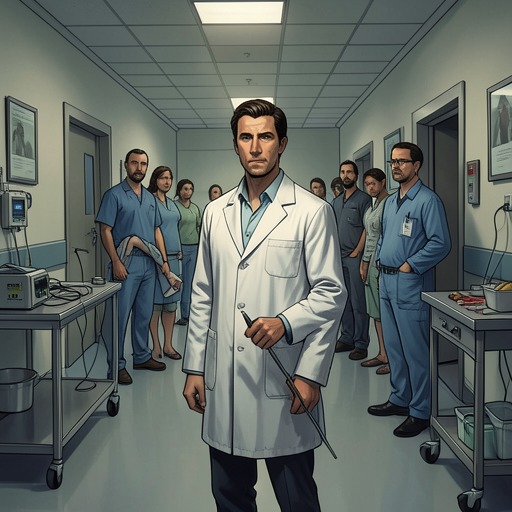
Born in Madrid in 1914, Guillermo is a doctor whose professional identity is complicated by the fact that, at one point, he lacks an official qualification. He works for a transport agency while continuing to practice medicine in secret. His medical work is not simply a former occupation: it remains an ethical commitment and a practical skill, even when his public life has been reorganized around survival.
The name Rafael Cuesta Sánchez becomes his principal cover after the war. In 1968 and 1969, he also uses Ángel Valverde Roldán, supported by borrowed legal credentials that allow him to enter Carabanchel Prison as the defense lawyer for José Antonio Urbieta Priego. This later identity shows how his resistance relies not only on personal courage but on documents and assistance supplied by others. The papers can open a prison door, but they do not replace the man whose history they conceal.
His concealed past is material as well as psychological. While searching through a hidden compartment in a bedroom object, Guillermo discovers a folder containing his medical degree, union card, a photograph of himself with Norman Bethune, a Republican Left membership card, and family documents. The papers include a family book issued to Guillermo and Amparo Priego Martínez and the birth record of their legitimate son, Guillermo García Priego. The cache reconnects a divided life: professional credentials, political affiliations, and family history have all survived in the same concealed space.
War, Medicine, and Resistance
The war establishes both the danger of his work and the need for secrecy. In November 1936, he has spent nearly forty-two hours inside San Carlos Hospital, with only a brief rest and coffee to sustain him. A wounded man brought in as though dead is identified through papers as Rafael Cuesta Sánchez, and the authorities’ instructions are stark: if he is dead, bury him without registering his name; if alive, save him but keep him out of any hospital record, because someone may try to kill him again. The scene makes anonymity a condition of survival, not a personal preference.
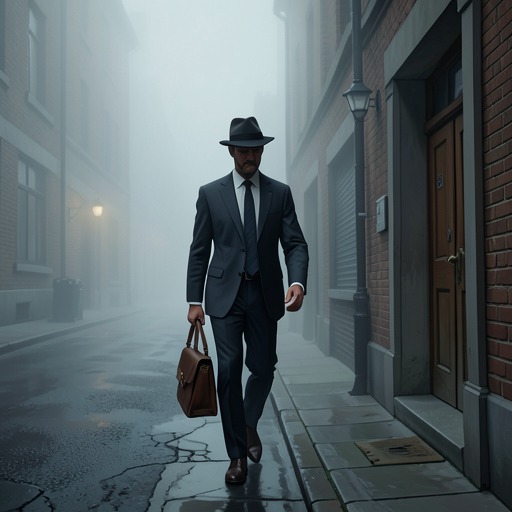
Years later, Guillermo describes himself as having lived like an underground militant since the spring of 1941, despite lacking a party card and carrying no weapons beyond medical instruments in an office briefcase. His practical contribution to resistance, he says, mattered more than his theoretical work on the Spanish National Union. This history explains why Manuel Arroyo Benítez’s later clandestine proposal excites him: Guillermo recognizes in it a continuation of the political life he has already been living, though he has spent years without a clear avenue for action.
His medical competence remains immediate and methodical. When Manuel reappears in Madrid, Guillermo prepares to treat him with the practiced efficiency of a wartime doctor: he boils water, clears and covers the dining table, lays out disinfected instruments, closes the shutters, and switches on the light. After treating Manuel, he shows him a bullet fragment that had been lodged beside the scars from El Pardo. He has nearly signed the wound as if it were his own handiwork, calling Manuel his masterpiece. The gesture joins professional pride to friendship, and the bodily evidence of their shared history to the domestic room in which Guillermo now works.
The reunion begins at the Café Lion in September 1946. Seven years have passed since the men last met. Guillermo initially struggles to recognize Manuel, whose foreign-looking suit, broad tie, hat, and English shoes are unlike the appearance Guillermo remembers from the final days of the war. Their earlier encounters had also presented Manuel in strikingly different forms: first with glasses and a thick beard, later clean-shaven and visibly younger. The changed appearance tests recognition, but Guillermo is already beside him before Manuel has collected his change.
Manuel Arroyo and the Escape Network
By March 1947, Guillermo is living as Rafael Cuesta Sánchez and working at a transport agency. He seeks out Amparo because she knows that Rafael is not his real name and that he is Guillermo García Medina, a doctor. What Amparo does not know is that he is trying to help Manuel, who has assumed the identity of Adrián Gallardo Ortega in order to infiltrate an organization helping Nazi fugitives reach Argentina.
Guillermo’s assistance is both personal and operational. After the Café Lion reunion, the two men see each other almost daily. Guillermo finds Manuel more discreet accommodation than his hotel, introduces him to his chess club, and helps him adjust to a Madrid that has become unfamiliar. Their companionship matters alongside the intelligence work: each has reason to trust the other with risks that would be difficult to share. Manuel remembers that Guillermo had already taken risks for him during the war, while Guillermo’s renewed involvement grows from both loyalty and the possibility of acting again.
Guillermo helps Manuel establish a credible cover story for entry into the network. He presents himself as a transport employee who encountered a destitute former Spanish volunteer at Legazpi and offered him a meal. In this account, Adrián is a wronged veteran seeking work, and Guillermo’s indignation at seeing such men reduced to begging supplies a plausible reason for his intervention. The performance draws on the contrast between his actual political history and the modest, apolitical employee he must appear to be.
The network’s methods sharpen the moral ambiguity of the work. Guillermo learns that it obtains authentic Spanish passports under fictitious identities and that the organization Manuel has entered was founded by a woman who recruited other women as collaborators. Its claims of helping persecuted men coexist with its role in facilitating fugitives’ escape. Guillermo’s covert involvement therefore requires him to move inside an institution whose humanitarian language cannot be separated from the protection it offers to Nazi fugitives.
When Clara Stauffer and an associate invite him to a meal, Clara does not introduce him, indicating that the other guest already knows his assumed name and the reason for his presence. Guillermo understands that the meeting is arranged to put Rafael Cuesta at a disadvantage, but he has seen a photograph of the man beside him and does not forget it. Clara frames his potential cooperation as a service that could help many men she describes as unjustly pursued, invoking Manuel’s case and suggesting that victories in offices can matter as much as victories on battlefields. Guillermo’s ability to listen without surrendering his own judgment is central to his usefulness as an infiltrator.
Secrecy, Documents, and Betrayal
The identities Guillermo uses protect him, but the people around him do not always understand what those identities conceal. He withholds his mission from Amparo, even as he seeks her help. In his account, she continues to call him Felipe when they are alone but does not know who he works for or why he and his companions have chosen to enter danger. He decides not to explain. Secrecy is a tactical necessity, yet it also makes trust uneven: those he protects may be acting without knowledge of the risks or the purposes of his work.
The rediscovered family documents expose a deeper rupture. Guillermo learns that Amparo has taken their son and that, while he was sheltering and feeding her, she cooperated with the men who ransacked his house. The search for the safe had left the hallway strewn with rubble and the study wall smashed; the safe was eventually opened and its contents taken. Guillermo believes that, without the replacement identity Manuel supplied, the betrayal could have led to his execution. Meg is convinced that Amparo’s associates denounced him, though the evidence does not establish whether Amparo approved that action.
The discovery changes how Guillermo hears his own history. He admits that he would not have narrated events in the way they are presented to him, yet the other account seems more coherent and introduces a new measure of resentment. He is urged not to regard the use of the family documents as blackmail because no money is to be demanded; the proposal is framed instead as an exchange. His response reveals how identity papers are both intimate records and instruments of leverage. The same documents that affirm a family bond can expose its fracture and become part of a clandestine bargain.
Violence, Family, and the Cost of Survival
Guillermo’s medical vocation eventually collides with an act he cannot understand as ordinary self-defense or heroic justice. On 29 December 1949, he kills a man in cold blood. He knows that a court would reject his claim to have acted in legitimate defense, but he believes the court would be wrong to deny that right. He has seen photographs of the massacre site at Klooga, including bodies prepared for burning and the remains of people reduced to charred matter. He knows the man he killed was a murderer, but says he did not act to play the avenger or the justiciar. The episode strains the identity he has built around saving lives: the violence remains an action he must own, not a role that his moral explanation can erase.
In October 1950, still under the name Rafael Cuesta Sánchez, he marries Rita Velázquez Martín at the Basilica of the Conception on Goya Street, close to the house where Guillermo had lived before the end of the war. The ceremony does not quiet his fear that the past is present. When the priest asks whether anyone objects, no one speaks, but the silence does not reassure him; his sense of threat persists through the wedding and begins to take shape before it is fully understood. A public marriage under the assumed name cannot settle the question of which life is being joined to the future.
The chess set remains in the sitting room as a private emblem of that divided existence. Manuel never becomes interested in chess, while Rita grows into a strong player, especially at speed. Guillermo promises that the set will someday be hers but does not let her take it to her room; it stays on the mantelpiece. He associates it with being a man called Guillermo García Medina who lives as Rafael Cuesta Sánchez, a doctor only partly and secretly, a leftist who has become wealthy working for Nazis, and a successful businessman who would exchange his office for a place in a neighborhood first-aid station. The set holds together identities that cannot be reconciled into a single public story.
Return of the Buried Identity
The separation between Rafael and Guillermo is not permanent. In a later encounter, a woman is certain she has never seen the man standing beside her, although she is wrong to think she does not know him. Elsewhere, a question directed to Rafael fails to reach the assumed identity and instead finds the missing, ostensibly nonexistent Guillermo García Medina. His true self answers. The passage gives the return a precise form: the name that has served as a shield can be bypassed, and the person buried beneath it remains capable of responding.
In 1968, Guillermo again uses an identity supplied by another person. Ángel Valverde Roldán’s lawyer’s card, lent by Ángel Valverde Roldán, and a court paper naming him as José Antonio Urbieta Priego’s defense lawyer let him enter Carabanchel Prison without difficulty. The documents are described as an excellent forgery, so convincing that Ricardo does not believe it is false. Once more, a borrowed public identity lets Guillermo reach someone endangered by the state. In this instance the impersonation is not a route into a fugitive network but a means of visiting his son in prison.
His decisive significance lies in the recurrence of this pattern. Guillermo’s identities are built to keep him alive and to make action possible: Rafael can work, marry, and approach the escape network; Ángel can pass through a prison entrance. Yet the old name survives in the family records, the chess set, the memory of friends, and the moments when someone addresses the person behind the cover. The disguises enable acts of care and resistance, but they also register the price of a life in which a doctor, a father, and a political fugitive must repeatedly occupy the same body under different names.