Guillermo Medina Acero
Los pacientes del doctor GarcíaGuillermo Medina Acero, known publicly as Don Guillermo Medina, is the narrator’s grandfather, a respected police commissioner whose hidden career as a writer paid for his family’s prosperity. His life is defined by a telling double existence: he publishes solemn historical dramas under his own name while secretly writing risqué songs and entertainments under a pseudonym, and passes to his grandson both a taste for private knowledge and a memory of humane, irreverent independence.
Identity and Public Life
In November 1936, Guillermo lives in Madrid’s Salamanca district, in a fine apartment at Hermosilla 49. The narrator recalls that the neighborhood remains outwardly quiet while distant bombs detonate and flashes light the sky elsewhere in the city. The apparent safety of the district is tied to its social standing: the Condor Legion’s pilots have been instructed not to bomb Salamanca, home to the city’s wealthiest families and to newcomers such as Guillermo, whose respectable position as a police commissioner has enabled him to buy an apartment through the concealed income of his triple life.
That public respectability is only one part of his identity. As a full-time policeman, he also writes plays in his spare time, presenting historical dramas in verse or prose each season under his own name and inviting his neighbors to their premieres. The serious plays, however, account for only a small fraction of his literary earnings. The work that brings in more money—and gives him greater pleasure—is written under a pseudonym.
Secret Writing and Family Fortune
Guillermo’s clandestine output includes vaudevilles, revue scripts, and, above all, cuplé lyrics. One of these songs, beginning with the image of a little hole that speaks at night, has become famous. Its risqué language stands in sharp contrast to the solemn historical dramas his neighbors associate with Don Guillermo Medina; no resident of Hermosilla 49 would suspect that the same man had written both.
The distinction between his public and secret writing is not merely artistic. The narrator describes the hidden production as much better than Guillermo’s dramatic work, and says that writing it amuses him more, even as it makes him feel guilty. Its proceeds support the family’s comfortable life, buy them a small house in Zarauz, and pay for the narrator’s medical education. They also help explain how a police commissioner came to afford the Salamanca apartment. Guillermo’s private authorship is thus at once a source of pleasure and a material foundation for the life his family takes for granted.
Chess, Childhood, and Amparo
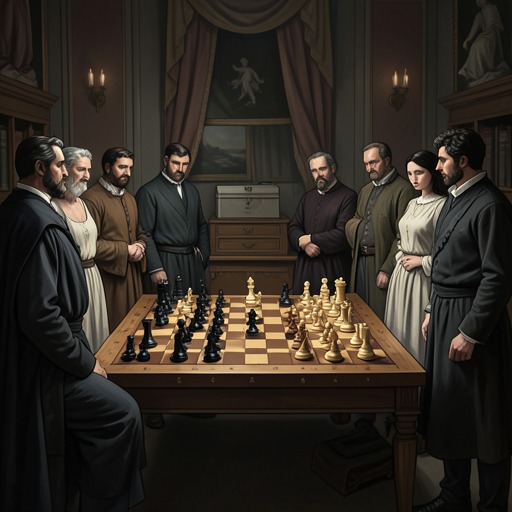
Guillermo’s relationship with his grandson is remembered through the repeated ritual of chess. Until death made another game impossible, he and Don Fermín played every Sunday afternoon, alternating between their two houses like opposing football teams taking turns at home. Their level was close, though Guillermo usually won six games out of ten. His grandson would eventually surpass that record; before Guillermo taught him to move the pieces, however, the boy was already accompanying him to the matches.
The visits also gave the child company. Don Fermín’s maid, Experta, was a poorer cook than the narrator’s household’s cook, and she often burned the picatostes, but Amparito’s presence outweighed the kitchen’s failures. Amparo lived with her grandparents despite having a living father: her engineer father worked for a German company exploiting mineral deposits in Huelva, and her mother lived with him beside the mine, far from the nearest village. The parents sent their children to Madrid as they reached school age. Amparo, the youngest, became the narrator’s only companion of his own age on days without classes.
The children invented new games each week, but most loved hiding together: in a wardrobe, the pantry, or behind baskets in the ironing room. They would hold hands, whisper, and stay still until the adults’ calls revealed that the search had spread through the house. Their favorite hiding place was inside the hollow lower section of a huge custom-built bookcase in Don Fermín’s study. The furniture’s concealed cavity, like Guillermo’s own hidden work, makes secrecy part of the domestic world the children inhabit, though their game is an innocent one of shared refuge and complicity.
Death and Remembered Beliefs
Guillermo’s death leaves a public memorial that states plainly the principles by which his grandson remembers him. His gravestone identifies him as a republican and freethinker and carries the epitaph he chose: “HIS ONLY HOMELAND WAS HUMANITY.” The narrator had the words engraved in granite on the eve of the burial. They condense a political and ethical identity that resists the narrower claims of faction or nation.
The funeral is conducted without a priest, but the narrator recalls it as beautiful and solemn. Miguel Salcedo takes the farewell letter from the grieving grandson when he cannot continue reading its central passages, reads them for him, and returns it so he can finish. An organ grinder plays “La Marsellesa” before the ceremony and the Himno de Riego afterward; mourners cry and embrace as the grave fills with flowers bearing tricolor ribbons. Guillermo’s beliefs are therefore present not only in the inscription but in the form of the farewell itself.
His wife does not attend the cemetery, believing funerals unsuitable for respectable ladies. Hearing what happened, she regrets staying away and asks whether it would be a sin to be buried beside the husband she had loved so much. The narrator tells her to consult her confessor, while recognizing that the sight of how many people loved Guillermo has comforted her. In the family’s recollection, his reputation is not simply the product of professional respectability: it is confirmed by the affection gathered around his grave.
Inheritance and Narrative Significance
A later exchange between Guillermo and his grandson turns secrecy into an act of trust. The boy expects a chess game, but Guillermo unlocks a desk drawer that is always kept closed and hands him a folder full of typed pages. The grandson anticipates another solemn historical drama—stories of Inés de Castro, Juana la Loca, the Comuneros, or El Cid—but the title page instead reads Orgía en Constantinopla. The author is named as Federico Ramos, an unfamiliar pseudonym, and the cover lists other works by the same supposed writer, including El capricho del serrallo and La molinera traviesa. When the grandson asks whether Guillermo wrote it, he laughs and confirms that he did, adding that his wife must not find out.
The scene links the grandfather’s private writing to the closeness between the two men: the locked drawer and false author’s name conceal a body of work, while the shared secret makes the grandson its first confidant within the family. Across the novel’s recollections, Guillermo’s concealed authorship, Sunday chess, and chosen epitaph offer different forms of inheritance. He leaves behind material security, a relationship organized around play and trust, and a humanist self-description that outlasts the respectable public identity through which the world knew him.