Hospital de San Carlos
Los pacientes del doctor GarcíaHospital de San Carlos is the wartime hospital where Guillermo García Medina’s work as a surgeon takes shape under siege, scarce supplies, and political danger. More than a place of treatment, it becomes the center of an ethic: attend to the wounded body before asking which faction the patient belongs to, while recognizing that such care can draw a doctor into conflicts beyond the operating room.
Wartime setting and working conditions
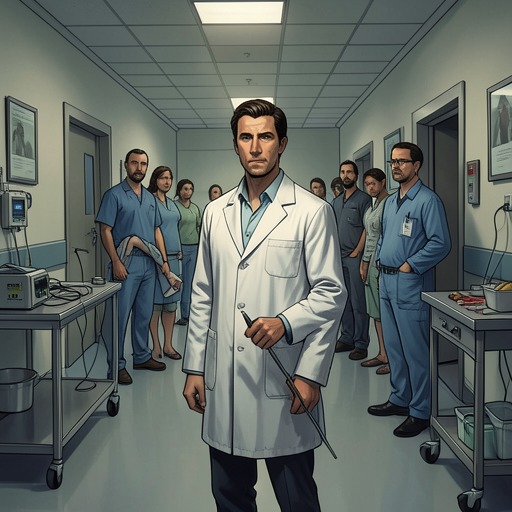
At two in the morning on 19 November 1936, Guillermo had been confined to Hospital de San Carlos for nearly forty-two hours. He had managed only a brief sleep on a cot in the guards’ room and had drunk large amounts of coffee; the rest of his time there had been consumed by the ordeal of wartime hospital work. The detail establishes the hospital through accumulated hours of labor rather than through a description of its architecture: its rooms are places where sleep is interrupted and a shift can expand beyond any ordinary limit.
The pressure continued into 20 November. Guillermo collapsed on the cot in the guards’ room, and a massive bombardment began minutes later. When a nurse woke him, he had slept almost five hours and felt recovered enough to return to work. From then until Fortunato Quintanilla sent him home again, Guillermo worked for more than twenty-two hours with scarcely a break. Bombardment does not pause the hospital’s activity; it makes the workers’ exhaustion part of the same emergency as the patients’ needs.
Surgery and the duty to treat
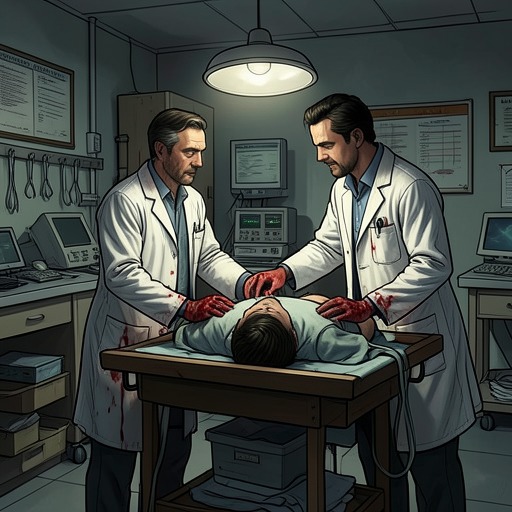
The hospital’s clinical decisions are repeatedly made under pressure. When a wounded man arrived with three gunshot wounds, Guillermo assessed the trajectories and found that none had struck a vital organ. The patient had lost so much blood that Guillermo gave him a bottle of universal-donor blood before determining his type, unwilling to spend even the two minutes the additional procedure would take. Once he learned that the man was B positive, he asked for the patient’s name, but no one answered. The sequence makes the urgency of treatment concrete while leaving the patient’s identity unresolved at the point when care begins.
Guillermo reflects that he had never asked about his patients’ political affiliations in the hospital. In surgery, he encountered a vulnerable human body like any other and tried to repair it as well as he could. The wounded man he rescued outside that ordinary hospital routine presented a harder question: Guillermo had taken responsibility for a victim of political violence without knowing who had attacked him or why. The patient might himself have been a gunman affiliated with a rival party, or someone targeted by members of his own faction. The uncertainty does not cancel Guillermo’s obligation to treat him; instead, it exposes the risk of applying the hospital’s practice of care in a setting where treatment can be interpreted as taking sides.
The supply crisis later made the work still more difficult. In a scene at the hospital, a young volunteer arrives with catastrophic injuries to his legs and asks for help. With medical supplies exhausted, Guillermo has no anesthetic available. He uses a cauterizer to make the patient lose consciousness through pain, then searches his pockets for two carefully saved aspirin tablets and gives them to the nurse. The episode shows how shortages altered practice: the surgeon’s skill remained essential, but it could not replace the medicine and equipment the hospital lacked.
Organization and medical service
Fortunato Quintanilla’s leadership helps keep the surgical ward functioning. He could track admissions and discharges, the surgeons available, which operating rooms were occupied or free, and how long each member of the team had been working without consulting a paper. In November 1936, while supplies were not yet the principal difficulty, no subordinate could remain in the hospital for more than forty-eight hours without Quintanilla noticing and sending that person home to sleep. His management thus addressed not only the flow of patients but also the exhaustion of the staff on whom their care depended.
Quintanilla’s practical skill became even more important when the hospital later faced shortages of medicines, instruments, and food for patients. The account credits his organization with keeping the surgical ward of Hospital de San Carlos operating under conditions described as nearly miraculous. The hospital’s survival therefore rests on more than the doctors’ individual endurance: it also depends on the often-unseen work of monitoring capacity, supplies, staffing, and rest.
The hospital was linked to the Canadian transfusion service established on Príncipe de Vergara. After news reached Hospital de San Carlos of a lifesaving achievement at Casa de Campo, Quintanilla devoted himself to securing a smaller transfusion unit for the surgical ward, modeled on the Canadians’ service. The effort connects the hospital’s needs to medical work elsewhere in Madrid and makes transfusion a continuing institutional concern, not merely an emergency measure at the operating table.
People and connections beyond the wards
Hospital de San Carlos is also where Guillermo’s personal friendships and professional life converge. Ignacio Fernández Muñoz, a law student who had volunteered when conditions became dangerous, became a close friend. Guillermo had operated on him seven times over the previous year for wounds that appeared severe but had not damaged vital organs. Ignacio’s courage in both the operating room and the trenches made him a popular figure associated with Madrid’s defense, while the repeated operations brought his wartime experience directly into the hospital’s daily work.
The hospital’s demands shaped Guillermo’s relations outside it as well. On one evening he sent a man home by motorcycle with a note for Amparo. Guillermo had transferred to his hospital service the useful equipment for mobile transfusion units, but had left the operating room, instruments, and one of the original sterilizers at Príncipe de Vergara. Because he could not take his patient to Hospital de San Carlos, he considered that address the best place to operate. A hospital’s reach in the story therefore extends beyond its own rooms: equipment, trusted acquaintances, and other usable clinical spaces form part of the practical network through which care is delivered.
The hospital also anchors the transmission of information. After Felipe Ballesteros Sánchez died for the second time, a coded letter was sent to the Secretary of the Presidency of the Government under a strange return address naming the transfusion service at Hospital de San Carlos and the Sierra Pambley Foundation. The code was based on the Bailén edition obtained by Pepe Moya, and, once deciphered, the message identified Guillermo and his hospital. It travelled to Valencia through the special mail available to the Madrid Defense Council. Guillermo expected that doctor Velázquez, whom he had met through the Canadian delegation and later shown the mobile units, would recognize him. Velázquez treated the letter as a report on the mobile transfusion service and placed it in the outgoing mail without reading the return address. In this episode, the hospital’s medical identity provides cover for a message whose significance lies beyond ordinary clinical administration.
A place revisited across a life
The hospital remains a point of reference long after the siege. When Amparo’s son develops a fever, Guillermo promises to call Quintanilla, who is still working at a clinic and may know a specialist. He suspects rheumatic fever, but presents this as a diagnosis to be checked rather than as a certainty. Quintanilla’s continued availability links the wartime hierarchy of care to later family life, while Guillermo’s response preserves the practical reliance on professional connections established during the war.
Hospital de San Carlos is significant because its medical purpose is continually tested by its circumstances. Staff work through bombardment and extreme hours; shortages force painful compromises; and patients’ political identities can make lifesaving care dangerous. Yet the hospital’s story is not only one of crisis. Quintanilla’s exacting oversight, Guillermo’s refusal to make political affiliation a condition of ordinary treatment, and the transfusion service’s ties to other institutions show how organized care persists through a collapsing wartime environment. The hospital also leaves the wards behind in coded correspondence, clandestine assistance, enduring friendships, and later family decisions: a place where the body is treated, and from which consequences travel outward.