Impunidad de los criminales de guerra
Los pacientes del doctor GarcíaImpunidad de los criminales de guerra is the condition in which political protection, false identities, and official inaction keep perpetrators beyond the reach of justice. The novel traces it across distinct settings and periods: from the clandestine handling of a wounded Republican whose identity must be concealed to Francoist Spain’s protection of Nazi fugitives, and finally to the unacted-upon intelligence that could have exposed them. Its central irony is that the routes, names, and evidence are available; what fails is the political will to use them.
Wartime concealment and the machinery of impunity
During the Spanish Civil War, a wounded man is brought to an infirmary under the assumption that he is dead. A military commander finds a credential from the Public Order Council of the Madrid Defense Council in his wallet and telephones for instructions. The caller, Commissioner Basilio Rodríguez, orders that if Rafael Cuesta Sánchez is dead, he must be buried as an unknown person without registration; if alive, he must be kept alive at any cost and admitted to no hospital under his own name, lest someone try to kill him again. The commander receives no explanation beyond the claim that the man is vital to the Republic. Concealment here is protective rather than criminal: a hidden identity and an unregistered burial are used to prevent an assassination, showing how secrecy can serve survival even as similar methods later help perpetrators evade accountability.
That wartime distinction does not make the machinery morally neutral. In Madrid, the narrator returns to find his home ransacked after Francoist forces enter the city. A sledgehammer has broken the wall around his grandfather’s office; a safe has been removed, and Don Fermín’s gold is gone. Family wills and the house deed lie trampled on the floor. The narrator’s locked drawer, however, still holds the envelope Manuel gave him, untouched. The home’s destruction and the surviving secret papers place the physical traces of private life beside the evidence that may outlast political defeat. The narrator stays inside with the shutters closed and no lights for three days, unable to decide what to do.
Protection through nationality and political calculation
The postwar system operates not only through hiding places but through paperwork and state authority. The Allied List of 104 identifies Germans considered especially responsible for advancing Hitler’s regime and sought by the courts. Spanish Foreign Minister Martín-Artajo delays, then answers the Allied demands with documents and certificates that his interlocutors have never seen. The excuses vary: some men have already been granted Spanish nationality, some are protected because of their service to the Nationalist Army, some cannot be found, and others are shielded by economic or religious considerations. The process converts administrative discretion into a barrier against extradition.
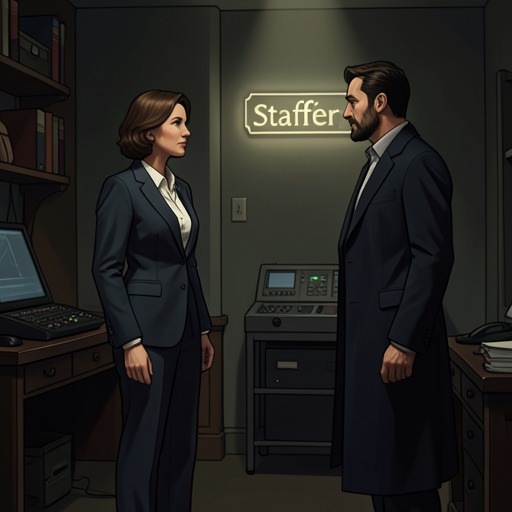
The list’s sole woman is Clarita Stauffer, whose correct Madrid address is given as 14 Calle Galileo. The Allied description identifies her as a principal organizer of a secret aid association involved in supplying false papers and finding jobs for Germans; it says that she received special permission from the German embassy to obtain Spanish nationality in order to continue such work after defeat. The specificity of the address and the account of her activities make the failure to reach her more than a problem of missing information. Her case belongs to a broader pattern in which nationality and official protection turn a refuge into a destination or a transit point for fugitives.
The novel also sets the Spanish protection of war criminals against the legal fate of Jean-Jules Lecomte. During the occupation of Belgium, Lecomte, a member of both the Rex Party and the SS, persecuted Jewish families in Chimay. He forced his way into convents where nuns had hidden Jewish children under false names, shot nuns, detained superiors, and identified the children; they were deported, and none returned. After the war he was tried in Charleroi and sentenced to death in absentia, but was never captured. The contrast clarifies the difference between a judgment and its enforcement: a court could name and condemn a criminal while still being unable to bring him into custody. In Madrid, the further obstacle is not simply that a fugitive cannot be found, but that a state may choose to protect him.
Evidence gathered, justice withheld
Manuel Arroyo’s work makes the failure of enforcement tangible. After years of exile and intelligence work, he assembles the Informe Pacheco, a document of more than four hundred single-spaced pages accompanied by nearly a hundred photographs. It records false and authentic names, private and professional addresses, dates, places, sea and air routes, and even the flight number by which Manuel himself arrived. The report’s precision turns information into a potential arrest operation: as Manuel explains, the authorities could have detained a hundred war criminals in Madrid and Buenos Aires in a single night simply by going to their addresses.
Its pages include Clarita Stauffer, Ingrid Weiss, Eberhard Messerschmidt, Hans Lazar, Johannes Bernhardt, Ante Pavelić, Walter Kutschmann, Jean-Jules Lecomte, Darquier de Pellepoix, Léon Degrelle, and Otto Skorzeny. The report is so exhaustive that it also lists the men who attended Manuel’s Spanish conversation classes. When the narrator recognizes them there, the catalogue’s reach becomes intimate: the machinery of escape is not an abstract foreign network but something that has entered Manuel’s ordinary life. Yet the document’s comprehensiveness only sharpens the reader’s sense of failure. The information exists, and the people are identifiable; the arrests do not follow.
Manuel says the authorities praised his work, but did not act on it. The CIA tried to recruit him, and he refused. He feared that keeping a copy of the report might endanger him, yet he could not bear the thought that the original would be destroyed in a Washington office. He kept his copy in a safe he installed in the wall after marrying Simona. When Perón fell in 1955 and Nazi fugitives in Argentina became less protected, he was glad he had not destroyed it. The report’s survival is thus both an act of preservation and evidence of the long interval between recording a crime and making accountability possible.
Political abandonment and the cost of remembrance
Manuel considers sending the report to Simon Wiesenthal or another Nazi hunter, but he has a wife and young children, and the fugitives in Buenos Aires know who he is. More fundamentally, he doubts that bringing them to justice would change anything in Spain: Franco would laugh, and no one had moved a finger for the Republicans. He frames his retreat as an exhausted response to abandonment, not as a claim that the crimes were harmless. His copy remains locked away for years, while the promise of universal justice feels detached from the political realities that have repeatedly defeated it.
The narrator’s response shows that the failure is not confined to legal procedure. He says that films about Nazi murderers are unbearable to him and that he switches them off before waiting for the title. Manuel recognizes the shared wound: they risked their lives believing that others had understood they were on the right side, only to discover that even this had not brought them into the company of the victorious or the protected. In this account, impunity has two consequences. Perpetrators remain beyond reach, while those who gathered evidence and fought for justice are left with fear, disillusionment, and memories that the official world has declined to honor.
The novel’s historical pattern
The contrast between Republican wartime concealment and postwar protection of Nazi fugitives keeps the concept from collapsing into a simple story about secrecy. The commander’s concealment of Rafael is ordered to thwart a second attempt on his life; the later concealment of fugitives depends on state-backed nationality, false documentation, and diplomatic delay. The same broad instruments—unrecorded identities, hidden whereabouts, and paperwork—can protect a threatened person or obstruct accountability, depending on who commands them and toward what end.
The novel extends this pattern beyond Spain. Under Argentina’s military dictatorship, political violence is organized through illegal arrests, secret detention, torture, executions, disappeared bodies, and the theft and reassignment of children’s identities. The machinery of repression makes disappearance an instrument of state power: it attacks people and also suppresses the records and relationships that might establish what happened. Set beside the Nazi escape network and the unpursued names in Manuel’s report, this later history underscores how official force can produce impunity not only by sheltering perpetrators but by controlling evidence, identity, and the prospects of investigation.
Manuel’s file is the counter-image to that erasure: names, addresses, photographs, dates, routes, and crimes held together in one stubborn archive. It does not itself deliver justice, and its preservation does not undo the choices that left the fugitives free. But it prevents political inaction from becoming the only surviving account. The novel’s bleakest judgment is therefore also a distinction: failure to prosecute is not the same as absence of evidence, and a record kept in defiance of that failure can preserve both the crimes and the history of those who were refused a hearing.