Jan Schmitt
Los pacientes del doctor GarcíaJan Schmitt is a fugitive war criminal whose postwar survival depends on converting a borrowed refuge into a convincing civic identity. Hidden by Agneta Müller in the last days of the Third Reich, he becomes Johannes Grunwald through the assistance of her family, joins the municipal police, and builds a life that conceals his criminal past. His later recognition and rescue of Adrián Gallardo expose the fragile boundary between refuge and impunity: Jan has escaped notice, but he has not escaped the networks and histories that made his reinvention possible.
Identity and refuge in Berlin
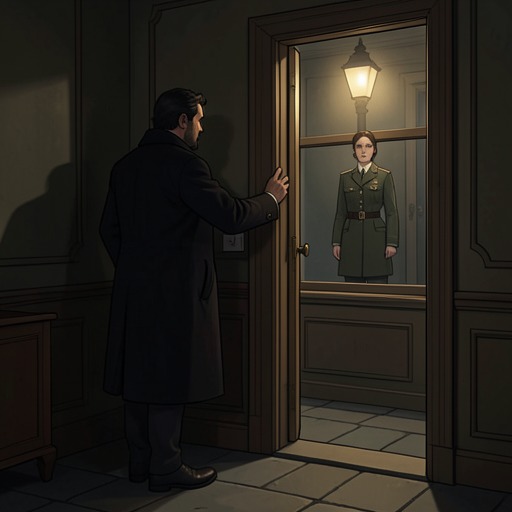
On 30 April 1945, Agneta hid Jan in a small storage room reached through the courtyard before going upstairs to her parents’ flat. Her father, Rudolf Müller, received her with anguished affection; her mother, Beate, greeted her with kisses and no reproach. That evening, the family ate boiled cabbage and a little bread. Agneta had saved her portion for Jan, and her younger brother Rudi gave up his own piece when he saw how quickly she had eaten hers. The intimate details of the meal register both the household’s hunger and the risk it accepted by sheltering a fugitive.
Jan’s presence in the flat was a secret held within a family already divided by the collapse of the regime. Agneta described him to her father as an ordinary soldier without criminal responsibility. She did not know about Klooga and therefore did not knowingly conceal that history from the family. Beate supported her daughter from the beginning, seeing assistance to Jan as a final chance to serve the Reich she had once loved. Rudolf, by contrast, never developed the same sympathy for his daughter’s boyfriend, though he eventually acted to protect him.
From fugitive to Johannes Grunwald
Jan spent months presenting himself as a diligent and affectionate partner. He took on domestic repairs left unfinished by the war, joining wires, fixing lamps and furniture, and painting the house before the end of 1945. The work was often clumsy, but his willingness to do it earned him a small neighborhood clientele. He still lacked secure papers and hid from Agneta and her parents that he was seeking work as an undocumented man, so no one would record the number on his Argentine passport. He had already burned his Belgian identity in the same fire in which his friend Adrián would destroy his own identity the next day.
In spring 1946, Agneta asked Rudolf for help with what she called her chance to be happy. He objected that the request would be a crime. When one quarrel ended with Agneta taking a kitchen chair to reach the suitcase on top of the wardrobe and beginning to pack, her father capitulated. At dinner he asked Jan for his father’s second surname. The next day, Rudolf completed and stamped a certificate of residence that made Jan Johannes Grunwald, born in Schöneberg and officially resident there at Roswitha’s flat. Roswitha agreed to house him for a few weeks, reducing the risk that an inspection would expose the arrangement.
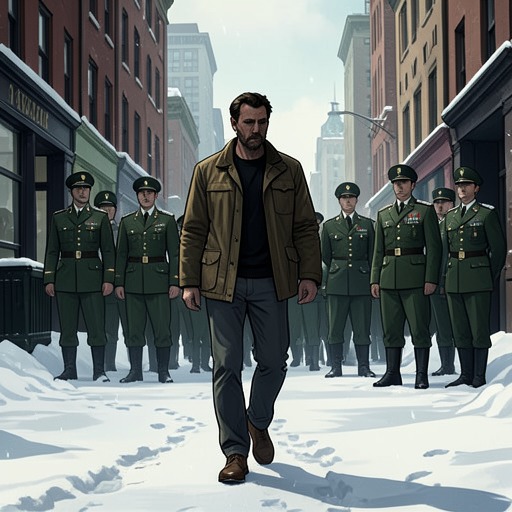
The certificate opened a path to a municipal police post in Schöneberg, a job reserved for citizens born and resident in the district. Jan obtained it with little difficulty, aided by Rudolf’s friendship with the occupying authorities. His transformation was therefore not simply a matter of assumed names: forged belonging became administrative fact, and the uniform gave that fact public force. The people he had known in Berlin never discovered that the man now patrolling the neighborhood was a war criminal. His trail disappeared on his first day on patrol.
Marriage, family, and concealment
Jan and Agneta married in June 1946 as Johannes and Agneta Grunwald. They would have preferred a home of their own, but Beate’s condition and the price of rents led them to remain in the Müller household. Their first son, Rudolf, was born there in February 1947. The domestic future that followed Jan’s escape thus grew inside the same family home that had initially concealed him, while the new name and official employment made the concealment durable.
The story sharply distinguishes what Agneta and her family believed from what Jan actually was. Agneta said he had no criminal responsibilities, and the account makes clear that she had never heard of Klooga. The family’s aid rested on her understanding of him as a soldier in need, while Jan’s successful reinvention depended on that limited knowledge, Rudolf’s intervention, and the credibility of local records. The result is not a clean redemption: the family’s generosity is real, but it also gives a war criminal the papers and position needed to disappear into ordinary civic life.
Recognition and the rescue of Adrián
On 23 December, after the cold had made excursions to Schöneberg impossible, Jan found Adrián Gallardo near the Salvation Army canteen in Berlin. Adrián had been living precariously around St. Hedwig’s Cathedral, hungry, dirty, without warm clothes, and so weakened that he had begun to consider returning to Spain even if it meant prison or execution. He had been surviving the winter by spending hours in the cathedral, where he could rest and sometimes sleep indoors, and by queuing for food.
Jan called to him from across the street, recognizing him by the nickname Tigre. Adrián collapsed before he could answer. When he came to, he still heard the same voice and could make out Jan beneath the brim of his police cap. Jan stayed with him, telling him to remain calm and that it was over; his recognition brought an immediate end to Adrián’s isolation and desperate search for survival. The meeting also reveals a striking reversal: Jan, who had once needed concealment and protection himself, now appears in the authority of a uniform and becomes the rescuer of another fugitive.
Jan’s small part in the larger escape history is defined by this double position. In Berlin he benefited from a household willing to shelter him and an official document that turned an assumed name into a usable life. Later, he used his new position and his memory of Adrián to offer help in turn. But the rescue does not erase the circumstances of his own escape. His settled identity as Johannes Grunwald remains an instance of how postwar protection could turn concealment into apparent normality, leaving a criminal past hidden behind the routines of marriage, work, and patrol.