Norman Bethune
Los pacientes del doctor GarcíaNorman Bethune is a Canadian physician and researcher whose work in Madrid transforms blood transfusion from a direct connection between donor and patient into a practical service capable of reaching soldiers at the front. His refrigerated-blood method saves lives during the Spanish Civil War, while his brief partnership with the narrator establishes a model of medical service that outlasts Bethune’s own presence in Spain.
Identity and Arrival in Madrid
Born in 1890 in Gravenhurst, Ontario, Bethune comes to Madrid on 14 December 1936 after weeks of arrangements and fundraising in Canada. His journey crosses the Atlantic, continues by road through France, and then proceeds through a divided Spain. He has long wanted to reach the capital; arriving at 36 Príncipe de Vergara Street, after the difficult journey, is the fulfillment of that aim.
Bethune comes to serve the Madrid Defense Council and the Republican government. The authorities provide him with a large, fifteen-room apartment formerly occupied by a German diplomat who has left after the military uprising. The International Red Aid occupies the floor above, placing Bethune’s operation within a wider network of relief and Republican support. His arrival is therefore both the arrival of an individual physician and the establishment of a Canadian-backed medical mission in the besieged city.
Building a Blood-Transfusion Service
Within hours, Bethune and his collaborators turn the apartment into a laboratory and treatment center. They remove the furnishings and install equipment unfamiliar in Spain at the time, including an Electrolux refrigerator, a large autoclave, sterilizers, and supplies for surgery and blood work. The portable equipment is especially important: fifteen packs contain bottles, solutions, and sterilized instruments, allowing the service to move beyond the fixed rooms in which it begins.
The Canadian Institute of Blood Transfusion asks Madrid residents to donate blood through newspaper advertisements and radio appeals. The appeal is made outside a hospital, and the team does not know how the public will respond. Its ambition is to preserve donated blood for later use, rather than rely on direct transfusion from a donor beside the recipient. On the first morning set aside for donations, volunteers are already queuing around the corner before the Institute opens. Civilians and soldiers of different ages and occupations come forward, with women making up the larger share of donors.
Donors give half a liter of blood while fasting. Each bottle is mixed with sodium citrate and labeled with the blood group, extraction date, and donor’s identity. Donors receive a drink of brandy and a food voucher; as the siege worsens, the Institute also gives a tin of beef to each donor. The response fills the largest available refrigerator in little more than three days, even as people continue to queue outside the Institute each morning. The scale of the donations demonstrates that the service depends not just on medical equipment but on the participation of Madrid’s civilian population.
The First Front-Line Transfusion
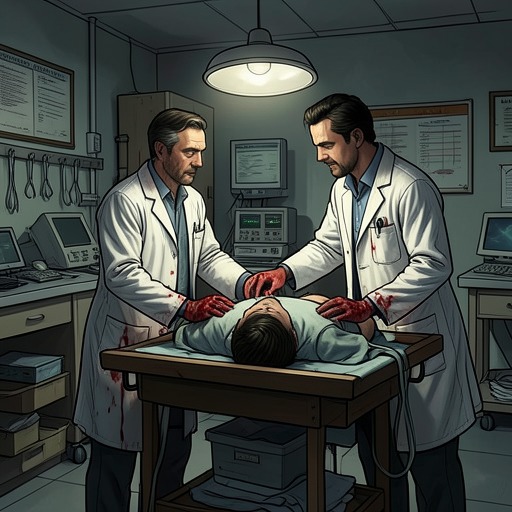
On 23 December, Bethune and his team load portable equipment and blood of different groups into a truck and travel to the Hospital de Sangre de la Casa de Campo, near the front. There, he chooses a young soldier who has lost so much blood that the hospital doctor considers him beyond help. Bethune identifies the soldier’s blood group and begins the transfusion using stored blood carried to the site.
The soldier responds after receiving the first bottle, but Bethune gives him a second because the blood loss has been so severe. The patient then looks at Bethune and smiles. This intervention establishes the decisive practical difference of Bethune’s technique: a donor no longer has to be physically present and connected directly to the recipient. Blood can be collected, preserved, transported, and administered where it is needed.
The account identifies this as the first successful transfusion of refrigerated stored blood to restore a patient considered beyond saving. The same morning, Bethune’s intervention revives twelve soldiers at the Casa de Campo hospital. The first survivor’s name is not recorded. His companions mark his return to life by giving him a cigarette, and the hospital’s response becomes an expression of collective relief and solidarity. The revived soldier adds his own exclamation, but Bethune does not understand the words; their effect on him is nevertheless clear, and the moment makes him profoundly happy.
Departure and Continuing Work
On 11 January, Bethune visits the narrator at San Carlos Hospital to say goodbye. He is preparing to travel with his team to other fronts. Although the Canadian Institute will continue operating with Spanish staff, he asks the narrator to take charge of the mobile service. The narrator’s care for a patient in Aravaca has already attracted public attention and helped the hospital director yield to pressure from Dr. Quintanilla; Bethune’s request gives him a new responsibility in the work.
The narrator finds that the method is simple enough to teach quickly. In less than a month, he organizes half a dozen mobile units without leaving his hospital post. Those units begin serving the fronts around Madrid, while the narrator also takes charge of the transfusion service established at San Carlos with a Canadian donation of a refrigerator. Bethune’s departure thus does not end the project: the portable system and trained local personnel allow it to continue and expand.
Medical Ethics and Legacy
Bethune’s influence is present in a broader medical ethic that the novel develops through the narrator. In the hospital, the narrator says, he has not made a patient’s political affiliation a condition of treatment: he encounters a vulnerable human body and tries to repair it. His account of treating a politically targeted patient makes explicit the principle behind that practice—his obligation as a doctor is to save lives, even when he does not know the patient’s motives or political role. Bethune’s work supplies a material counterpart to that ethic: blood collected from many donors is preserved for whoever needs it, rather than tied to a single immediate donor-recipient pair.
The narrator’s later recollections also preserve Bethune as part of the history of his own life. A photograph of the two doctors appears among the documents he finds years later, alongside his medical degree and family papers. The image records a period when the narrator’s work was publicly associated with the transfusion service, even though he believes that the attention gave him more prominence than he deserved. Bethune devised the method; the narrator’s subsequent work depended on making it usable across multiple fronts.
The novel also extends Bethune’s significance beyond the wartime episode. A son is named Manuel, after the name shared by his parents’ best friends, and the child’s early development recalls to the narrator the first son he lost from his daily life. Bethune is one of the figures whose work and presence belong to the narrator’s earlier wartime history, now preserved in the documents and memories that later generations encounter. His legacy in the story is consequently both medical and personal: refrigerated blood becomes a means of saving soldiers, while the photograph and the narrator’s recollections make the work part of a history handed down through family life.