Peter Louzán’s American passport
Los pacientes del doctor GarcíaPeter Louzán’s American passport is the credential Manuel Arroyo Benítez uses in Buenos Aires to pass as a United States citizen, obtain a postal box, and place a discreet international call. In a life shaped by invented identities, it is especially effective because it presents him not as another Spanish fugitive but as an ordinary foreign traveler whose papers are accepted at a glance.
The Passport Among Many Identities
By the time Manuel reaches Buenos Aires, his documents preserve several incompatible versions of his life. He has used the name Rafael Cuesta Sánchez, first as a fictional identity supplied by the Republic and later in documents he prepared for Guillermo García Medina. He also retains his genuine Republican passport, which connects him to his birth in Robles de Laciana and to his parents, Juan Arroyo and Gertrudis Benítez. A Republican diplomatic passport had enabled him to obtain Swiss residence papers under the name Felipe Ballesteros Sánchez, recorded as stateless. His current Spanish passport identifies him as José Pacheco Hernández; he has no official papers in the name of Adrián Gallardo Ortega, the fugitive whose identity he has used.
Against this crowded documentary history, Peter Louzán’s valid United States passport offers a different kind of cover. The bearer is recorded as a United States citizen born in 1910 in North Arlington, New Jersey. The passport is not his authentic identity, but it has a practical authority that the expired documents and concealed histories cannot provide: Manuel considers no other document as effective at dispelling a clerk’s suspicions when an unfamiliar person stands at a counter.
A Credential Put to Work
The passport’s first use in Buenos Aires is administrative and deliberately impersonal. At the central post office, Manuel asks for a box for commercial activity and explains that his name should not appear on its correspondence. When the employee examines his passport, Manuel learns that Argentine post-office boxes are called casillas. The clerk tells him that the service is concerned with the numbers, not the names, and hands him the key to box 1,924, which has just become available. The exchange shows the passport opening access without requiring Manuel to expose the identity under which he receives mail.
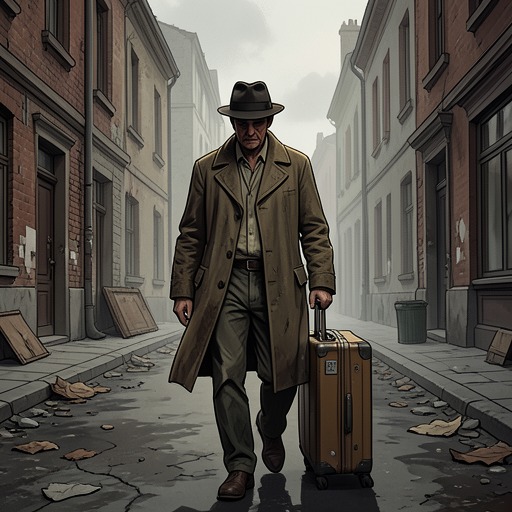
On January 6, 1949, Manuel uses the same American identity to register for one night at the Hotel Crillon. He refuses help carrying his luggage to the third floor, preventing anyone from inspecting a small suitcase that he bought only ten minutes earlier to avoid the suspicious appearance of arriving at a hotel without one. The suitcase is empty. His briefcase contains little more, though he takes out newspapers and a book and reads until half past one. These small acts of ordinary travel are part of the disguise: the passport makes the assumed nationality plausible, while his conduct supplies the familiar habits expected of a visitor.
The Call to Pablo de Azcárate
Manuel chose the modern, expensive hotel because its lobby had telephone booths from which he could place a call to Europe. He already expects that the booth will be available, but registering under a false name at a hotel allows him to use it without making the call from a location linked to him. He cannot rule out British monitoring of a public telephone conversation, particularly because Pablo de Azcárate is a diplomat with responsibilities in the Arab-Israeli conflict; the possibility shapes his caution even though he believes Argentine intelligence is unlikely to monitor calls from public phones.
When the operator connects the call, a Spanish-speaking woman’s voice overlaps hers. Manuel recognizes the woman but does not greet her. He asks in English for Azcárate, avoiding language or familiar forms of address that might identify him. The passport does not itself make the call safe; rather, it supports a chain of precautions that includes the hotel registration, the public booth, and the choice of language. Manuel can reach his longtime employer while withholding his own name, and Azcárate answers in a way that likewise avoids naming him.
Documentary Identity and Survival
The passport’s importance emerges through its contrast with the other papers Manuel has carried, altered, destroyed, or kept. He once burned the Republican document issued in the name of Rafael Cuesta Sánchez before traveling to Madrid with a replacement bearing the same name for Guillermo. Yet he cannot bring himself to discard the authentic passport issued to Manuel Arroyo Benítez: despite the danger of retaining it, it remains a link to his family and birthplace. The passport of Peter Louzán serves the opposite purpose. It does not preserve the past; it makes a new passage through the present possible.
Across the wider story, forged or repurposed documents do more than label their bearers. Rafael Cuesta Sánchez’s papers allow Manuel to return to Madrid and later let Guillermo assume a fabricated history that can survive official scrutiny. A false municipal registration allows Jan Schmitt to become Johannes Grunwald and obtain a police post in Schöneberg. At Galileo 14, fugitives are supplied with food, clothing, lodging, work, and baptismal records bearing German names. Peter Louzán’s passport belongs to this recurring world of administrative identities, but its use in Buenos Aires is particularly economical: one valid-looking national credential is enough to obtain a numbered post-office box and enter a hotel under cover of a routine traveler.