Red Stauffer
Los pacientes del doctor GarcíaRed Stauffer is the clandestine escape network organized around Clara Stauffer in postwar Madrid. Its operation joined the ordinary work of sheltering and resettling fugitives to a larger, politically dangerous system of forged documentation and suspected routes out of Spain. The same structure that made escape possible also created a trail of people, papers, and relationships that Manuel Arroyo Benítez hoped to expose.
Organization and Methods
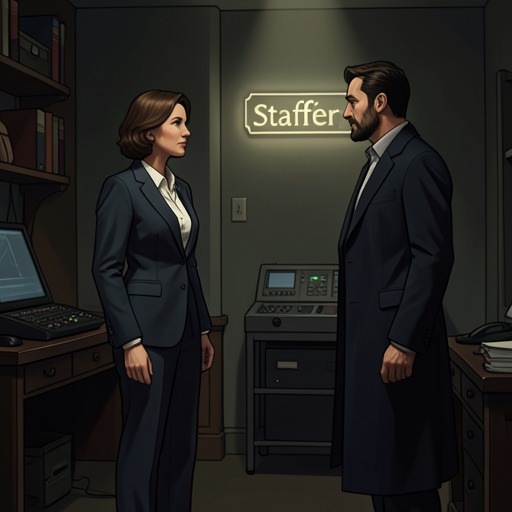
In the summer of 1945, Clara renovated two rooms of her house to serve as an office, installed a new telephone line, hired two secretaries, and filled new wardrobes with men’s clothing in every size and shoes in every size. The house’s visitors changed along with it. Alongside familiar guests who came for meals or coffee, thin, exhausted men began appearing at all hours. Sole Ruiz recognized them as fugitives: some had escaped European prisons and crossed the Pyrenees on their own; others had been released from Nanclares.
The house at Galileo 14 offered practical aid rather than merely temporary concealment. The men were welcomed, fed, and given clean clothes; they apparently received lodging elsewhere and, in many cases, help finding work. They returned to the office to make arrangements and left looking healthier. Since none spoke Spanish, Sole began to suspect that their presence meant more than ordinary hospitality.
Documentation was another part of the system. A Spanish replacement soldier brought sealed envelopes to the house almost every week, often bearing the letterheads of Madrid parishes. When one envelope was accidentally left open, Sole found a baptismal certificate bearing German names and a date in 1907. The flow of certificates continued until she fled Spain. The network could thus turn religious records and access to state administration into tools for furnishing fugitives with Spanish papers.
Exposure and Investigation
Sole’s account gave Manuel Arroyo and his associates a lead, but not yet proof of an organized escape operation. Meg Williams helped persuade Congressman Sal Burnstein, who had spent months looking for solid evidence of a stable Nazi escape organization. The Stauffer network appeared to provide such evidence, but the information available from a servant’s testimony could not yet substantiate a case before the United Nations or pressure the United States government.
The investigators needed to establish identities and connections, not simply repeat suspicions: whether Jean-Jules Lecomte was in fact Lecomte, whether Horst Fuldner was Fuldner, whether the Argentine visitors were trusted representatives of Juan Perón, and whether Clara’s work extended beyond feeding and clothing German soldiers. The eventual identification of Lecomte made Sole’s observation consequential. Meg discovered that he was a Nazi and a member of both the Rex Party and the SS; during the occupation he had been appointed burgomaster of his hometown, Chimay.
The suspected destination gave the inquiry its international stakes. The investigators believed the network cooperated with Perón’s government and that Argentina was the intended destination for fugitives welcomed by Clara. They also suspected that friendly priests supplied baptismal certificates and that Clara’s contacts with the Spanish administration helped secure documents. Argentina’s shipments of grain and frozen meat to Spain, despite the blockade, formed part of the political context in which this route seemed plausible. The account distinguishes carefully between what the investigators believed and what they could prove: the Argentine connection remained a hypothesis requiring an infiltrator and corroborating evidence.
Infiltration and Network Pressure
Manuel entered the network under assumed identities and made himself useful at Galileo 14. He accompanied Ingrid Müller there almost daily, cultivated the secretaries by bringing them newspapers, sharing coffee, and running errands, and, when his vacation shift began on June 15, became almost an additional secretary. This access let him observe the office from within rather than rely solely on Sole’s report.
His intelligence work depended on small, concealable means. Saving some of the modest pocket money Ingrid gave him, he bought a small notebook, pencils, and a sharpener at a stationery shop on Calle Eloy Gonzalo. A parish errand took him to collect the baptismal certificate for José Pacheco Hernández, a document whose purpose had not been explained to him. He had not yet written in the notebook when he moved to Calle del Pez, but his employment and access to the office had created the conditions for recording what he learned.
In Argentina, the network’s protection was also a source of vulnerability. Manuel told Fred Goodwin that his housing, money, and social contacts all depended on Clara’s circle. He was learning more each day, but until he could become independent he needed to limit meetings with his controller, because contact itself could endanger him. His position reveals the network’s double character: it sustained the people it sheltered, while its control over their resources could constrain anyone operating inside it.
Political Stakes and Limits
Manuel and his allies hoped that evidence linking the escape network to the Franco regime could turn a covert route into an international scandal. If they could show that Spain sheltered and assisted war criminals implicated in the genocide of European Jews, they reasoned, the Allies would face pressure to break relations with Madrid and international opinion might force a more decisive intervention. That prospect aligned with Burnstein’s political campaign, but not entirely with Manuel’s own priorities: his allies’ interest in whether the United States recruited former Nazis was not the same as his interest in exposing the protection afforded by Franco’s government.
The network’s suspected reach extended beyond individual fugitives. Manuel considered whether Clara’s contact with the man she knew as Rafael Cuesta Sánchez related to a planned shipment of looted art, jewelry, antiques, and perhaps gold, silver, or currency. A name Clara had once used, possibly Josef Hans Lazar’s nickname, suggested to him a connection to treasures and missing embassy records. He also considered reports that Otto Skorzeny exercised authority over escape routes. These remained uncertain deductions, dependent on clues and repeated qualifications rather than established findings.
That uncertainty shaped the proposed case against the network. Manuel believed that evidence of a shipment, documentation, and the escape system might expose both the people running it and the government that allowed it to operate. Yet Clara could claim she had innocently invited a guest under a false identity, while Spanish officials could deny knowledge of his presence. The network’s clandestine methods and the state’s capacity for denial therefore reinforced one another: even a public arrest or exposure might leave the broader arrangement intact.
Red Stauffer’s significance lies in that intersection of intimate aid and political machinery. A meal, a change of clothes, a place to stay, a job, and a baptismal certificate could each appear as an isolated act of assistance; together they formed a practical route for fugitives. To investigate that route, Manuel had to become useful to the people he was trying to expose, making his access both the source of his evidence and a danger to his independence.