Sal Burnstein
Los pacientes del doctor GarcíaSal Burnstein is a Jewish Democratic congressman whose family’s destruction in the Holocaust transforms bereavement into a sustained effort to expose the escape networks protecting Nazi criminals. A photograph from Korczyna, marked with the date 12 April 1919, anchors both his private memory and his public purpose: he carries its absent family into the Capitol, then turns toward the living networks that helped perpetrators disappear.
Identity and the family photograph
On 21 May 1946, Burnstein arrives at his Capitol office ten minutes before a scheduled meeting. He has left its furnishings unchanged from the standard Democratic representatives’ offices; instead, the first drawer of his desk contains the object that explains him to himself. Before setting the photograph on the desk, he turns it over to read his mother’s handwriting: Korczyna, 12 April 1919. He has read the inscription hundreds, perhaps thousands, of times, yet it continues to move him.
The photograph shows sixteen members of the Burnstein family gathered around a table. By the day of the meeting, only two people in the picture are still alive. Burnstein’s older brother, Elyahu, had emigrated to the United States in November 1918 after returning from the war and learning that his fiancée had married someone else. His father, Abraham, was murdered in January 1919 during a pogrom in Korczyna. The attackers used the allegation that Galicia’s Jews supported the Soviets and opposed Polish independence as a pretext. They destroyed Abraham’s shop, dragged him through the streets, and applauded his hanging in the town square; the religious, orderly shopkeeper was not given an opportunity to answer the accusation.
The rest of the family’s fate makes the photograph more than a record of those who were once together. Had Efraim not accepted his older brother’s offer to emigrate, and waited until Saul’s Bar Mitzvah to take him to America, Burnstein would not have become a congressman. He would instead have been killed in Plaszów, like his mother, sister Agar, brother David, and their families; other relatives died in the Warsaw Ghetto or at Auschwitz. The three brothers who crossed the Atlantic were the only survivors of the Korczyna family. The photograph preserves a gathering while also measuring the scale of its later absence.
Grief and political transformation
Burnstein learned only after May 1945 that his family had been exterminated. More than two years of waiting for news gave way to grief so profound that his wife, Gloria, took him to hospital. He was suffering from severe anemia and malnutrition after nearly three weeks without eating, and he could not sleep. Clinging to a framed copy of the family photograph, he mourned his dead, repeated childhood prayers without faith, and felt guilty for surviving.
During the summer of 1945, a psychotherapist helped him emerge from that state and regain his strength. The recovery did not return him to the religious life he had left behind: he did not go back to the synagogue, to Yiddish, or to observing the Sabbath. Instead, he resolved to honor, remember, and avenge his mother, siblings, and nephews. The narrative describes the hatred that grew from his recovery as the eventual center of his life. That shift gives his later political work its intimate origin: the effort to trace fugitives is not abstract opposition to Nazism, but a response to what happened to the people in the photograph.
From grief to an investigation
Burnstein is not the only Jewish congressman to have lost family in Nazi camps, but his ardor brings him into contact with an influential group of Jewish businessmen and financiers alarmed by the postwar turn in Germany. Public attention is fixed on the Nuremberg trials, while American officers increasingly accept former Nazis’ claim that the Soviet Union, rather than the defeated Reich, is the principal threat to peace and Western civilization. Former SS officers disappear from lists as the political definition of the enemy changes.
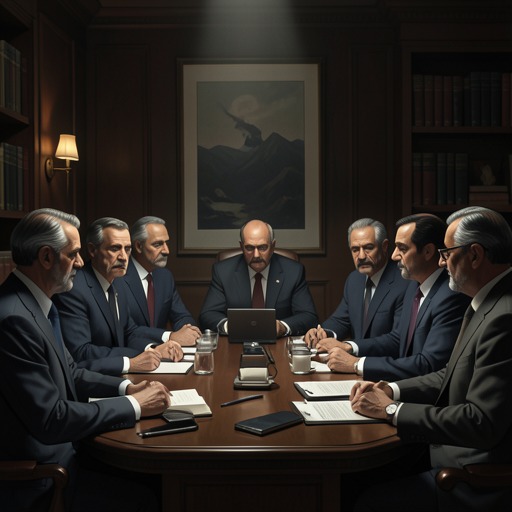
Burnstein forms a group of Democratic politicians that works with the lobby to which Sammy Cohen belongs. Its purpose is not simply to remind the public of Nazi crimes. It is to counter those arguing that any means are justified to prevent another war with Stalin’s Russia. Burnstein finds that sympathy for his loss does not translate into political risk-taking: people offer kind words and genuine tears, but hesitate to endanger their careers. In the new Cold War division, untried followers of Hitler can be repainted as acceptable allies, while those seeking accountability have little leverage through lawful channels.
On the first anniversary of the Third Reich’s surrender, reports of Nazi war criminals escaping their countries under false identities make the fugitives’ support networks Burnstein’s principal target. He hopes that exposing those routes will oblige Washington to help dismantle them. That objective sets the stakes of the meeting in his office: the matter is not only how to remember past crimes, but how to prevent postwar politics from sheltering their perpetrators.
Meg Williams and the Stauffer network
Sammy Cohen brings Meg Williams, Hank Williams’s daughter, to explain a proposal she had made to Burnstein the previous week. She asks what he knows about Spain and whether he has heard of Clara Stauffer. An hour later, Burnstein parts from Meg with an embrace, two kisses, and a single word of thanks. Her proposal has given his political group more than a general cause: it has supplied a mission, a concrete objective, a setting, and an enemy identified by name.
Burnstein immediately asks his secretary to find a photograph of Stauffer, a Spanish woman of German origin who leads the Falange’s Women’s Section and lives at 14 Calle Galileo in Madrid. Three weeks later, the portrait Abby obtains through an official at the American embassy sits beside the family photograph in the first drawer of his desk. The two images hold different kinds of knowledge: one records the family he lost, while the other gives a face and address to the network he wants exposed.
The investigation’s underlying suspicion is that Stauffer’s network cooperates with the Perón regime. According to Pablo de Azcárate, the route to Argentina is more than rumor: South America is the destination sought by Nazis trying to evade international tribunals, and Argentina is the only country disregarding the blockade to send Spain grain and frozen meat. The theory is that Stauffer shelters fugitives, supplies them with Spanish documents, and uses birth certificates provided by friendly priests alongside her contacts in the state administration. Yet the investigators cannot prove that the people she assists ultimately travel to Argentina. Azcárate identifies the missing requirement plainly: an infiltrator. The proposed operation thus depends on turning suspicion into evidence, not treating the suspected route as already established fact.
Political purpose and historical significance
Burnstein’s campaign takes shape amid a broader postwar accommodation with former Nazis. In the account of the Argentine meeting convened under the cover of discussing Juan Perón’s “third position,” Perón presents himself as opposed to both Marxism and liberalism, but the gathering’s practical business is to welcome Third Reich-linked technicians and scientists, civilian and military, in the hope of making Argentina a world power. He anticipates that a future conflict between the West and the Soviet Union could turn today’s villains into tomorrow’s allies. That Cold War calculation echoes the very argument Burnstein’s group is trying to resist in Washington.
His personal history also sits within the novel’s larger record of organized concealment: a Republican official’s instructions to bury or hospitalize a wounded man under a false identity, Francoist-era destruction or removal of incriminating material, and the handling of unidentified dead all show how violence can be followed by the suppression of names and records. These episodes are not actions attributed to Burnstein; they establish the narrative’s recurring concern with the machinery that makes victims difficult to trace and perpetrators difficult to prosecute. Burnstein’s family photograph is a counter-image to that machinery: it names a household and preserves its members even when almost all have been erased from life.
The book does not give Burnstein a simple victory over that system. Meg warns that results cannot be guaranteed and that the work will be expensive. Burnstein accepts the cost, saying that money is the one thing they have in abundance. His resolve is therefore both practical and personal: he backs an investigation because it offers a way to act on his grief, while the photograph remains in his desk as the measure of what that work can never restore.