Siege and bombing of Madrid
Los pacientes del doctor GarcíaThe Siege and bombing of Madrid is the novel’s defining experience of urban war: sustained bombardment overwhelms medical care, drives families from their homes, and makes survival depend on hurried acts of treatment and solidarity. The siege is seen not from a distant military map but from the hospital ward, the refugee column, and streets where the apparent quiet of one district conceals the destruction of another.
Bombardment and the overwhelmed hospitals
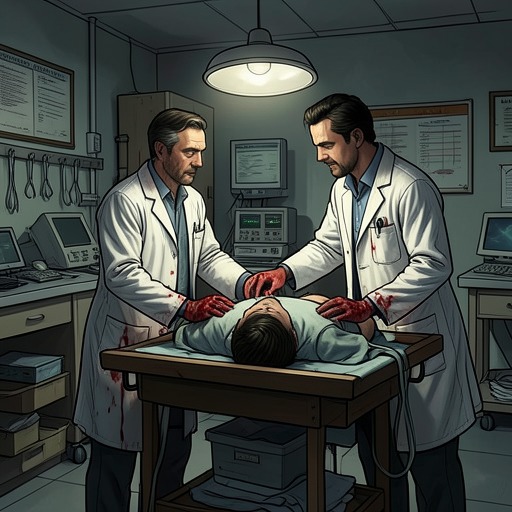
On 19 November 1936, the narrator recalls that the slaughter had begun three days earlier. A German five-hundred-kilogram bomb struck Puerta del Sol and tore open the street, exposing metro rails strewn with bodies. The bombing continued by day and night. At two in the morning on the nineteenth, the narrator had been confined for nearly forty-two hours in Hospital de San Carlos, with only a short spell of sleep on a guardroom cot and many litres of coffee to sustain him.
The hospital’s work had become an uncountable succession of amputations, sutured wounds, and decisions between patients whose injuries could or could not be survived. The narrator describes having to choose which of two shattered bodies might live and which had no hope; by the end, even the effort to lower his voice before giving such a verdict had fallen away. His filthy, blood-soaked coat embodied the cost of that work, stained by the blood of many different people rather than by one identifiable casualty.
The strain did not end when he left the ward. He was so exhausted that he could no longer register his own fatigue, yet sleep did not come. His senses seemed unnaturally heightened, while the world moved both slowly and frantically around the continuing influx of wounded people. Some cried out; others lay silent with their eyes wide open. The stillness of those who seemed to anticipate death stayed with him as one of the worst sights of the bombardment.
Emergency transport and a city divided
The collapse of ordinary services extended beyond the hospital. When the narrator was finally ordered home, the porter Bernabé explained that the city had commandeered taxis because ambulances could not keep up and hearses were even scarcer. Vehicles shuttled between the wounded and the dead; at the cemetery, workers had begun digging mass graves because there were too many bodies to bury properly. Bernabé stopped a taxi that was heading to the hospital morgue and persuaded its driver to take the exhausted doctor to Hermosilla Street instead. The driver refused payment and asked only that, if the narrator found him on a stretcher the next day, he should treat him well.
The journey revealed the unequal geography of the attack. In the early hours, the narrator saw an apparently ordinary, empty street, with distant detonations and flashes over other parts of the city. He did not yet know that Condor Legion pilots had been instructed not to bomb Salamanca, where the city’s wealthiest families lived. That protected area included the home of his grandfather, Guillermo, whose respectable public position as a police commissioner coexisted with concealed income from a secret literary career. The contrast between the devastated districts and the seemingly intact streets of Salamanca makes the city’s exposure to war a matter of both military violence and social privilege.
Refugees and medical solidarity
The road beyond Moncloa showed what bombardment had done to the people driven out of their homes. On the way toward the Hospital de Sangre de Aravaca, the narrator travelled in a truck with Canadian volunteers wearing the blue overalls of the militia beneath their winter clothes, a public sign of their commitment to the Republic. Past the city’s familiar streets, the road to A Coruña had become a stretch of smoking rubble where houses and garden cafés had been reduced to ruins.
Two slow-moving lines of refugees filled the roadside. People wore as many layers of clothing as they could manage and carried the rest in baskets, suitcases, sacks, and mattresses balanced on men’s backs. Children clung to their mothers’ skirts, while the women carried still smaller children in their arms. The narrator had seen displaced people gradually occupy Madrid’s doorways, courtyards, benches, and pavements, but the procession beside the ruined road changed his perception: from above, he imagined, it would look like ants laboriously carrying crumbs scattered over grass. At Aravaca, a line of the dying bordered the rear courtyard; after seeing the refugees, he resolved to save one soldier from a family like theirs.
The city’s response also included an organized effort to make blood available beyond the immediate donor. Volunteers gave half a litre after confirming they had fasted. Their blood went into bottles containing sodium citrate, each labelled with the blood group, date of extraction, and donor’s identity. Donors received a drink of brandy and a food voucher; later, as the siege tightened and living conditions worsened, each donation brought a tin of beef. Within a little over three days, the bottles filled the largest refrigerator available, while donors continued to queue each morning on Príncipe de Vergara Street. The effort joined experimental medical logistics to practical civilian aid: stored blood was prepared for use where wounded soldiers needed it, while food helped donors endure conditions in the besieged city.
Hidden violence and the afterlife of the siege
The novel places the bombardment within a broader account of violence that does not end with the immediate assault on Madrid. In one episode, soldiers mistake an injured man for a corpse and carry him to the infirmary. A commander discovers papers identifying him as Rafael Cuesta Sánchez and receives telephone instructions from a police commissioner: if Rafael is dead, he must be buried as an unknown person without registration; if alive, he must be kept out of any hospital under his own name because someone may try to kill him again. The commander is told that the man is vital to the Republic’s interests, but receives no fuller explanation. The episode shows how wartime injury can lead into secret custody and concealed identity, with survival dependent on suppressing the official record.
The novel’s later account of the unidentified dead gives that logic an aftermath. In a subsequent Madrid case, an inspector arranges for a body with a fatal gunshot wound to the neck to be recorded as a routine death and buried without an autopsy. At La Almudena Cemetery, the corpse is assigned to a common grave for undocumented people, many of whom have been given the same vague cause of death: cardiac arrest. The gravediggers notice the bullet wound, but the institutional paperwork has already converted violence into an innocuous category. The contrast with the earlier mass graves is sharp: the city’s overwhelmed burial system is followed by a more deliberate apparatus for hiding how particular people died.
The account also sets Madrid’s wartime and postwar practices beside the systematic state terror of Argentina’s later dictatorship. It describes the 1975 Operativo Independencia as a campaign whose declared military purpose enabled repression across five military zones, extending to civilians including teachers, students, intellectuals, artists, scientists, and religious people. From 1976 to 1982, the dictatorship forcibly disappeared thousands; estimates place the number of victims at around thirty thousand. Clandestine task groups divided the work of abduction, secret detention, torture, execution, disposal of bodies, and the removal and reassignment of babies born to imprisoned women. The so-called death flights carried living, drugged prisoners out to sea and dropped them from aircraft. The comparison does not make these histories identical: it traces how state violence can move from visible mass death toward secret operations that erase both bodies and identities.
Meaning of the siege
The siege is rendered through competing forms of visibility. A bomb exposes bodies and the metro tracks beneath Puerta del Sol; the hospital forces the doctor to make decisions he can no longer soften; refugees display, in their clothes and burdens, the homes they have lost. Yet the protected Salamanca district looks almost untouched, and later records can make a bullet wound disappear behind a routine cause of death. War is therefore not simply a spectacle of destruction. It also produces boundaries around who is sheltered, who must flee, who receives scarce medical attention, and whose death can be publicly acknowledged.
Against those divisions, the blood-donation effort and the driver’s unasked-for ride offer limited but concrete forms of mutual aid. They do not stop the bombs or restore the city’s ordinary services, but they preserve possibilities of life: stored blood can reach the wounded, a doctor can get home, and a donor’s contribution can be accompanied by food when hunger intensifies. The novel’s account of Madrid holds these acts beside mass graves and concealed deaths, insisting that care and violence operate in the same besieged city, sometimes within the same journey.