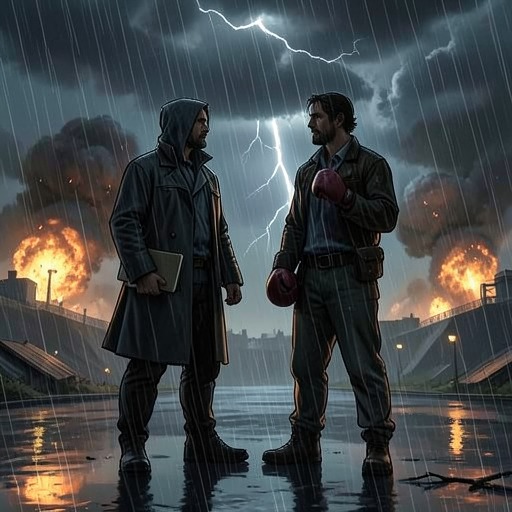
Soviet air raid on Berlin, 10 April 1945
Los pacientes del doctor GarcíaThe Soviet air raid on Berlin, 10 April 1945, is the final mass bombing of the Third Reich’s last stronghold in the novel. More than 1,200 Soviet aircraft strike a city already seemingly reduced to ruins. For Adrián Gallardo, quartered with his unit in a damaged palace on Unter den Linden, the attack makes defeat suddenly physical: the building collapses around him, and he survives only because a fallen iron beam shelters him long enough for Lazlo and Jan Schmitt to reach him.
The exposed refuge
The soldiers have spent a week in a palace that has withstood earlier bombing better than most buildings on Unter den Linden. Their first task is to clear rubble from its floors so the unit can occupy the space. As they work, the walls shed dust and stones at the slightest touch; the men recognize that another air raid could turn the palace into a tomb. Their commanders, watching them work and smoking calmly, dismiss the prospect of a further attack.
That confidence rests on an assumption the soldiers cannot safely voice: Soviet infantry is advancing so rapidly, and outnumbers the defenders by so much, that Stalin would have little reason to spend aircraft on Berlin when a ground assault is imminent. The raid overturns that calculation. The narrative identifies the leadership’s willingness to strike despite the approaching land offensive as an expression of Stalin’s refusal to forgive, and presents the bombing as a simultaneous assault on the Reich’s last refuge.
The strike and the collapse
By 10 April, the defenders’ position has already become a waiting game. Food is scarce, and the unit’s leaders let the men spend much of their time sitting inside the quarters or outdoors among heaps of garden rubble. To prevent desertions, they forbid the soldiers to leave a compound from which nobody else is allowed to enter. The men experience the Soviet advance as an agonizing delay: the enemy seems at the gate, yet never quite arrives. Adrián and Jan pass the time talking, detached from the desperate fighting on Berlin’s outskirts.
Then the palace comes down before the men can distinguish the sound of one explosion from another. The impact throws Adrián to the floor. A large iron beam falls into a position whose ends lodge among the rubble, leaving a narrow shelter between him and the wall as it collapses. Trapped in a space he cannot break out of with his hands, Adrián expects a slow death by suffocation, hunger, or thirst. He had wanted to die in Berlin, but not buried alive beneath a building, without heroism or any certainty about how long the end would take. He screams for help in every language he knows.
Rescue and reversal
Lazlo, the Hungarian volunteer who had been with Adrián at Klooga, answers first; Jan’s voice soon joins his. Together they open a gap, climb down, pull Adrián from beneath the beam, and haul him to the surface. The rescue reverses the scene’s apparent outcome: the same collapse that seems to have sealed Adrián’s fate has left him a chance of survival, while the two men who reach him make that chance real.
Jan explains his own fortunate absence from the palace’s destruction in crude, comic terms. He had gone down to the basement latrines because of the chronic constipation that had tormented him since childhood; after six days without relief, the urge arrived just as the Soviet attack began. His bodily misfortune becomes the circumstance that saves him from the building, sharply contrasting with Adrián’s life-or-death entrapment above. The scene sets the ruin of Berlin against an unheroic accident: survival arrives not as a military victory but through a beam’s position, a friend’s voice, and a trip to the toilet.
Significance in the narrative
The raid strips away the orderly expectations of the soldiers’ commanders and exposes the vulnerability of the palace they have made into a barracks. It also brings Adrián face to face with the death he believes he has been waiting for, only to deliver it in a form he neither wanted nor could control. His rescue does not erase the defeat surrounding him; it carries him forward from one catastrophe into the postwar struggle for survival. In miniature, the episode makes the novel’s contrast between heroic accounts of war and the contingent facts of staying alive unmistakable.