Tesoro nazi de la embajada alemana en Madrid
Los pacientes del doctor GarcíaThe Tesoro nazi de la embajada alemana en Madrid is the missing cache of valuables and records from the German Embassy in Madrid, whose disappearance turns an apparently empty building into the trace of a larger postwar operation. The cache connects Hans Lazar’s influence in wartime Madrid to the escape networks that sheltered Nazi fugitives, and eventually to the narrator’s work disguising shipments of stolen art and treasure for transport out of Spain.
The Embassy’s Disappearance
Hans Lazar’s influence rested on more than the envelopes he distributed. His social skill and the hospitality he and his wife offered at their home cultivated loyalty among selected journalists, government officials, and Nazi diplomats. Through those connections, he helped infiltrate the newly founded EFE agency and spread Berlin’s views in Latin America, while keeping the embassy and its government’s responsibility difficult to prove. In postwar Madrid, he also used the hardships of the Spanish population to assemble a substantial art collection.
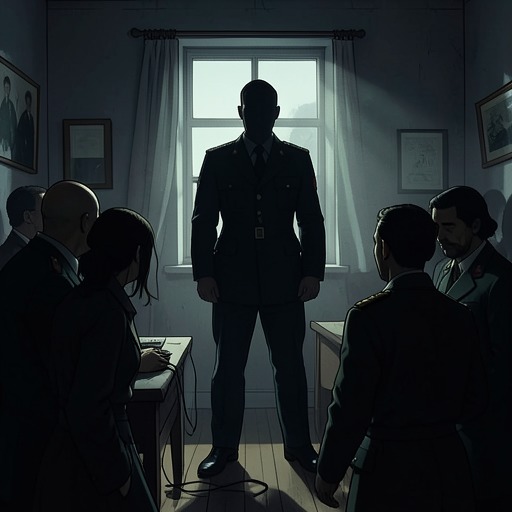
On June 5, 1945, nearly a month after Berlin’s capitulation, Allied representatives finally entered the German Embassy in Madrid, delayed until the last possible moment by bureaucratic obstacles imposed by the Francoist authorities. The building appeared stripped: documents and records, money and gold, antiques and works of art had vanished. The safes were empty, the walls bare, and even the furniture was gone. The cache was not simply an assortment of missing objects; its disappearance suggested that evidence and material wealth had been removed together.
Lazar and the Hidden Cache
The Allies came to believe that Lazar had secretly moved the embassy’s and ambassador’s residence’s treasures to a hiding place they had been searching for in vain. They suspected that the stash included artistic treasures, gold bars, precious objects, and documents from an archive that had disappeared from view. Their suspicion gained a dramatic edge from Lazar’s own abrupt evasion of repatriation: in February 1946, the Spanish government authorized his return to Germany, but the day before his scheduled flight he entered Clínica Ruber with severe appendicitis. His appendix was indeed removed, yet his pursuers suspected the hospitalization had served to keep him from boarding. Afterward, he disappeared from their sight.
Years later, Manuel Arroyo Benítez connects Lazar’s name to the shipments he has been asked to oversee. When Clara Stauffer had once proposed introducing the man she called Rafael Cuesta Sánchez to a friend named Ban or Bam, Manuel reconsidered whether the name might have ended in an m. Bam was Lazar’s intimate nickname. The thought linked Stauffer’s escape network to the man associated with the embassy’s vanished contents, though Manuel recognizes that the inference rests on a single consonant and a chain of uncertain conclusions. He also recalls that Stauffer seemed to defer to Rolf Steinbauer, saying that her friend had more authority than she did—an unusual arrangement for a woman who had never seemed to occupy a subordinate role.
From Suspicion to Shipments
The Argentina connection gives the missing treasure a wider political setting. Pablo de Azcárate tells Manuel that the route to South America is considered solid, although it cannot yet be proved: the CIA, Sal Burnstein, and Meg Williams suspect that Stauffer’s network works with Juan Perón’s government. Stauffer, they believe, supplies fugitives with Spanish documents, aided by friendly priests who provide birth certificates and by her contacts in the state administration. Argentina is the hoped-for destination of the people she receives and equips for escape.
At a meeting in the Casa Rosada, Perón publicly presents a position opposed to both Marxism and liberalism, but the discussion moves toward the practical question of receiving civilians and military personnel connected with the Third Reich. He wants German technicians and scientists to help make Argentina a power, reasoning that a future conflict between the West and the Soviet Union might transform present-day enemies into useful allies. In this account, ideological language and political welcome converge with the practical requirements of flight: routes, documents, ships, and the resources needed to resettle fugitives.
Manuel’s later suspicions concern the material side of those operations. He believes that shipments Guillermo has undertaken to supervise may contain art looted from museums and Jewish owners in occupied territories, valuable jewelry and antiques from the same sources, and perhaps gold, silver, or foreign currency from the vanished Nazi treasury. He recalls that Lazar may be the key to the empty embassy, but the evidence remains circumstantial until movement of the goods becomes visible in Madrid.
The Treasure in Transit
Between January and April, the narrator helps disguise Steinbauer’s shipments in seven trucks. His work gives him knowledge he was not formally required to have: Steinbauer sometimes summons him to Jacometrezo Street to wait for Lazar, who initially dislikes finding him there. When Lazar realizes that the narrator is better at camouflage, he begins to describe the objects whose sale he has arranged. The narrator’s practical skill thus becomes part of the machinery moving the treasure, even as he privately hopes French customs will inspect a load and stop future operations.
The cargo is chiefly works of art. Paintings are removed from their frames, rolled, protected in metal or wooden tubes, and hidden among construction materials or inside apparently ordinary tubes used to reinforce a container’s bottom. Gold without artistic value is melted into bars; both bars and jewelry can travel in false-bottomed boxes, with oranges serving as the narrator’s preferred packing material. Larger three-dimensional objects—statues, candelabra, and clocks—require more elaborate concealment. So do sacred objects, including crucifixes, icons, ancient monstrances, chalices, and tabernacles looted from churches across Europe. To hide them, the narrator asks Gabino de la Fuente to have a trusted coachbuilder alter at least one truck, creating a compartment in the floor between its axles.
The story makes the cache’s afterlife concrete: objects stripped from the embassy and valuables taken elsewhere do not remain an abstract mystery but enter an organized process of concealment, transport, and sale. The narrator is paid for his work. In April 1949, Steinbauer gives him an envelope, explaining that not asking for payment does not mean he has not earned it. The amounts increase as the deliveries succeed; the narrator deposits them gradually, in varying sums, into three bank accounts opened for the purpose, without yet spending any of the money. His camouflage work places him inside the continuing circulation of the treasure, while the empty embassy remains the original sign of how thoroughly its owners had hidden what they carried away.