Chinese American identity and belonging
Loveboat, TaipeiChinese American identity and belonging in Ever Wong’s story are not settled facts but positions she is repeatedly assigned, measured against, and begins to contest. Moving between her English-speaking home in Ohio and Taiwan, Ever discovers that shared ancestry does not automatically confer cultural fluency or acceptance. Her gradual shift from feeling like an outsider among Chinese Americans toward challenging inherited stereotypes makes belonging less a test of authenticity than a question of who gets to define the terms.
Language, Inheritance, and Distance
At the airport in Taiwan, Ever finds herself surrounded by Chinese characters and Mandarin announcements, with only a few phrases learned at Chinese Church to orient her. At home, her family speaks English; her parents sometimes use Mandarin to keep secrets. Ever knows the words for dim sum dishes, but fears that this thin vocabulary may not be enough to navigate the country. The scene makes her cultural inheritance tangible and incomplete: language reaches her through family habits and religious instruction, yet neither has prepared her for the unfamiliarity of being immersed in a Chinese-speaking place.
Her arrival also carries the weight of immigrant family memory. Before she left Cleveland, Ever’s Father performed the family ritual of saying “Safe travels,” a practice tied to stories of relatives who left and never returned. Ever had once heard this blessing said to her father at departures; now, impatient to go, she pulls away from his arm. The moment shows how inherited history can protect and unsettle at once. She resists the ritual even as the fear behind it follows her, making migration not just a change of place but an encounter with family memories of loss.
Belonging Among Chinese Americans
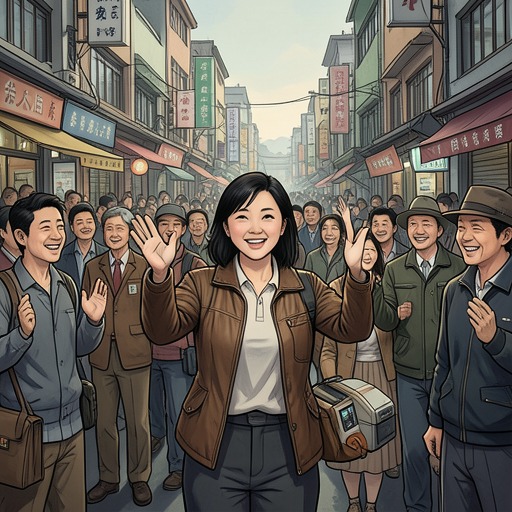
In a mall in Taiwan, Ever watches Chinese Americans recognize one another through overlapping connections. Sophie Ha describes their social world as one where everyone seems to be linked by only a few degrees. Ever, by contrast, knows no one. Yet the crowd brings an unexpected relief: back home, she says, people sometimes turned to look when she walked with her family, whereas here her Asian Americanness seems to disappear. The same environment that makes her feel socially alone temporarily frees her from being visibly marked as different.
That relief does not last as uncomplicated acceptance. When Ever struggles with bubble tea, Sophie jokes that she is a Twinkie: white inside and Asian on the outside. Ever is not angry, but the label defeats her. Even surrounded by Chinese Americans, she feels insufficiently Chinese American, and the sense of exclusion sharpens her longing for her younger sister, Pearl Wong. The scene complicates the apparent comfort of racial sameness: being among people who share her broad ethnic background does not erase differences in familiarity, experience, or self-understanding.
Ever’s uncertainty becomes explicit when the group discusses identity. Sophie identifies herself as Asian American and part Korean; Ever admits she has not thought much about what she is. She has understood herself as American and wanted little to do with her Asianness, but Taiwan has disrupted that easy separation. The exchange does not give her a new label that resolves the problem. Instead, it marks the beginning of her recognition that identity is something she has been avoiding as well as something other people may impose.
Family Stories and Measures of Success
At home, ethnic identity is also communicated through comparisons and public stories. Ever’s Father reads the World Journal, a Chinese-language newspaper that reports on politics and celebrates exceptional Chinese American achievers. Ever remembers seeing Woo Guang-Ming’s accomplishments there from childhood: a national spelling-bee victory when she was nine, a Lincoln Center piano debut at twelve, and a Google Science Fair win at fourteen. Her parents’ injunctions to study harder made his success a recurring measure against which Ever felt inadequate.
Ever’s feelings shift when Woo quits piano to sit on a football team’s bench. She is delighted that, for once, he has stepped outside the familiar script of the high-achieving immigrant Asian American child. But the reprieve ends when Yale recruits him as a running back. The newspaper’s attention and her parents’ renewed admiration restore him to the position of exemplary success, while Ever’s resentment returns. Through this running comparison, the book shows how belonging can be policed not only by cultural knowledge but also by a narrow image of achievement: the child who excels in recognized academic, musical, or collegiate arenas becomes a family and media emblem.
The newspaper’s accounts also carry a darker warning. Ever remembers another prodigy whose parents commemorated his suicide with a full-page résumé. The contrast exposes the cost of treating a life as a record of accomplishments, even as the publication’s celebration of achievement continues to shape the family’s expectations. Ever’s response to Woo is therefore not simply envy; she is reacting to a model of success that makes individual worth feel inseparable from public distinction.
Challenging the Scripts
At a family gathering, Ever has to explain that her family did not come from Taiwan. Her parents migrated from Fujian to Singapore and then to the United States. That route distinguishes her from relatives whose families are associated with Taiwan, even as the conversation turns toward shared claims of migration, educational success, and parental sacrifice. Aunty Claire describes immigrant parents as brave and smart and attributes the children’s achievements to genes and upbringing. Ever’s family history is thus made legible through a flattering collective narrative, but one that risks reducing varied lives to a familiar story of merit and parental sacrifice.
Gendered stereotypes are challenged more directly by the boys around Ever. During a discussion of masculinity, David objects to the assumption that Asian men are effeminate and unable to get girlfriends. Later, Marc explains that the group is taking back its stereotypes. Their performance at the Chien Tan talent show turns that declaration into a public act: Marc, Sam, David, Benji, and Peter appear as contestants in a beauty contest, rechristening themselves the Gang of Five and reclaiming the effeminate Asian male stereotype on their own terms. Ever cheers them on, and The Dragon applauds alongside the dignitaries. What began as a stereotype imposed from outside is recast as a performance chosen by the people it was meant to diminish.
Ever’s own arguments with Rick Woo reveal another edge of the same conflict. When she insists she has as much right as he does to be on a balcony, he scowls with the certainty she associates with Boy Wonder. Her response mocks his concern about his good name and the approval of his parents. Elsewhere, she champions Rick by describing how much he gives in his relationship with Jenna Chu, insisting that love should involve equal sharing and give-and-take. These moments connect identity to more than ethnicity: Ever contests who is entitled to speak, who carries obligations, and whether a person’s role should be dictated by family reputation or by reciprocal choice.
A Belonging Still in Motion
The evidence of Ever’s changing relationship to Chinese American identity lies less in a final declaration than in the encounters that unsettle her earlier assumptions. She begins with little interest in her Asianness and limited Chinese-language knowledge; Taiwan makes her difference and her ignorance newly visible. Among Chinese Americans, she experiences both the relief of not being singled out and the pain of being judged culturally insufficient. Family rituals, newspaper success stories, and conversations about race show how belonging can be offered through shared histories while constrained by expectations about language, achievement, gender, and family duty.
The Gang of Five’s stage performance offers a particularly clear counterpoint to the labels that trouble Ever. Their belonging does not depend on disproving a stereotype according to someone else’s standards; they transform it into a collective gesture of self-definition, and the audience’s response makes that gesture publicly visible. Ever’s own path remains unresolved in these scenes, but her willingness to question inherited measures and recognize the force of imposed labels marks a change: she is no longer treating cultural identity as irrelevant simply because she once hoped to stand outside it.