Father's stethoscope
Loveboat, TaipeiThe stethoscope Ever’s father gives her before she leaves for Taiwan embodies both his thwarted medical career and the future his family has imagined for her. Unused and gleaming, it seems to fit Ever as if it has been waiting for her; yet the instrument’s emotional force comes from the cost behind that apparent inheritance. As she begins to question whether she can become a doctor, the stethoscope marks the difference between receiving her father’s dream and choosing her own life.
The Gift and Its Meaning
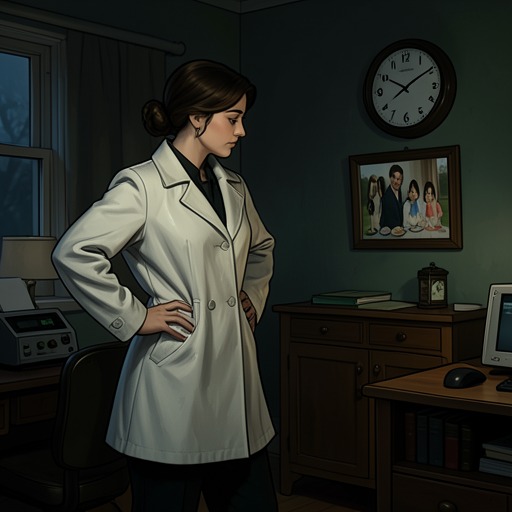
Ever’s father brings the stethoscope into her room while she is packing for Taiwan. He explains that it is not for her to take on the trip, but that he wants her to have it. The case’s zipper no longer works, and when Ever takes it, the stethoscope spills into her hand: a small, practical failure that makes the object itself suddenly present, rather than merely an emblem of medicine.
He says his medical-school adviser gave it to him when he graduated, and that he has been saving it for Ever. Its chrome remains shiny because he has never used it. Ever notices its soft Y-shaped neck and round chest piece, which can hold a heartbeat, and weighs it in her hands “like a baby.” To her, it represents a respected profession that her family has watched from outside. Its size seems more suited to her than to him, as though it has been waiting for her to take it up.
That sense of destined fit is tender, but not uncomplicated. Ever receives a carefully preserved object from a father who could not practice medicine as he had trained to do. The stethoscope’s condition records both his restraint and his hope: it has been kept for a future in which his daughter might enter the profession denied to him.
The Career Behind the Object
The gift carries the history of Ever’s father’s medical degree from China. The state licensure board would not recognize it without a residency he could not afford, with a wife and baby on the way. He instead spent years pushing an orderly cart at the Cleveland Clinic to put food on the family’s table. Ever’s mother invokes that work as evidence of what her husband sacrificed, while Ever understands that her parents’ difficult choices have become an obligation she feels she must repay as the elder child.
Ever’s memories make the career loss intimate rather than abstract. As a child, she gashed her knee falling from a bike, and her father stitched it up while telling her that she would become a doctor and care for such injuries herself. He came home from the clinic deflated and smelling of antiseptic, but shared stories of surgeries he had glimpsed and lives doctors had saved. Ever understood that medicine was the profession he had not been able to pursue, and came to believe that her own success could make his pain worthwhile.
The stethoscope therefore joins an object to a family narrative. It offers a route into medicine, but it also carries an expectation shaped by licensing barriers, financial constraint, and the work her father accepted to support his family. Its promise is inseparable from the question of whether Ever’s career can be her own when it has also been made to stand for his unrealized one.
The Gift Among Other Sacrifices
The instrument belongs to a wider pattern of care that Ever recognizes in her mother’s black pearl necklace. Her mother’s father brought the necklace back from a failed business trip to Hong Kong; after his death, Ever has watched her mother polish the pearls with red silk on his death anniversary. The necklace becomes an echo of the Wongs’ repeated sacrifices: her mother covering Ever’s chores while she studied, cutting her finger while preparing food for her during finals, and her father driving her to a clinic internship and worrying over medical-school applications.
Set beside these acts, the stethoscope is not simply an heirloom or a career tool. It is one more material sign through which parental care and a child’s sense of indebtedness become intertwined. Ever’s room, with Degas posters, a lavender satchel, and a hidden stash of peanut-butter cups, feels like a sanctuary as she prepares to leave; the stethoscope brings the family’s medical hopes into that private space. When she later puts it on a banned leotard, the objects meet in a compact image of her divided future: the profession her family values set against the dance her parents have tried to prohibit.
A Dream Reconsidered
Ever’s attachment to the stethoscope’s implied future does not resolve her conflict. Years later, talking with Rick, she describes her father’s childhood poverty: he had no shoes until he was nine, and his mother stretched noodles with scraps of meat. He admired American roads because he had known only dirt roads; when Ever spat out meat as a child, he ate it rather than let protein go to waste. Ever connects these memories to her parents’ immigration difficulties and to her mother’s sacrifices, including selling her necklace to send Ever to Taiwan to learn about their culture. Letting her parents down feels, in this account, like spitting in her father’s face.
She also remembers that her father injured himself at the Cleveland Clinic after walking onto a spill he never saw. His work, once a means of sustaining the family and a setting for the dreams he shared with Ever, has exacted a physical cost. When she admits that she may not have it in her to become a doctor and wonders whether she could become a dancer instead, she experiences even the desire as a betrayal. The stethoscope’s promise thus darkens: it is not a neutral invitation to care for others but an object bound to her effort to redeem what her father lost.
The ending reopens the meaning of that inheritance through a reversal in her father’s own choices. Still using crutches and on light duty, he announces that he will retire from the Cleveland Clinic and pursue his consulting business full-time. A doctor has encouraged him and secured another contract in Taitung, but he acknowledges the risk: the work may bring in less than his hospital job. He has considered the move for ten years, and connects his decision with Ever’s happiness and her change of direction, suggesting that none of them can hide who they are. The stethoscope remains evidence of what he once hoped Ever would become, but his late career choice loosens the idea that love requires her to fulfill his abandoned ambition. What it passes on, finally, is not only a profession’s symbol but a family history whose obligations can be reconsidered.