Loveboat summer program
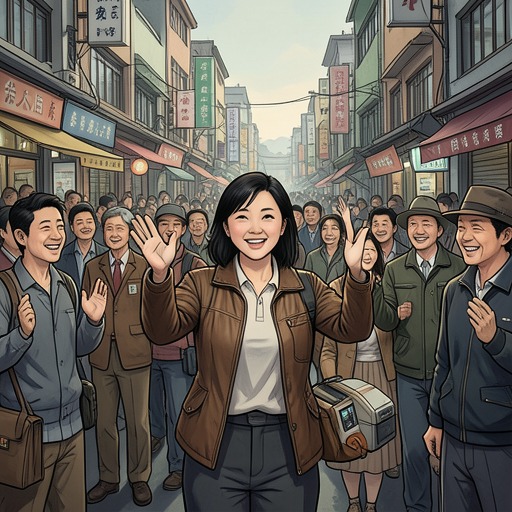
Loveboat, TaipeiThe Loveboat summer program is an eight-week program in Taiwan for Asian American teens, and the setting where Ever Wong’s assumptions about identity, belonging, and family expectation are unsettled. Its nickname suggests romance and youthful freedom, but the experience is more complicated: Ever finds relief in being surrounded by other Asian Americans, even as she feels culturally out of place among them. The program’s fictional world is rooted in actual summer programs attended by thousands of Asian American teens since the 1960s.
Identity and Background
Loveboat is not literally a boat. The name is a nickname, explained to Ever by Sophie Ha when Ever asks why there is no boat. Sophie connects it to the old television show, and Ever begins to understand the program through the people and social life around her rather than through its name. The correction captures a feature of the setting: its meaning is something newcomers have to learn from other participants.
The fictional program draws on real summer programs in Taiwan that have brought Asian American teens together since the 1960s. The author says the program has changed over time, and that alumni from different summers may recognize landmarks while also noticing creative liberties used for storytelling. The story and its characters are fictional; the novel uses the program’s real-world precedent without presenting its characters as portraits of actual participants. South Korea hosts a similar program for young adults of Korean descent, extending the broader context beyond Taiwan.
Arrival and Cultural Belonging
For Ever, the program’s first significance is the strange relief of being one among many. At home in the mall, heads sometimes turn when she walks with her family; at Loveboat, her Asian Americanness seems to disappear into the crowd. That sense of blending in feels unexpectedly comforting, but it does not settle her questions about belonging. She knows almost no one, even as the shared background around her makes her identity less conspicuous.
A small social encounter sharpens the contradiction. Sophie offers Ever bubble tea, which Ever has heard of but never tried; she punctures the plastic seal, tastes the cold, sweet tea and tapioca pearls, and admits that she likes it. Sophie then calls her a Twinkie, a term for someone perceived as Asian on the outside but culturally white within. Ever is not angry so much as defeated: even among a crowd of Chinese Americans, she feels not Chinese American enough. The program therefore offers both inclusion by shared appearance and exclusion through assumptions about cultural familiarity.
That tension also surfaces when Sophie describes herself as Asian American and part Korean, then asks Ever where she fits. Ever admits that she has not really thought about it. She has considered herself American and kept her distance from her Asianness; the new setting makes that distance harder to maintain. At a gathering with Rick Woo’s family, Ever explains that her parents migrated from Fujian to Singapore and then to the United States. Her family history complicates any simple equation between Asian American identity and a single national origin or a direct connection to Taiwan.
Social Life and Family Expectations
The program’s social atmosphere quickly overturns Ever’s expectation that she has arrived at a nerd camp. As she encounters the other students, she sees a mix of boys who are tall, short, lean, heavy, and facially hairy; many are headed to highly selective colleges, and their eager attention overwhelms her. Loveboat’s reputation, as Sophie presents it, is not only academic or cultural: parents sometimes send their children hoping they will find someone. Sophie says her own parents are old-fashioned in this respect, though she insists she would have come regardless.
The matchmaking expectation gives the summer a family dimension before the students have made their own choices. At Rick’s family gathering, Aunty Claire praises the students’ parents as brave and smart for going to the United States and attributes the children’s success to their genes and upbringing. Her approving account places achievement within an intergenerational story of migration and sacrifice. Rick counters with the example of Benji, whose father drives a taxi and who nevertheless got into Princeton, complicating the assumption that elite achievement follows a single parental or family pattern.
Family expectations also travel through media and comparison. Ever’s father reads the World Journal, which reports on a Chinese American chess champion and a Yale-bound former child prodigy. When Ever was nine, her parents used the paper’s stories about Rick, then known as Woo Guang-Ming, to urge her to work harder at spelling; later they invoked his piano debut and science-fair achievement to press her to practice and improve her biology grade. Even Rick’s departure from piano to sit on a football bench briefly pleased Ever, because it seemed to break from the expected path. When he was recruited as a Yale running back, however, her parents’ admiration returned. The summer setting brings these inherited measures of success into contact with young people trying to define themselves beyond them.
Stereotypes, Conflict, and Reframing
Loveboat’s shared background does not erase disputes over how Asian American men are seen. In a conversation about masculinity, David objects to the stereotype that Asian men are effeminate and unable to get girlfriends. The discussion makes clear that identity at the program is not merely a matter of finding people with similar roots; it also means negotiating public images that participants may reject or recast.
That effort becomes collective in the students’ Gang of Four Manifesto. Ever finds the boys forming a human pyramid in the rain, with Sam and David on hands and knees, Peter and Marc climbing on top, and another student taking photographs. Marc calls the action a way of taking back their stereotypes. Later, at the Ms. Chien Tan Beauty Contest, Marc, Sam, David, Benji, and Peter appear as contestants under playful stage names. The Gang of Five turns the effeminate Asian male stereotype into a performance on their own terms, rather than accepting it as an insult imposed from outside. Ever cheers; in the front row, the Dragon and two dignitaries clap and cheer as well. The scene gives the program’s social experiment a public audience, while showing that its participants can transform a stereotype through collective performance.
Significance and Real-World Context
The summer program is both a gathering place and a pressure chamber: the same density of shared ancestry that lets Ever blend into a crowd exposes her uncertainty about what that ancestry means. Bubble tea and the Twinkie label condense this contradiction into a personal encounter, while conversations about migration, elite colleges, family matchmaking, and masculine stereotypes broaden it into a communal one. Loveboat’s significance in the novel lies not in supplying a single, settled definition of Asian American identity, but in bringing competing definitions into close contact.
The author distinguishes the novel’s fictional story from the real programs that inspired it. She and her husband attended the program in different summers and later met through mutual friends; she also notes that the program evolved over the years. Alumni may recognize landmarks, but the book takes creative liberties in service of storytelling. For historical background, the author points readers to Valerie Soe’s 2019 documentary, Love Boat: Taiwan. This context frames the novel as an imaginative account shaped by a lived institution, not a documentary record of it.