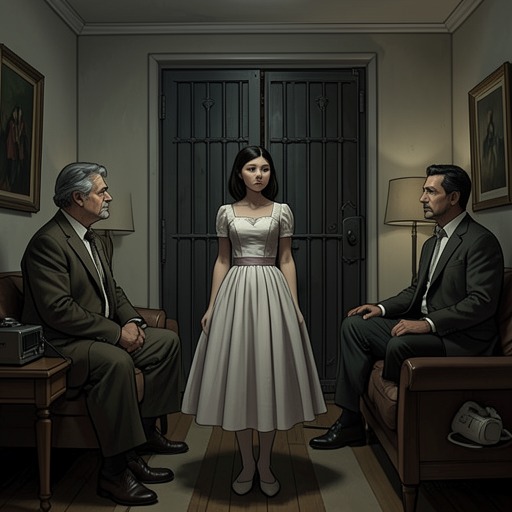
NYU Tisch admission letter
Loveboat, TaipeiThe NYU Tisch admission letter is the fragile, repeatedly handled document at the center of Ever Wong’s conflict between dance and the future her parents have planned for her. It first records a qualified possibility—a place on the Dance Department’s waiting list—then becomes proof that Ever has pursued dance without her mother’s knowledge. When her mother crumples it and throws it away, the letter’s destruction turns that conflict into a physical contest over who gets to determine Ever’s future. Ever eventually sends Tisch a formal refusal, but the letter’s importance outlasts both its paper and the decision it records.
From Waiting List to Acceptance
The letter’s story begins with a distinction between Ever’s medical and artistic prospects. Northwestern University offers her a place in its Honors Program in Medical Education, a seven-year program for students aspiring to medical careers. In an April 4 communication, New York University Tisch School of the Arts tells Ever that its Dance Department cannot admit her at that time, but offers her a place on its waiting list. The early document therefore does not yet promise a place in dance; it places Ever between a concrete medical offer and a still-uncertain artistic possibility.
That uncertainty changes when Ever tells Megan that she has gotten into Tisch. During dance practice, Megan has just urged Ever to hurry and change because the field is needed for a staff event and they have only an hour. Ever clutches the bag Megan has kept safe from her mother and announces the news. Megan’s poles clatter onto the asphalt as she reacts with a loud shriek and embraces Ever. In this scene the letter’s significance is first shared as joy: the admission confirms that Ever’s dance ambition has become a real opportunity, and Megan is among the first people with whom she celebrates it.
Discovery and Destruction
The letter returns in a sharply different setting when Ever’s mother confronts her. As Megan pulls Dan away from the argument, Ever’s mother shoves a page toward her: cream stationery folded into thirds, marked with a purple flame insignia and creased by her mother’s grip. Ever recognizes it as her Tisch letter. Its physical details make the concealed application impossible to keep abstract or private; the page itself becomes the evidence in her mother’s accusation that Ever has been hiding something.
Ever tries to explain that she applied on a whim, did not get in at first, and had not treated the application as serious. Her mother answers by crumpling the letter into a ball and throwing it into a dumpster. The action reverses the document’s earlier movement: a letter that carried the possibility of admission is now cast away as something Ever supposedly does not need. Ever screams that it is hers and climbs toward the dumpster, grasping its rusty edge as her hands blister. The letter is beyond her reach, buried among garbage; her mother pulls her away by the back of her leotard and clangs the lid shut. The admission paper is thus not merely rejected in argument. Its destruction is enacted through a blocked, bodily effort to retrieve it.
A Choice Recorded Under Pressure
The family conflict continues into Ever’s departure for Taiwan. While packing, she places her father’s stethoscope on a leotard she has been forbidden to wear, then falls back onto the suitcase zipper. She does not look up when her father leaves. The scene sets the medical object and the banned dance clothing beside the emotional aftermath of the letter’s destruction: both futures remain present, but Ever describes herself as moving mechanically through preparations controlled by others.
Before she boards, Ever writes to Tisch from her school email account: “With regret, I decline your offer of admissions.” She signs the message with her full name, Ever Wong. The brief email gives the admissions office a definite answer, but its formality contrasts with the earlier struggle over the physical letter. Ever does not describe the decision as a freely chosen change of ambition; it arrives amid the packing and the departure arranged by her family. The refusal closes the immediate administrative possibility of attending Tisch while preserving the larger conflict that the offer had exposed.
The Letter’s Wider Resonance
The story places the document within a network of unequal responses to educational opportunity and reading difficulty. Ever’s younger sister, Pearl, is dyslexic; Ever explains that their father tutors her, that she had a special education teacher through elementary school, and that she receives accommodations and uses voice dictation software. Ever also says that Pearl loves music, finds reading notes difficult, and uses her ear to help. When Ever later encounters Xavier’s workbook, its fragile pages are crowded with practice copying Chinese characters and their English translations, including misspellings such as “Bibent” and “Pensel.” Xavier says that his father regards dyslexia as an excuse and that a tutor in Taiwan once told his father Xavier could not learn; his father had said he should have beaten him harder so he would learn. Ever replies that dyslexia is not stupidity and tells Xavier about Pearl’s support and success.
These details do not make the Tisch letter a story about dyslexia; rather, they place Ever’s educational choices beside contrasting experiences of support and stigma. Pearl’s access to tutoring, special education, accommodations, and dictation software gives Ever a concrete basis for challenging Xavier’s internalized sense that difficulty means stupidity. The document’s own path—from waiting-list notice to admission, destruction, and refusal—likewise shows how opportunity depends on more than talent or formal eligibility. A letter can certify an opening, but it cannot settle who is allowed to pursue it.
Material Object and Narrative Function
The letter’s importance is built through changes in its material condition and handling. It is first an admissions communication, then a celebratory revelation to Megan, then a creased page held by Ever’s mother, a crumpled ball in a dumpster, and finally the occasion for an electronically delivered refusal. Each change accompanies a change in who controls the decision. Ever’s excitement with Megan gives way to her mother’s confrontation; Ever’s attempt to reclaim the paper fails; the email that follows makes the outcome official without resolving the family disagreement that produced it.
The sequence also clarifies why the letter matters beyond the admissions outcome. Tisch’s initial waiting-list notice leaves dance uncertain, while Ever’s later announcement confirms that the possibility has opened. Her mother’s disposal of the letter makes the conflict over dance visible and physical, and Ever’s refusal records the immediate consequence of being sent away. The object does not determine Ever’s eventual identity or settle her future, but it marks the point at which a private artistic hope becomes a dispute that reshapes her summer and her relationship with her family.