Taitung
Loveboat, TaipeiTaitung is the southeastern region of Taiwan where successive typhoons flood villages and devastate the home of Mei-Hwa’s family. Its importance in the novel grows from a landscape first seen through the bus window into a human emergency that unsettles the students’ sense of privilege, connects Ever Wong’s reflections on family sacrifice to another family’s loss, and gives their final performance a concrete purpose: raising relief funds for those affected.
Setting and the First Signs of Disaster
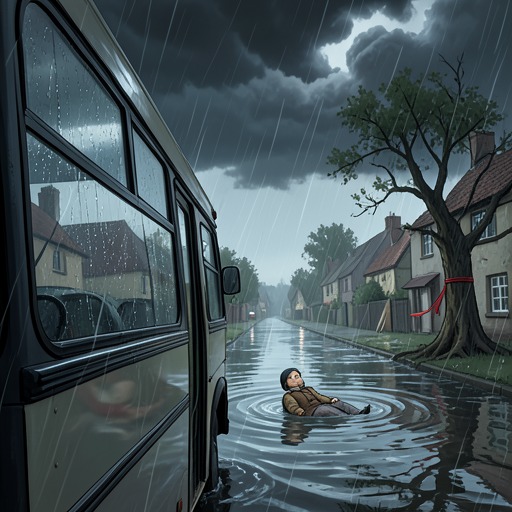
During the group’s tour, increasingly severe typhoons send rain against the bus windows and blur the passing countryside. The students pass a Puyuma village submerged in muddy water, with only tin roof peaks visible above the flood. The scene is marked by ordinary possessions and remnants displaced by the water: an inverted rickshaw’s spinning wheel, dead fish with silver undersides, and a muddy doll whose striped skirt fans out around her. When Debra asks whether anyone was hurt, the tour guide says no, and conversation resumes. That quick return to talk leaves the destruction in view without making it the group’s immediate focus.
The flooding returns later as new information, not a resolved incident. During a blackout, the hotel manager speaks in Mandarin and Rick translates that another typhoon is over Taitung, where six villages have flooded. Ever remembers the doll in the muddy water and asks where the families will go. Spencer says the tour guide described a shoreline that changes with every season because of typhoons, an account that makes the disaster seem recurrent rather than exceptional. The changing coast and repeated flooding give Taitung a force in the story beyond scenery: weather and water reshape the circumstances in which its residents live.
Mei-Hwa’s Home and the Human Cost
The damage becomes immediate for Ever when she encounters Mei-Hwa in the hallway, pulling a worn rolling bag bound with rope. Ever asks, dismayed, whether Mei-Hwa is leaving. Mei-Hwa explains that her home in Taitung has been hit, her whole village destroyed, and that she is returning to help her parents. Her parents and sisters are safe, but the family has lost its clothes, photographs, and furniture. The survivors’ safety does not lessen the scale of what has disappeared from their home.
Mei-Hwa’s distress makes the loss more than a report about flooded villages. She clings to Ever and sobs; then she voices the practical questions the disaster has left unanswered. She is at university on a scholarship and does not know how she can afford to stay, how her family will survive, or what they will do. Her concern is divided between her education and the people who have lost everything. The tied-up bag she carries gives the scene a stark material detail: even on the journey back, replacement and comfort are beyond reach.
Ever imagines Mei-Hwa’s parents struggling day by day and sacrificing to give their daughter a chance. She recognizes that Mei-Hwa is a minority in her own country and thinks that, but for the accident of being born in the United States, she could have been in Mei-Hwa’s position. The thought does not erase their different circumstances; it makes their distance feel contingent. In this moment, Taitung’s destruction exposes how geography, resources, and family obligations shape who can leave, who must return, and what a student can afford to risk.
From Witnessing to Shared Responsibility
The disaster also changes the meaning of the group’s activity. The students’ artistic work and preparations for performance become a means of responding to families in Taitung rather than an event concerned only with their own ambitions. Their final program includes an auction, with proceeds designated for families affected by the typhoon. Sophie announces that the mural behind her will be auctioned after the finale and repeats that all proceeds will go to relief for those families. The work thus connects Xavier’s art and the students’ public performance to a defined community in need.
Xavier’s mural gathers images of the summer, including Sun Moon Lake, dancers, the gates of the National Palace Museum, and a confluence at Taroko Gorge. The river image distinguishes blue water populated by Asian American children from gray water crowded with black-haired families of different ages. Xavier calls the composition an analogy for the group; Ever reads it as people making their own way through rock before joining the larger river of life. In a fundraising setting for Taitung, that image of separate currents meeting carries an added resonance: the students’ experiences and the lives of families affected by flooding are not identical, but the performance creates a channel through which the group can act in support of them.
At the end of the performance, Sophie announces that the relief fund has raised more than 500,000 New Taiwan dollars. The students respond with screams, embraces, and celebration. That amount gives their efforts a measurable outcome, though the story does not claim that it restores what the families have lost. Taitung’s significance lies in the movement from seeing devastation at a distance, to hearing a friend explain what it has cost her family, to directing artistic effort and auction proceeds toward those living with its consequences.