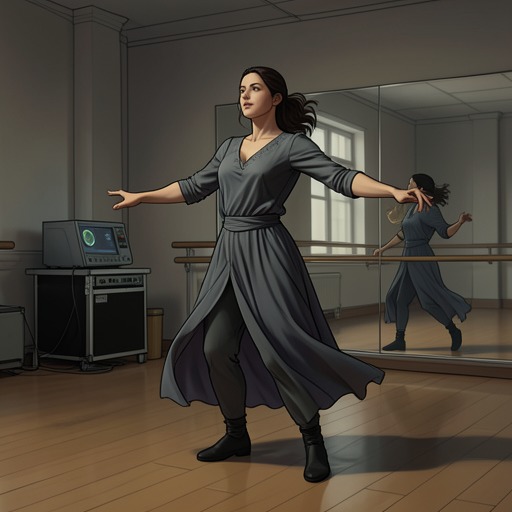
Ever decided to give up medicine and pursue dance
Loveboat, TaipeiEver’s decision to give up the expected medical career and pursue dance is the decisive act through which she claims authority over her future without denying the sacrifices that shaped it. In a conversation with her parents after returning from Taiwan, she rejects Northwestern’s medical program, explains that she wants to create dances, and sets out a practical next step. The choice makes visible the tension between an inherited sense of family obligation and the freedom her parents’ own risks helped make possible.
Background: A Career Inherited Through Sacrifice
Ever’s medical ambition is bound to her father’s thwarted career. His Chinese medical degree was not recognized by the state licensing board without an unaffordable residency, so he worked pushing an orderly cart at the Cleveland Clinic instead. When Ever was a child and cut her knee, he stitched it and spoke of her becoming a doctor; later, he described surgeries he had glimpsed and lives doctors had saved. Ever understood that medicine represented more than a profession to him: it might make meaningful the loss of the career he could not pursue.
Her sense of obligation is reinforced by the family’s everyday sacrifices. She recalls her mother covering chores while she studied, preparing food for her during finals, and worrying about her medical-school applications, as well as her father driving her to a clinic internship. Her mother’s black pearl necklace, a present from her own father, becomes an emblem of those sacrifices: she had sold it to help send Ever to Taiwan, a decision Ever associates with the family’s hopes that she would learn about her heritage. Ever has therefore experienced the medical path not as an isolated personal preference but as repayment for the lives and opportunities her parents gave up.
That inherited pressure has a public dimension too. The family reads the World Journal, which reports achievement as well as global news. As a child, Ever was repeatedly compared with Rick Woo, a Chinese American prodigy whose spelling-bee win, piano debut, and science prize arrived as standards against which she was urged to work harder. Rick’s later departure from piano to sit on a football team’s bench briefly seemed to Ever like a break from the expected route; his recruitment to Yale restored his standing in her parents’ eyes. Such comparisons help explain the surrounding culture of achievement, though Ever’s eventual refusal is directed not at her family’s worth but at the role she has been expected to fill.
The Conversation at Home
A few weeks after returning from Taiwan, Ever prepares red oolong tea and asks her parents to talk. At the dining table, her mother is looking over bills; her father closes his newspaper and adjusts his spectacles. Ever acknowledges that she has disappointed them in smaller ways over the summer, but tells them she will not attend Northwestern in September. She says she does not want to become a doctor and has long known it, even though she was afraid to admit it. Her vertigo at the sight of blood is one concrete reason medicine does not fit, but she clarifies that her deeper reason is her desire to dance and create dances.
Ever does not present her decision as an unconsidered escape. She proposes taking a gap year, working as a dance instructor at Zeigler’s, and applying to dance schools and scholarship programs the following fall. She has a film of a dance she choreographed in Taiwan to use with her applications. She also tells her parents that she learned to negotiate from her roommate: she requested and obtained the return of the Northwestern deposit, and brings the letter and enclosed check to the table. The returned money makes the decision tangible. She is not merely questioning the plan; she has begun replacing it with another.
Her mother argues that dance is impractical, warns that Ever might not find work after dance school, and urges her to complete medical school while dancing on the side. Ever answers that her mother has not heard her: she is not going to medical school. The disagreement exposes two different meanings of security. To her mother, continuing along a difficult but established route protects the family’s investment; to Ever, continuing would deny a choice she has finally acknowledged as her own.
Family Duty and the Meaning of Choice
Ever’s defense of dance does not amount to rejecting her parents’ hardships. She tells them that she would give up dancing and undertake medical work if her family needed food and shelter, but that their sacrifices mean she does not have to live as her father did, wanting another life while pushing an orderly cart. She calls her parents brave for leaving their families to come to America and recognizes that her father gave up medicine so his children could grow up there. Her own willingness to risk an uncertain career, she argues, follows the example of their willingness to risk security for something larger.
She also identifies what she wants her dancing to do: bring attention to people who are not being noticed. The purpose links her artistic ambition to the concern for others associated with medicine, without making the two careers interchangeable. Earlier, her mother had invoked the father’s work and the cost of immigrant opportunity as reasons for Ever to pursue medicine. Ever’s answer accepts the reality of sacrifice but disputes that gratitude requires her to repeat her father’s lost dream in a different form.
Her mother leaves the room angrily, while her father remains stunned but not angry and squeezes her hand before following. The immediate response is neither agreement nor reconciliation. Instead, the gesture preserves the hard-won trust Ever senses between them, even as her mother calls the decision foolish and stops speaking to her.
Aftermath and Significance
The conversation continues painfully over many days, interrupted by meals, Pearl’s Mozart Sonata in C recital and first day of middle school, and Ever’s tearful farewell with Megan. Its duration matters: announcing a decision does not instantly settle the family conflict. Ever is nevertheless glad to have had the conversation because she had concealed her love of dance and her larger ambitions for too long. She comes to understand that rejecting her parents’ wishes is not the same as rejecting them, and reads her father’s quietness as possible support rather than judgment.
Ever also tests her choice against the future she once treated as the measure of success. She says she has looked far enough down the road to know she would be happier dancing on a community-theater stage than advising the Oval Office as surgeon general. That comparison turns the choice from a temporary reaction into a deliberate assessment of the lives available to her. She recognizes that she does have a choice, and that the permission to choose has been shaped in part by parents who did not regard her gender as an obstacle to professional success.
The ending extends the decision’s implications beyond Ever. On August 24, Rick visits on his way to Yale, and her father announces that he plans to retire from the Cleveland Clinic and pursue his consulting business full-time. He is still on crutches and light duty, and acknowledges the financial risk, especially as Ever changes direction; nevertheless, he has considered the move for ten years and has secured another contract in Taitung. His decision does not erase the family’s disagreement, but it places Ever’s risk beside his own renewed willingness to pursue a different future. Her choice to dance thus marks not a repudiation of family responsibility but a change in how that responsibility can be lived.