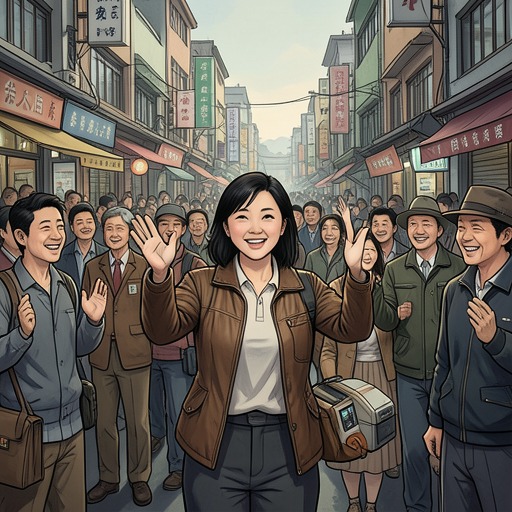
Ever is sent to Loveboat
Loveboat, TaipeiEver is sent to Loveboat after her parents arrange an eight-week summer program in Taiwan, presenting it as a chance to learn her family’s culture. The journey begins not as Ever’s chosen adventure but as a collision between her own plans and her parents’ hopes: she has won admission to dance school, while they have already bought her ticket and sacrificed a treasured possession to send her away. Her arrival in Taipei makes that conflict a physical passage from Ohio into a world she recognizes only in fragments.
The decision to send Ever
Ever’s parents have long spoken of visiting Fujian, the southeastern Chinese province where they were born and met in college. They left after Ever’s father finished medical school, but the family has never had enough money to make the trip. With her maternal grandparents gone before Ever’s birth and her paternal grandfather dead four years later, family history reaches her more through her parents’ memories than through visits to relatives. Taiwan, then, is not simply a destination: it is the parents’ means of connecting their daughter to a culture and history she has not experienced firsthand.
The plan is revealed in front of Ever’s friends. Her mother explains that she and Ever’s father believe it is time for Ever to learn her culture and that they have enrolled her in a program in Taiwan. The timing makes the decision feel less like an invitation than a fait accompli: the eight-week program starts that weekend, with departure scheduled for Sunday. Ever protests that she cannot leave for a week, then objects that she has been accepted to Northwestern and has done everything her parents asked of her. Her mother rejects the idea that the trip is a punishment, but her near tears expose the emotional stakes beneath the argument.
Ever’s mother says that Aunty Lilian recommended the program and that the ticket is too expensive to refund. Ever learns that her mother sold her black pearl necklace to pay for it. The necklace had been a gift from her father, Ever’s maternal grandfather, who died when her mother was fifteen. On his death anniversary, her mother would bring it out and polish the pearls with a scrap of red silk; she had also told the story of how her father brought it back from a failed business trip to Hong Kong. The journey is therefore financed not by an abstract family budget but by the loss of a keepsake bound to a death and a parent’s memory. Ever’s resistance meets the material evidence of her mother’s sacrifice.
Departure and the decision about dance
After the argument, Ever cannot meet Megan’s eyes. She says she will need to find her passport, then walks to the car, describing her heart as left behind in a dumpster and gasping like a dying fish. The image captures the gap between outward compliance and inward consent: she is preparing to go, but she does not experience the decision as hers.
As she packs, Ever sits on her father’s plaid suitcase and struggles with its stubborn tasseled zipper. She places his stethoscope on top of a leotard that has been banned, and thinks of herself as an automaton, with her parents’ hands seeming to move through hers. The packed medical instrument and forbidden dance clothing make the pressure between the two futures visible in a single domestic scene. Before leaving, she sends a brief email to NYU Tisch declining its offer of admission. The departure is thus bound to a decision that closes off the dance opportunity she had earned, even as dance remains the source of her conflict with her parents.
At the Cleveland airport, her father takes her arm and says, “Safe travels.” The phrase is a family ritual associated with stories of relatives who left and never returned: a great-uncle who went to Germany and a niece lost at sea. The family treats the words like throwing a pinch of salt over one’s shoulder, a protection against possible misfortune. Ever has usually been the one saying it to her father when the family drops him off. This time she pulls her arm back and walks through security, refusing the ritual even as she hears the fear carried inside it. Her thoughts turn to the possibility that her father might die before she comes home, or that she herself might get lost and be unable to return.
Arrival in Taipei
Twenty-one hours of connecting flights bring Ever to Taoyuan International Airport. She walks down a metal ramp bleary-eyed, with the roar of the jets still in her head and a sour taste from the foil-wrapped teriyaki chicken. The airport’s bright floors, crowded passengers, stores, pineapple-cake displays, and black-lacquered bento boxes surround her with details she does not yet know how to read. She catches her reflection in a mirror and sees herself as small and frightened among strangers. Her crumpled welcome packet tells her that Chen Li-Han is her contact and that her ride should be waiting outside baggage claim; reaching him safely becomes her immediate task.
The route through the airport underscores how little command she has over the setting. Ever passes billboards featuring Asian models and reaches immigration, where Chinese characters share space with English and Mandarin announcements fill the hall. At home, the family speaks English, except when her parents use Mandarin to keep secrets. Ever’s Chinese schooling ended in second grade after the shame of being told that her fluency was like that of a two-year-old became too much for the family. What she has retained comes in limited pieces: a few phrases from the Chinese Church’s line-by-line translations of services and the names of familiar dim sum dishes. She hopes those fragments will be enough, but the airport makes plain that her parents’ cultural inheritance is not the same as her own practical fluency.
Family sacrifice and cultural inheritance
The circumstances of the trip make its cultural purpose inseparable from the family’s finances and migration history. The parents cannot afford the long-imagined visit to Fujian, and Ever’s mother sells a sentimental inheritance to send her daughter to Taiwan instead. Later, Ever explains to Rick how the sacrifice weighs on her: her father grew up without shoes until he was nine, ate noodles with scraps of meat because the family could afford little, and admired American roads because he had known only dirt roads. When Ever was young and spat out meat, her father ate it rather than let protein go to waste. These memories give force to her feeling that disappointing her parents is like spitting in her father’s face.
Ever’s account also links her parents’ earlier poverty to their life as immigrants in the United States. She recalls immigration officers pursuing her parents and dried-out dragon fruit as part of the difficulties that surround the family’s story. The necklace sale belongs to that larger pattern of sacrifice: her mother gives up an object tied to her own father so Ever can travel to learn a heritage the family has not been able to visit together. Ever understands why the gesture matters even as she resents being made responsible for answering it with obedience.
The trip’s meaning is not resolved by arrival. The family has imagined Taiwan as a route toward cultural connection, but Ever reaches it unable to speak confidently with the people around her and carrying fears about both her return and her father’s safety. Her departure therefore establishes the central tension of the Loveboat journey: cultural belonging is offered as a family gift, yet delivered through parental authority and personal cost. In Taiwan, Ever must contend with the distance between the heritage her parents hope to pass on and the life she is trying to choose for herself.