Tai Dong Typhoon Flood Disaster
Loveboat, TaipeiThe typhoon flooding in Taitung is both a disaster that strips villages of homes and possessions and a turning point in the students’ summer: once the damage becomes visible and Mei-Hwa’s family is among those affected, their talent-show preparations become a public relief effort. The flood’s force is measured not only in submerged buildings and lost belongings but in the urgency of returning home, the work of organizing aid, and the money raised for families whose losses are otherwise easy for tourists to leave behind.
The Flood Becomes Visible
As the students travel through the countryside during worsening typhoons, rain sheets against the bus windows and blurs the landscape. The bus falls quiet when they pass a Puyuma village under muddy water. Only the peaks of tin roofs remain above the flood, like islands; debris drifts through the water, including an overturned rickshaw wheel, dead fish flashing their pale undersides, and a muddy doll with its striped skirt spread around it. The scene gives the damage a human scale: the water has not merely altered a view but swallowed the ordinary settings and possessions of village life.
Debra asks the tour guide whether anyone has been hurt. He says no, and conversation resumes. That brief exchange registers both the immediate concern for people’s safety and the ease with which the group can return to its own tour. The visible debris remains harder to set aside. At a hotel later, a blackout interrupts the students’ evening: wind shakes the building, rain drums against its windows, and a lighter and emergency lights replace the electricity. The manager tells them, through Rick’s translation, that another typhoon has struck Taitung’s southeast coast and flooded six villages.
The report changes the meaning of the earlier sight. Ever remembers the doll floating in the muddy water and asks where the families will go. Spencer says their guide has told them that typhoons continually alter the shoreline and that communities there are repeatedly hit. Rick names the disparity plainly: the students are privileged. The disaster is not an isolated spectacle but a recurring condition for people whose homes lie in its path; the contrast between their mobile tour and the families’ exposure makes the question of responsibility immediate.
Mei-Hwa’s Loss
The news becomes personal in the hotel hallway. Under pale yellow emergency lighting, Ever sees Mei-Hwa pulling a rolling bag whose worn cloth has been tied together with rope. The improvised repair recalls the economy of Ever’s mother, who would have tried to save money rather than replace it. When Ever asks whether Mei-Hwa is leaving, she explains that the typhoon has hit her home in Taitung: her whole village has been destroyed, and she is going back to help her parents.
Mei-Hwa says her parents and sisters are safe, but her family has lost everything—clothes, photographs, furniture. The distinction between survival and security is stark: no one in her immediate family is reported hurt, yet the possessions and records that made a home have disappeared. Mei-Hwa breaks into sobs as Ever embraces her. She is studying on a university scholarship and asks how she can afford to stay, how her family will survive, and what they will do. Her departure is therefore not simply a response to a ruined village; it is also a decision shaped by family need and limited resources.
Ever had not wanted to burden Rick, who has already carried a great deal for Jenna, but the crisis draws her toward him as someone dependable enough to lean on. In their conversation, she connects Mei-Hwa’s hardship to her own family’s history: her father grew up without shoes until he was nine, and her mother sold a necklace to send Ever to Taiwan to learn about her parents’ culture. The flooding sharpens Ever’s awareness that other people’s losses cannot be treated as background to a summer adventure. Mei-Hwa’s situation gives that recognition a present, specific face.
From Sympathy to a Benefit
When Sophie secures the National Theater for the students’ performance, Ever proposes that the proceeds go to Mei-Hwa’s family and to all the families in her village affected by the typhoon. Rick immediately identifies the proposal as a benefit concert. Ever calls it a small way to give back, while Rick suggests adding an auction so that people who cannot perform can still contribute. The plan thus creates more than a stage for the students: it gives donors another route to support those who have lost their homes and belongings.
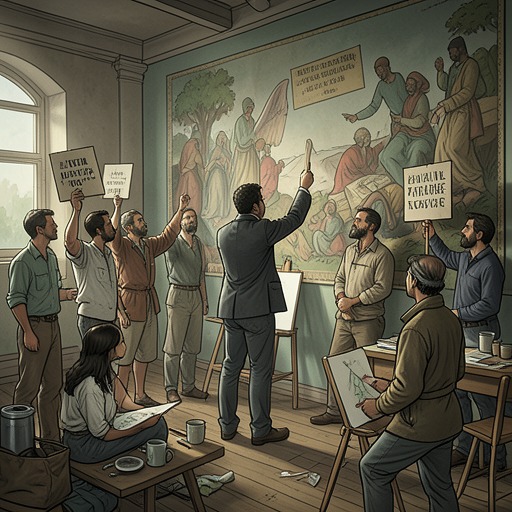
The performance’s fundraising is made explicit to its audience. Sophie announces that the auction proceeds will go to families in Taitung affected by the typhoon, and she reserves Xavier’s mural as a final auction item after the grand finale. The mural itself gathers the summer’s places and memories into a larger image: among its elements are the National Palace Museum, Sun Moon Lake, and a river confluence at Taroko Gorge, where Asian American students and black-haired families occupy different waters that meet. Its sale joins art to relief, turning an image of movement and connection into a contribution to people facing the consequences of the storm.
Public Outcome and Significance
After the performance, Sophie announces that Chien Tan has raised more than five hundred thousand New Taiwan dollars for the typhoon relief fund, approximately US$16,000. The announcement comes before the curtains have finished falling. The students answer it with screams, embraces, and celebration: their success is not only that they have performed but that the event has produced a substantial, stated sum for affected families.
The fundraising does not undo the destruction or restore Mei-Hwa’s family’s lost possessions. Its consequence is narrower and concrete: the students organize a concert and auction whose proceeds are designated for households in Taitung, and the public announcement makes the scale of the contribution visible. Within the story, the typhoon shifts the students’ attention from their own plans to the people who must live with the disaster. The flooding gives their artistic work a practical purpose, while the benefit makes their response an act of collective responsibility rather than sympathy alone.