Tour Down South
Loveboat, TaipeiTour Down South is the island journey taken by Ever Wong and the Chien Tan group, a moving interval in which travel, dance, and a worsening typhoon season converge. Its significance lies in the way the tour carries Ever and Rick through Taiwan’s landscapes toward greater intimacy, even as the group’s route reveals the flooding affecting local communities.
A fast-moving route
The tour runs at breakneck speed. Ever and Rick share a seat at the back of Bus A, one of eleven luxury buses carrying the Chien Tan group around the island. From the elevated highways, the travelers pass treetops, city skylines, and modern buildings accented with swallowtail roofs and Chinese architecture; farther on, cities give way to farmland, glass-roofed greenhouses, concrete dikes, waterways, and mountains. The changing view makes the trip a progression through distinct landscapes rather than a single uninterrupted city excursion.
At Taroko Gorge, the bus leaves the pair between high cliffs covered in moss, with a river running through the gorge. Ever and Rick race ahead together over the rocks. The scene places their movement within the larger rhythm of the tour: the travelers are carried from one destination to the next, but the pair’s pace briefly becomes their own.
Travel and dance
The itinerary makes dance practice increasingly difficult. As the group visits tombs, caves, and temples, buses arrive later at each new hotel, and the dancers must find a place to rehearse away from The Dragon’s notice. Travel therefore does not simply interrupt the performance preparations; it forces the group to adapt them to the spaces and time left over after sightseeing.
At the group’s lodging in Kenting National Park, sixteen dancers run the full routine in a basement ballroom before a wall-length mirror. Debra connects speakers to her phone, while Spencer and Benji bring in large wooden drums recruited by Sophie. The improvised rehearsal shows the group continuing to prepare despite the compressed schedule, with percussion added to the routine as they work.
The typhoon and the flooded village
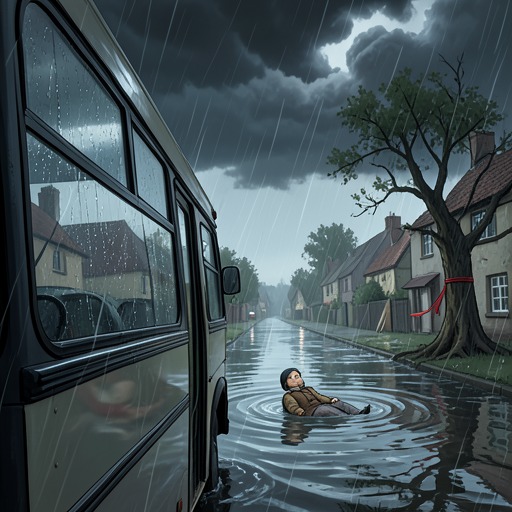
As the tour continues, the typhoons intensify. Rain sheets against the bus windows and blurs the countryside, until the travelers pass a Puyuma village submerged in floodwater. Only the peaks of tin roofs remain above the muddy surface; debris, including an overturned rickshaw wheel, dead fish, and a doll, is visible in the water. The bus’s passage turns the tour into an encounter with the disaster rather than a view of scenery alone.
Debra asks whether anyone has been hurt. The tour guide says no, and conversation resumes. That brief exchange sets a limit on what the travelers learn: they receive a reassuring answer, but the visible scale of the flooding remains part of the journey. The village scene contrasts sharply with the group’s orderly movement between hotels and tourist sites.
A closer bond on the final day
On the last full day of the tour, the group reaches the hot-springs resort Sophie has talked about throughout the summer. Ever and Rick walk hand in hand along a stone path through floodwater and a grove of trees toward the resort. They have remained physically close since Rick’s letter, though they have not kissed again; Ever understands the restraint as a threshold between their current closeness and a more consequential step.
The resort’s bathing arrangements bring the two together with the group while keeping the facilities divided by gender. Rick carries Ever’s bag to her door and explains that the hot springs are separated for men and women. Later, after Sophie clarifies that the Japanese-style baths are used without clothing, Ever recognizes the reason for Rick’s emphatic choice of the word “Alas.” The small misunderstanding gives the intimate end of the trip a light, social tone without erasing the distance they have not yet crossed.
The tour’s ending and significance
The tour’s final stretch holds two conditions in view: the travelers’ growing ease with one another and the destructive effects of the typhoons. Its landscapes move from elevated highways and farmland to the gorge, the southern shore, and a resort reached along a flooded path. Meanwhile, the practical demands of sightseeing and rehearsal continue, even as the weather changes the meaning of the countryside passing beyond the bus windows.
For Ever and Rick, the journey marks a period of closeness rather than a completed resolution. They share travel, movement, and hands held since Rick’s letter, but the narrative preserves their hesitation. The Tour Down South thus binds a developing relationship to the group’s collective itinerary and to the flood-damaged places that the tour passes through.